Chris Dooks / Machinefabriek – The Eskdalemuir Harmonium

LP Title: The Eskdalemuir Harmonium

EP Title: Non-Linear Responses of Self-Excited Harmoniums
Komino K0M1N0-004 (Vinyl LP & Digital w/ EP) Time: LP About 36 Minutes EP About 13 Minutes
Record Label: http://kominorecords.com/
Chris Dooks: http://www.dooks.org/ More on the LP trilogy: http://www.idioholism.com/
Machinefabriek: http://www.machinefabriek.nu/
Tracks LP (LP & Digital): 1) The Pike Knowes The Loupin’ Stanes; 2) Betamax and Dictaphones; 3) Ewe Knowe The Girdle Stanes; 4) Settlement
Tracks EP (Digital): 1) Steady States and Transient Oscillations; 2) Aerodynamic Excitation of the Harmonium Reed; 3) The Motion of Air-Driven Free Reeds
Authentic, synthetic, living, languishing, animate, inanimate, well, ailing, history and the now: these are the explorations of the latest collaboration of Chris Dooks and Rutger Zuydervelt (Machinefabriek). Like many, I have always been drawn to the old and mysterious, wanting to know more about the history of things, the times in which they existed (and in this case, what hands and feet brought these venerable machines to life). Harmoniums are vestiges of another time (mostly from the late 18th C through the middle 20th C), inanimate objects, strangely biomorphic in their inner workings that are revived with physical exertion, air in their bellows (the lungs) and resonant metal reeds producing the sounds (the vocal chords). Neglected harmoniums often mournfully creak and object to being revived after long slumbers. A friend of mine once used the term “lumbering harmonium” to describe his relic on an instrument—curiously descriptive in both reality and material (when the verb is used as a noun).
These soundtracks depict a retreat of solitude into the Scottish countryside, one of a series of three projected works and part of Chris Dooks’s PhD research in sound art and medical humanities, as well as response to a chronic illness; the search for comfort and rest through improvised sonic threads (passed between Dooks and Zuydervelt during their development) that were crafted from music, field and voice recordings. The resulting drone-like ambiance is a fascinating and relaxing journey with sociological, archaeological and radio documentary parallels. Thanks to the on-location recordings, there is a strong sense of place and memory imbued into this album.

The recordings, liner sleeve and notes, photographs and graphics are impeccably produced as is the ruby red vinyl LP. This is the second Komino Records LP that I have acquired (the first being Kyle Bobby Dunn’s In Miserum Stercus, which I reviewed in late 2012). The digital EP presents additional serene field and harmonium recordings—a beautiful production overall.
The next album in the series will be Three Hundred Square Miles of Upwards.
Pre-Master Recordings from Three Hundred Square Miles of Upwards
The third album will be CIG{R}LES.
Pre-Master Samples from CIG{R}LES
Review: Celer – Without Retrospect, the Morning

Glacial Movements Records – GM015 (CD) Time: 52:13
Artist Websites: http://thesingularwe.org/celer/ & http://celer.bandcamp.com/music
Record Label: http://www.glacialmovements.com/ & https://soundcloud.com/glacial_movements
Tracks: 1) Holdings of Electronic Lifts; 2) A Small Rush into Exile; 3) Dry and Disconsolate; 4) Variorum of Hierophany; 5) A Landscape Once Uniformly White; 6) Distance and Mortality; 7) With Some Effort, the Sunset;
Although not as indiscriminate as is denoted by the term, I am often a completist when it comes to collecting the works of selected authors and musicians. Yet, I would be hard-pressed, given his massive output of creative work, to even begin to collect all the music of Will Long in the guise of Celer. By now, I probably have a dozen or so of Celer’s recordings, but if I had to recommend one and only one recent work, it might just be this almost mystical and entrancing album. I’m also drawn to this release since it fulfills one of the most significant inspirations for why I listen to music—it takes me somewhere, and the images and sensations are vivid.
Album Samples
This is the third work in a trilogy based on water (to some, water symbolizes comfort and freedom). The two previous albums are Cursory Asperses (2008) and Escaping Lakes (2009)—the former alluding to the slow movements of small streams and the latter to the calmer depths. The music on this album being inspired in part by Will’s trip to southern Alberta in 2009 (documenting the wilderness in photographs for a local Park Service).
Without Retrospect, the Morning is different from the first two in the series in that it has distinct tracks (versus a continuous thread of sound) and it captures water (or the sense of it) in a different state—a chilled desolation, at times at the edge of an existence where the potential energy is stored and released ever so sparingly in a landscape yearning for Sun and warmth. It’s therefore appropriate that this album landed at the Glacial Movements record label, a self-proclaimed “glacial and isolationist ambient” label. I also appreciate that the recording has been mastered with a softness that retains the intricate clarity of the many layers of sound buried in the crystalline strata (to heck with the loudness wars!). There are also hidden sonic depths, and some passages might be felt before they are heard (as in Dry and Disconsolate).
A lateral effect of this CD is that it triggers (for me) some pleasant, albeit quirky, sonic memories from long ago. I’m a fan of the original 1960s Star Trek. There was some great incidental music and ambient sounds used in that series that, to my ears, are recalled in a track like Distance and Mortality (see if you hear the resonance of the wind from the pilot episode, The Menagerie or the sound of the transporter beam).
Distance and Mortality
So find a quiet room, bundle-up, get comfortable, and explore stunning breadth of this vast hyperborean landscape. Just remember to turn the volume back down on your amplifier before you change the sources on your preamp or pop-in another CD.
A List Too Small – My Favorites of 2012
Thank you to all the artists and record labels for such wonderful and diverse music.
This is one list of many, it’s my list, and it leaves off many other favorites that I have enjoyed over the year in addition to the thousands of other albums and single tracks that make up music throughout the World. What has helped me arrive at this list is what I have always loved about music: Does it move me? In addition, is it creative, well recorded and produced with a degree of care that makes me pay attention to it? There was a time when I was obsessed with highly produced and tightly engineered works, then I learned about artists such as East River Pipe and Sparklehorse, and many other genres of music were opened to me.
If you don’t see your favorite album on this list (or even your own album), it doesn’t mean a thing. If an album has been reviewed on my website this year, it’s meaningful to many others and me, but this is only a very, very small slice of the music world. Often people ask me about new music, and what I recommend. When I started this website in late January, 2012 it was first a means to write about music that I enjoyed, but also to get to know other artists and learn about new music that they create, so I could pass it on. Often, the best new music is that referred by a friend. Please feel free to send me your comments and recommendations.
Special note: There are still three or four late 2012 releases that are either enroute to me, have yet to be released or have just arrived. I need to spend proper time listening to and absorbing these albums. Rather than delaying this list further, and if after listening to those last 2012 releases I feel that they hit a sweet spot, I’ll review those albums in early 2013. I know of at least two 2012 releases that I’ll likely not receive until 2013.
I have three categories: Albums (12), Individual Tracks (6), and Special Releases (3) that don’t necessarily fit into a category.
Albums (Artist – Album Title – Record Label)

1) Twigs & Yarn – The Language of Flowers – Flau

2) Lambchop – Mr. M – Merge Records

3) Zammuto – Zammuto – Temporary Residence
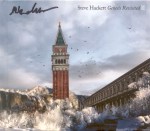
4) Steve Hackett – Genesis Revisited II – Inside Out Music

5) Taylor Deupree – Faint – 12k

6) Billow Observatory – Billow Observatory – Felte
7) Gareth Dickson – Quite A Way Away – 12k

8) Pill-Oh – Vanishing Mirror – Kitchen. Label

9) Brambles – Charcoal – Serein

10) Almost Charlie – Tomorrow’s Yesterday – Words On Music
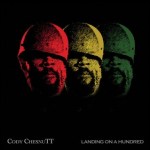
11) Cody ChesnuTT – Landing On A Hundred – One Little Indian
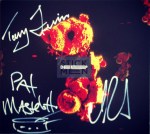
12) Stick Men – Deep – Stick Men Records
Individual Tracks (from other albums)
[vimeo http://vimeo.com/46499688]
1) Library Tapes – Sun peeking through (from the album Sun peeking through) – Self Released
2) Cock & Swan – Orange & Pink (from the album Stash) – Lost Tribe Sound
3) Alex Tiuniaev – Daylight (from the album Blurred) – Heat Death Records
4) Kyle Bobby Dunn – In Praise of Tears (from the album In Miserum Stercus) – Komino
5) Kane Ikin & David Wenngren – Chalk (from the album Strangers) – Keshhhhhh
6) Olan Mill – Bleu Polar (from the album Paths) – Fac-ture
Special Releases
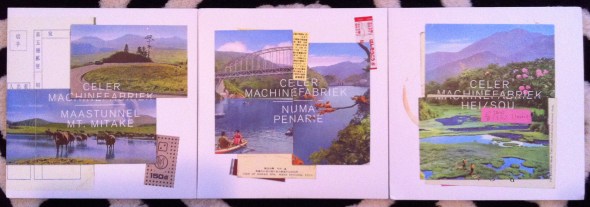
1) Celer & Machinefabriek: Maastunnel/Mt. Mitake, Numa/Penarie, Hei/Sou – Self Released



2) Birds Of A Feather: Michael Frommer – The Great Northern Loon, Porya Hatami – The Black Woodpecker, Darren McClure – The Black Kite, The Green Kingdom – The Great Blue Heron – Flaming Pines

3) Simon Scott, Corey Fuller, Marcus Fischer, Tomoyoshi Date and Taylor Deupree (Recorded live in Japan October, 8, 2012) – Between (…The Branches) – 12k
Record Labels Noted Above
Flau: http://www.flau.jp/
Merge Records: http://www.mergerecords.com/
Temporary Residence LTD: http://temporaryresidence.com/
Inside Out: http://www.insideoutmusic.com/
12k: http://12k.com/
Felte: http://www.feltesounds.com/
Kitchen. Label: http://www.kitchen-label.com/
Serein: http://www.serein.co.uk/
Words On Music: http://www.words-on-music.com/
One Little Indian: http://indian.co.uk/shop/landing-on-a-hundred-1.html
Stick Men Records: http://stick-men.net
Library Tapes: http://librarytapes.com/
Lost Tribe Sound: http://www.cockandswan.com/ Note: I have not listed the weblink to the record label as Google has noted that the website MAY be compromised.
Heat Death Records: http://www.heatdeathrecords.co.uk/
Komino: http://kominorecords.com/
Kesh (Simon Scott’s label): http://www.keshhhhhh.com/
Facture: http://www.fac-ture.co.uk/
Machinefabriek & Celer: http://machinefabriek.bandcamp.com/ & http://www.thesingularwe.org/fs/
Flaming Pines: http://flamingpines.com/
Review: Benjamin Dauer – The Pace of Which

Twice Removed Records – Time: About 39 Minutes – Limited Edition CDr (50 copies)
Record Label: http://twiceremovedrecords.blogspot.com/ & http://twicerememberedtwiceremoved.bandcamp.com/
Artist Websites: http://www.benjamindauer.is/ & https://soundcloud.com/benjamindauer
Tracks: 1) Anchors and Roots; 2) Either By Storm Or Low Frequency; 3) With Closed Mouth; 4) Melting Tines; 5) Waiting for the Rain; 6) From Ebb To Flow
Coming from Twice Removed Records on January 1, 2013 (a small label in Perth, Australia that releases short-run limited editions) is the latest (third) solo album from Benjamin Dauer. I have great admiration for the various interests that BD pursues. He has diverse accomplishments, from his design and digital media day-job at NPR (National Public Radio) in Washington, DC to raising awareness and environmental activism projects like Save The Pollinators.
I also appreciate BD’s musical pursuits as both a multi-instrumentalist solo artist and collaborator (with other musicians near and far), including his active participation with the Disquiet Junto (an ongoing music-making project where restrictions are used as a catalyst for inspiration). Recently, I’ve been following with great interest the sound-sketch development (posted on SoundCloud) for a forthcoming album by The Dwindlers (his ongoing collaboration with poet Michelle Seaman).
From what I have heard of Benjamin’s previous solo work, it tends to be less rhythmic, a bit darker and more saturated than his (often Jazz-rooted) work with The Dwindlers. There is an enmeshed yet subtle grittiness recalling earlier analog electronic and instrumental works (like the 1970 soundtrack to Frederic Rossif’s documentary L’Apocalypse des animaux by Evangelos Papathanassiou), while continuing to explore new aural horizons and narratives. BD has an interesting quote at his website, which I think reveals that his solo work is less about an arrival at a particular sound, but more about the journey:
“As a musician & composer, I explore the boundaries of modern music through experimentation and play.”
In The Pace of Which, BD seems to be investigating different methods of creating musical atmospheres by blurring distinctions between musical genres (such as ambient, drone or others). Each track takes a different approach, but there are some common elements in varied intensities. Some of the pieces focus more on background with minimal foreground, whereas others the foreground elements are more pronounced, as well as the in between.
The background is predominant in Anchors and Roots. The sound is broad, resonant on the edges, and heavily blended. There are subtle placements of keyboards into the foreground, along with gentle clicks. At a point where there seems to be a recognizable rhythm or melody, it disperses back into the haze.
Either By Storm Or Low Frequency takes time to develop; initially it has more hushed surroundings, with distance pulses and slow waves. Sounds are buried down deep, almost immersed in rolling surf, reminding me of the analog warmth of Tangerine Dream’s album Rubycon (one of my favorite TD albums). BD is quite good at disguising the instrumentation—sounds seeming to be more keyboard-based, with purer tones entering the sound-mantra and slowly dissolving as if being pulled back into a sonic undertow.
The foreground takes a more prominent role in With Closed Mouth. The contrast of far and near is sharper. The more dominant sounds could be the concurrent mechanics of the music being created, or blended field recordings. There is interplay between reverberant sustained guitar and muted keyboards. The result is a feeling of suspension, yet with some of the most tangible sounds on the album. Melting Tines returns to clustered tones. It’s a gentle wall of sound, punctuated by an almost reluctant guitar, and then veiled appearances of a piano. An environmental-dominant foreground opens Waiting for the Rain. It could be an early morning street scene of a city coming back to life on a gray morning with placid breezes. The album closes with From Ebb To Flow, which again blends the sounds of the outdoors with an expanding tonal haze and an undercurrent of low frequency pulses before fading.
Since I tend at times to prefer more discreet sounds in mixes, I found that there were brief moments (particularly in the last track) where I was distracted by a “tape-saturated” ambience, but I stress that this is a particular quirk of mine. I listen to music in the ambient and drone realms as vehicles to either clear my mind or to transport to a different (and often more pleasurable) zone. Listening to works on the drone side of the spectrum, however, tends to be a more sensory intensive experience, even if the desired end result is a more numbed state of being.
Benjamin Dauer’s explorations in The Pace of Which will take you to many places with transformative and lush fabrics of sound—his work blurs the edges of the recognizable with richness beyond expected musical genre norms. I’m looking forward to the further results of his experimentation and play.
***
More on Benjamin Dauer’s band The Dwindlers here: http://thedwindlers.com/
The Pelican and the Girl – From Allegories
Review: Kyle Bobby Dunn – In Miserum Stercus

Komino Records – K0M1N0-003 (12” LP & Digital) Time: About 36 Minutes
Artist Website: https://sites.google.com/site/kylebobbydunn/ & http://kbdunn.tumblr.com/
Record Label, Etc.: http://kominorecords.com & http://store.standardform.org/
Tracks: 1) Buncington Revisited; 2) Lake Wapta Rise; 3) In Praise Of Tears; 4) Meadowfuck; 5) The Milksop
A sesquidecade ago, I had a pretty regular gig as a lone passenger in a twin-engine Piper Seneca. I sometimes had work to do as I traveled, but often I was able to sit in the co-pilot seat and put on a closed-ear headset with a microphone and either listen to radio chatter, talk with the pilot or sit silently and look at the scenery. The travels took me over a mountainous wilderness. The pilot was a pretty quiet guy, with a very steady hand in rough weather (and we saw some—snow storms too). I was fortunate to even get a few short flying lessons during the trips, but mostly what I appreciated was the solitude of the vistas, leaving the towns and cities behind.
The views were broad landscapes of largely unpopulated forest areas. Whether I had a headset on or not, focusing on what I was beholding would often silence the noise of the plane’s engines. Every so often I’d get distracted and the sound of the synchronized engines would enter my consciousness. At times the engines would have a slight harmonic pulse, as their RPMs fluctuated in the crosswinds.
Those halcyon memories of soaring above the wilds return when listening to Kyle Bobby Dunn’s latest album (self-deprecatingly titled) In Miserum Stercus. About 5 minutes into Buncington Revisited is one of those points of distraction, and the harmonic of the Twin Sixes enters the picture, and then is gone and the passing landscape and feeling of seclusion returns. KBD has his own distinct sound; it’s often just off in the distance and rarely head-on, but despite this tangential nature there is clarity. And although he sometimes disguises the intent of his work in irony, I feel like there are often lucid memories evoked of places, especially in Lake Wapta Rise*, northwest of Banff, in British Columbia. The landscape there in many ways is like what I saw on my journeys, although even more dramatic. There is an expansive desolation in the restrained and blended sounds of this track, although the tones become purer and stronger, before fading.
Machismo apparently isn’t one of KBD’s distinct musical qualities, and so a layer of his thick outer skin is washed away to reveal some lachrymose tendencies with In Praise Of Tears. Measured, peaceful and resonant waves calm the scene, before leading into the not-so-gently titled Meadowfuck. Oh the irony of Mr. Dunn. Although somewhat hushed, this track seems to be making an announcement with its rolling and distant brass-like atmosphere. It builds, and then dives swiftly into The Milksop, which is staunch and paradoxically titled. Have a listen…
***
So, buckle-up, enjoy the views and happy flying. Oh, and KBD, don’t be so hard on yourself 😉
***
* Postscript: I have since been given a geography lesson, on the finer specifics of Calgaric Locus–operative term “Rise”, which just so happens to be one Province east in the plains of Alberta, but I’ll cling to the romantic notion of the mountains.
Review: Taylor Deupree – Faint

Record Label Website and Links: http://www.12k.com/ & http://www.taylordeupree.com/
http://www.12k.com/index.php/site/artists/taylor_deupree/
Taylor Deupree’s Discography: http://www.taylordeupree.com/music/
12k2025 (CD, Deluxe CD & Digital)
Tracks: CD1 57:17 1) Negative Snow; 2) Dreams of Stairs; 3) Thaw; 4) Shutter; 5) Sundown & CD2 38:38 1) Thaw (Reprise)
Whether it’s his music, photography, collaborations, and even the work from his record label 12k, Taylor Deupree is an Artist (emphasis on capital A). I’m a relative late-comer to his work, and I’m not even quite sure how that I came across his work or the 12k label, but I think that it had something to do with a 12k sampler CD, and then as I often do, I took a dive into his back catalog, focusing on physical releases (since those tend to be my preference—I’m old fashioned that way).
While Deupree has an extensive solo output, he also is an active collaborator with a wide range of artists (follow the discography link I noted above) in addition to many other musicians not listed for concerts and tours. He also actively experiments with new approaches and directions in his work—reinvention invigorates. Just as in his musical works, there is a peaceful desolation in his photography. I’m drawn to many of his photos, especially his landscapes (I’m fortunate to have a copy of his book of photos and CD Sea Last), but this is one of my favorites:
Moss, Kyoto (linked from Taylor Deupree’s website)
I also enjoy his Instagram photos posts, many of them are taken on outings in the woods, the fields and a reservoir nearby his home. It’s evident in his mastering of his own work and those of other musicians that the quality of the sound is important too (I often seek out music, not only for the artist, but the studio, sound engineer, producer and mastering engineer). Each release by 12k, whether CD, LP, standard or deluxe edition, receives special attention in the design, execution and promotion of the work. I admire this greatly—the time and attention is worth the money and the effort.
Faint is Taylor Deupree’s new album. It’s available in the latest 12k packaging as a standard release, as digital files or in a deluxe edition (pictured here) with a second CD of extended version of the track Thaw as well as twelve prints of photos taken by Deupree with a handmade camera. Faint overall is more restrained and pared-down to elemental sounds (though not at all stark) compared to his other recent work, yet it has a warmth that makes this album deeply comforting (hints of this are in the track titles). I’m not sure of the timeline in the recording of this album (beyond that it was recorded over a two year time span), but there are similarities in Negative Snow to the environment in Simon Scott’s expansive album Below Sea Level. It’s like taking a walk in a field that still has a foot in Winter, but the cold is subsiding in the sun and streams are returning to refill vernal pools.
Dream of Stairs is a gorgeous track with a lightly guiding keyboard thread (sounding like a Fender Rhodes piano) weaving through whispers of treatments, gentle guitars, remote looped voices, and ephemeral sounds of an almost intangible reality that might be captured on the edges of a dream.
Thaw (with a longer reprise on CD2 in the deluxe issue, akin to Brian Eno’s Thursday Afternoon) has a broader aura, like a fog lifting on an very early Spring morning where the air is warmer than the still-frozen ground. There is an ethereal suspension into which a distant organ-like sound appears and retracts back into the haze—like gentle waves on a flat sand beach. It has an ancient and mysterious sound like that in Creation du Monde, a very early post-Aphrodite’s Child soundtrack by Vangelis. Shutter has a hazy analog-reverberant foundation behind a placid and heavily treated electric guitar solo that is later joined by gentle reminders of Dream of… Sundown at first is a like a quiet seascape, watching distant ships passing and hearing far-off signals as a day draws to a close. Closer sounds enter to illuminate the scene, like fleeting afterglows that fill a sky once the sun disappears below the horizon—nature’s reverberation of what was, before entering darkness.
It’s a restful and warm journey.

Review: Naked Truth – Ouroboros
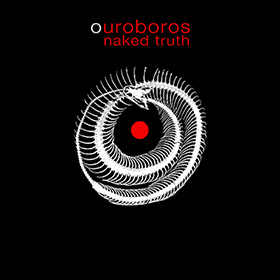
RealNoiseRecords RNR029 (CD & Digital) Time: 49:51
Record Label Websites: http://www.rarenoiserecords.com/
Sound Samples: http://www.rarenoiserecords.com/jukebox/naked-truth/ouroboros/
Tracks: 1) Dust; 2) Dancing With The Demons Of Reality; 3) Garden Ghosts; 4) Orange; 5) Right Of Nightly Passage; 6) Yang Ming Has Passed; 7) In A Dead End With Joe; 8) Neither I
Ouroboros, the eternal consuming and replenishing serpent can be seen in the singular (nothing outside of itself) or in a broader societal context. In this case, my interpretation is more of a collective urban consciousness. This is an album of motion, not of rest, an album of experiences, not of contemplation (at least until after the intense experience is over). It’s a fusion-brew of industrial, urban and cosmic sounds, and a potent follow-up to the 2011 album Shizaru (the lesser-known fourth primate of see, hear, speak, and DO no evil).
Graham Haynes has joined the Naked Truth quartet on electric cornet and trumpet (following Cuong Vu’s departure) along with original members, King Crimson alum drummer Pat Mastelotto, English keyboardist Roy Powell, and Italian Lorenzo Feliciati on electric bass and guitars.

Shizaru from 2011
First a warning: Prepare your audio system (and your ears) for a workout. Ouroboros will shake out the cobwebs. The opening track Dust is the warm-up, the testing of the systems. It’s a more keyboard dominant, brass punctuated bookend before entering the fuzzed sonic maelstrom. It has the atavistic fibers of many eras, and I’m old enough to have been around for the many incarnations of King Crimson, Weather Report and other Jazz-Fusion, Progressive Rock variants, and it’s all there–the solid musicianship and the sometimes angst-filled drive. There’s also a hint of Miroslav Vitous’s 1976 spacey funk inspired album, Magical Shepherd.
Track One: Dust
Next, place yourself in a traffic jam with an impetuous case of not-so-mild road rage (in the aggressive spirit of KC’s Neurotica, sans vocals), and that’s Dancing With The Demons Of Reality. The pauses are the waiting at traffic lights, restoring momentary sanity, but tension builds with pressurized chromatics, electronics and percussion before subsiding. Garden Ghosts is a respite; at first a progression of sonic fragments, a meandering prepared piano, percussion and fuzz-bass. The trumpet is the roaming spirit joined by a languid beat, murky electronics and guitar background; ultimately it ends as a brass-teasing percussive danse macabre.
At the start of Orange it’s disguised as an atmospheric piece, a quiet evening perhaps—serenade with cornet, but then diverts quickly with syncopated rhythms (bass, guitar and keyboards reminiscent of Kazumi Watanabe’s work), before returning to the more sedate themes. Right Of Nightly Passage is an instrumental recasting of the driving rhythmic “heat in the jungle” anagram. Clustered horns interlace with the cadence of the frenetic scene. The spirit of Miles Davis’s later more electronic work is channeled in Yang Ming Has Passed. It’s a menacing and deeply rhythmic piece (sounding like it could be dock-side in a shipping yard) with traded riffs between bass, percussion and trumpet meshed together by a high-cover of electronics.
The heavy backbeat continues in the darkly raucous In A Dead End With Joe. The trumpet soars and trills against the syncopated drums, electric guitar and keyboard phrases. Neither I is the other keyboard-textured closing bookend of the album. It displays some Far Eastern influences, and is more experimental and atmospheric with clustered brass, melodic percussion and roving piano before finding its beat. By contrast to the rest of the album, it closes with a gentle yet furtive purity.
Ouroboros is an adventurous and deliciously brash album that reveals glimpses of the eternal and sometimes daunting cycle of existence from different perspectives. Naked Truth is a sturdy, tight and vibrant quartet, and I’ll be very interested to see and hear where they take us next.
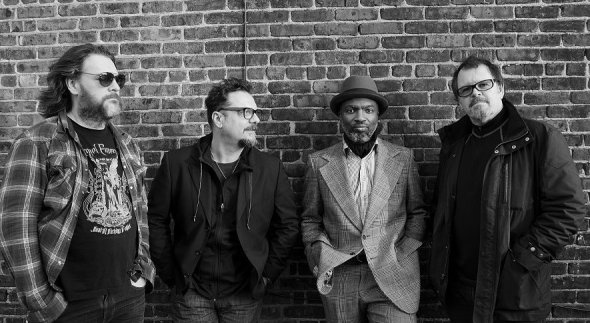
Naked Truth – courtesy of RareNoiseRecords
****
This is a solicited review.
Updated: What’s Spinning Today – Robin Guthrie, Olan Mill, Machinefabriek and A Winged Victory For The Sullen

Robin Guthrie – Fortune ***Updated with Souncloud link sample***
Soleil après minuit – SM1203CD – CD and 300 copies forthcoming on Vinyl
Robin Guthrie, long ago, moved on from his work with Cocteau Twins. Some fans want him to keep looking back, but frankly, I’m glad that he has continued on with his own work (albums and EPs) and numerous collaborations with Harold Budd, Eraldo Bernocchi and others as well as film soundtracks. Don’t get me wrong, I still enjoy my CT albums, and nothing is more searing, emotionally than the CT track (from their last album, Milk and Kisses) Violaine.
Fortune is a personal work, putting his life, emotions and experiences into his layered, chorus-and-echo-filled guitar sound. I sense intense memories too. I find that Guthrie’s work is filled with sound-color, which is also why I am so drawn to it. My favorites include the languid ladybird, the refreshing like water in water, the tender and deeply-toned melody of perfume and youth, and and so to sleep, my little ones, which picks up where the EP Songs To Help My Children Sleep leaves off—enchanting.
Artist Website: http://robinguthrie.com/
Available also at: http://darla.com/?fuseaction=item_cat.ecom_superitem_detail&item_cat_id=41313
****

Olan Mill – Home
Preservation CIRCA512 – limited 300 copy CD release and Digital
With each Olan Mill release, I am drawn all the more to their work. There is a subtle lag between rhythms, melodies and harmonies that gives a tidal flow, similar to some works of Ralph Vaughn Williams or Claude Debussy. Also, I’m not sure how this will be taken by some current listeners of this genre, but some of Olan Mill’s work reminds me of early to mid 1970s compositions of Evangelos Papathanassiou’s, especially the soundtrack to the Frédéric Rossif film La Fête Sauvage.
Record Label: http://www.preservation.com.au/product/olan-mill-home
Album overview at Experimedia:
****

Machinefabriek – Secret Photographs
Important Records – IMPREC366 – CD and Digital
This is a three track (more than 70 minute) soundtrack for a forthcoming film about Alvin Karpis (notorious bank robber and longest serving prisoner at Alcatraz Prison) by Mike Hoolboom. Karpis was released from prison in 1969, moved to Spain and wrote a memoir. He took photographs in the closing years of his life, and never shared his work with anyone until the collection was found for sale on ebay. Rutger Zuyderfelt’s response to the work is separated into three parts (black and white, color and black and white). It is a subtle guitar and electronics-based composition that gives the sense of taking a hushed and private tour through chambers of secluded memories.
Artist Websites:
http://www.machinefabriek.nu & http://machinefabriek.bandcamp.com/album/secret-photographs
****

A Winged Victory for the Sullen – A Winged Victory for the Sullen
Erased Tapes – ERATP032 – Vinyl, CD and Digital Files
Released about a year ago, the eponymous A Winged Victory for the Sullen album is the work of Stars of the Lid’s Adam Wiltzie and LA composer Dustin Halloran. I didn’t realize that there was a connection between Adam and Mark Linkous (Sparklehorse), but it was ultimately that connection and colleague Francesco Donadello that brought …Winged Victory… together. Large spaces, grand pianos, string quartets and delicate woodwinds and brass are the framework for this lush and stunning album.
Artist Website: http://www.awvfts.com/
Record Label: http://www.erasedtapes.com/artists/biography/16/A+Winged+Victory+For+The+Sullen
Some Recent Kitchen. Label Releases

Record Label Website: http://www.kitchen-label.com/
Soundcloud Page (Excerpts of Albums): http://soundcloud.com/kitchen-label/sets
Available at: http://www.darla.com/
I am always on the lookout for new music, especially from record labels that are doing something different, something special, and I don’t mind spending extra money for well crafted, limited or richly illustrated art editions. In a way, it’s my reaction against the trend of digital only releases, which include not only music, but e-books (I still prefer finely crafted, bound books).
I’ve missed some of Kitchen. Label’s earlier releases that have gone out of print, but to date I have acquired four albums from their US distributor, Darla (their first release being in 2008 and they are an outgrowth of their design firm Kitchen, founded in 2005). K.L is based in Singapore and specializes in releasing art-editions of talented emerging artists, and label founders Ricks Ang and April Lee take great care in all aspects of their work, from the engineering of the recordings to the diverse and creative designs.
***
ASPIDISTRAFLY – A Little Fable – Kl-007 – 2011
ASPIDISTRAFLY is composer and vocalist April Lee and producer Ricks Ang, and their work tells charming and delicate stories. Their second album A Little Fable was released in 2011 and it has the presence of a secret garden. I find the depth and airy quality of Homeward Waltz to be particularly enchanting–it’s like chamber music. Their first album I Hold A Wish For You was also released on K.L.
Homeward Waltz
Landscape With A Fairy
***
FJORDNE – Charles Rendition – Kl-006 – 2011
FJORDNE is the solo project of Tokyo-based composer, Fujimoto Shunichiro. His work has a timeless richness that is brought to life with acoustic instruments and a laptop computer. Music for a quiet night of contemplation. Charles Rendition is his 5th album.
Constellation Live
Gathering
***
Pill-Oh – Vanishing Mirror – Kl-010 – 2012
Pill-Oh consists of electronic artist Hior Chronik and classical pianist Zinovia Arvanitidi, both from Greece have been working together since 2009. They each have established solo careers of composing for theater, film, documentaries, and art performances. Zinovia is recording her 2nd solo orchestral album, to be released within 2012. Their album Vanishing Mirror is like the soft and hopeful first-light of a spring day. The feeling is sometimes reflective, but not sentimental. In this music there is restful comfort along with accomplished musicianship. The track Melodico is my favorite.
February Tale
Melodico
***
Szymon Kaliski – From Scattered Accidents – KL-011 – 2012
Szymon Kaliski is a multi-media artist from Poland. From Scattered Accidents is his fourth album. His work combines familiar acoustic and invented instrumentation. His work has a tranquility that often evokes a suspension of time within a vast sonic depth of field.
Of Symmetry
Interlude I (with Peter Broderick)
***
The music at Kitchen. Label is never strident, but it can challenge some norms of straight-up ambient, post-classical or electro-acoustic genres. There are even some jazz influences (FJORDNE, especially), yet the compositions are often ethereal and filled with memories of nature and surroundings of daily life—rediscovering the forgotten in the familiar.
Review: Steve Hackett – Genesis Revisited II

InsideOut Music 0506240 (Ltd 2 CD & Book, also 2 CD & 4 LP)
Time: CD 1: 73:18 CD 2: 71:27 minutes
Record Label Website:
http://www.insideoutmusic.com/ & http://www.insideoutmusic.com/artist.aspx?IdArtist=458
Artist Websites:
http://www.hackettsongs.com/ & http://hackettsongs.sandbag.uk.com/
Photos of Musicians on the Album:
http://www.hackettsongs.com/gallerySub/gallery82.html
Tracks CD 1: 1) The Chamber of 32 Doors; 2) Horizons; 3) Supper’s Ready; 4) The Lamia; 5) Dancing With the Moonlit Knight; 6) Fly on a Windshield; 7) Broadway Melody of 1974; 8) The Musical Box; 9) Can-utility and the Coastliners; 10) Please Don’t Touch
Tracks CD 2: 1) Blood on the Rooftops; 2) The Return of the Giant Hogweed; 3) Entangled; 4) Eleventh Earl of Mar; 5) Ripples; 6) Unquiet Slumbers for the Sleepers…; 7) …In That Quiet Earth; 8) Afterglow; 9) A Tower Struck Down; 10) Camino Royale; 11) Shadow of the Hierophant
It has been 16 years and many life changes since the last Genesis Revisited album by Steve Hackett (subtitled Watcher of the Skies) in 1996. Although the span of time recounted musically is similar, 1971 through 1976; the breadth of the work on GRII is far more comprehensive. It’s also worth noting that in 1987 Steve was a special guest on an orchestral reinterpretation album of Genesis work, We Know What We Like: The Music of Genesis (led by arranger David Palmer conducting The London Symphony Orchestra), although in that case it includes works after Steve had left the band (from albums And Then There Were Three and Duke). On that album is perhaps the best example of how well the work of Genesis transfers to an orchestral format: Can-utility and the Coastliners. As much as I love the instrumental section with waves of Mellotron on the original recording, the full orchestra adds great depth and power to that track.
I’ve read (and I’m paraphrasing) that Steve didn’t want to literally re-record these works (as some Genesis tribute bands so painstakingly perform), rather enhance them with the lens of time, since many were recorded somewhat hastily between concert tours in the 1970s. Another added benefit is that some recording technologies have improved, and this is quite clear in the warmth and clarity of GRII. Frankly, I rather liked many of the reinterpretations on the last GR album, and there was the added track Déjà vu originally penned by Peter Gabriel and SH, then set-aside, to be revived and beautifully completed with Paul Carrack’s vocals.
As much as I wanted the limited 4 LP vinyl set, I opted for the 2 CD version along with the extensively illustrated and annotated small format hardbound book—a quite worthy trade-off (designed by Harry Pearce of Pentagram Design). It’s clear that this album was an enormous undertaking (with a special mention for the co-production, recording and mixing by collaborator and keyboardist, Roger King), with some 30 guest musicians and vocalists (including brother John Hackett, SH Band alum Nick Magnus, and the members of the most recent touring and recording SH Band: Roger King, Gary O’Toole, Nick Beggs, Amanda Lehmann and Rob Townsend). I have provided a link above to a page on the SH Website showing a complete list (with photos) of all who participated on GRII. A matrix of the album track performers in included in the credits.
Throughout the album there are a number of acoustic guitar introductions (like the opening to the potent The Chamber of 32 Doors), variations and electric guitar solo fills by Steve that are not on the original recordings; they reflect journeys and musical influences from his many years as an artist. Horizons and Supper’s Ready are preserved in their pairing from the original Side B of Foxtrot. The solo acoustic guitar of Horizons has long been a mainstay of Steve’s live shows since the early days of his solo career, and here it’s just as pure, unrushed and striking as a morning sunrise or evening sunset at one’s favorite place to be. The vocals and instruments on Supper’s Ready are powerful, clear and Steve’s guitar is “up” in the mix (as it is on much of the album). The treatment greatly invigorates the original, and made me want to take the time to listen to the entirety of the track repeatedly. The Apocalypse in 9/8 and the closing section of As sure as eggs is eggs (aching men’s feet) just sends chills up the spine as from those concert days long ago.
The purity of Nik Kershaw’s vocals on The Lamia is different from Peter Gabriel’s more raspy treatment of the song, and to my ear it’s a stunning performance (brighter than the original). Again, the instrumentals have a clarity superior to the original (although, I’ll never turn my back on the Charisma/ATCO recording of The Lamb Lies Down on Broadway—too many aural historic memories there). SH’s closing solo echoes the original while adding a smooth lyricism. I’d be interested in knowing how and why Kershaw was chosen for the track. After a brief acoustic guitar link of Greensleeves, Francis Dunnery’s (It Bites et al) vocals on Dancing With the Moonlit Knight are probably the closest to channeling Peter Gabriel and the Selling England by the Pound performance as on any of the album’s tracks. As has been the case during recent concerts, drummer Gary O’Toole performs the vocals on the Lamb’s two tracks Fly on a Windshield and Broadway Melody of 1974. Both are broad and authoritative performances. O’Toole’s voice is his own.

I have always wondered why Anthony Phillips isn’t credited as a songwriter on The Musical Box, since he and Mike Rutherford wrote and recorded the early demos in 1968, when the track was known as F Sharp, but anyway… TMB opens with an almost Raymond Scott-like musical box fantasy, before entering into the realm of the long ago Nursery Cryme album. Sung by Nad Sylvan (who also provides vocals on Chamber and Eleventh Earl), this interpretation has an intimate sound, chamber-music-like, with clustered and freer vocals, before breaking into the raucous guitar-centric bridge and to the familiar closing that was performed in concerts during the mid to late 1970s.
As noted above, I think one of the most powerful and diverse Genesis tracks from the early days, which is frequently overshadowed by Watcher of the Skies or Supper’s Ready, is Can-utility and the Coastliners. Steven Wilson (solo and Porcupine Tree) provides the vocals. This version has the “soft bits and loud bits” and combines the oceanic strings (violins/violas) and bass pedals with the rawness of Foxtrot. Please Don’t Touch (from the 1978 album) closes CD 1 and was a track originally to have been linked with the instrumental Wot Gorilla on the 1976 album Wind and Wuthering. One of the reasons SH left Genesis (well documented) was he felt at that time his contributions to the band were being overlooked, so when he appeared officially as a solo artist, this track was the perfect, aptly named, composition to strike out on his own. It has had many incarnations, including sections of a 1986 track Hackett to Bits from the eponymous GTR album with Steve Howe et al. I remember concerts from the late 1970s and early 80s that would end with this track at ear-splitting volumes. This version is dark and authoritative.
CD 2 contains many tracks co-written with single Genesis members rather than the full band (exception is Hogweed and In That Quiet Earth), and one of my personal favorites is the timeless (and still topical) track penned with Phil Collins, Blood on the Rooftops. For years, SH played small sections of this track as a teaser during his acoustic “breaks” at concerts, and then in the early 2000s, the full track appeared in concerts and live recordings. This piece has a great deal of meaning to me—like entering a time machine to another place. Steve opens with a small fantasy on his nylon string guitar before the track begins, and I consider it a great gift to his fans that it has been recorded again (vocals by Gary O’Toole and woodwinds by Rob Townsend).
The Return of the Giant Hogweed is a different type of track in the Genesis oeuvre that starts with an attack (or rather, an infestation!). It also displays SH’s early fret-tapping technique. Although this video is not the recording from the album, it has a similar spirit and same vocalist, Neal Morse (taken from the 2010 High Voltage Festival by Transatlantic with SH as the guest guitarist).
Entangled was written by Hackett and Tony Banks—the dreams and nightmares of an altered mind. The vocals (fuller than on A Trick of the Tail) are by Jakko Jakszyk with backing vocals by Amanda Lehmann (guitarist and vocalist in the SH Band, and Jo Hackett’s sister). Eleventh Earl of Mar (Banks, Hackett, Rutherford) has a much deeper and clearer sound that I always found lacking in the original recording (and all of the reissues…for some reason the David Hentschel engineering that sounded so great in the Seconds Out live album, just sounded so flat and compressed). Nad Sylvan also adds layers to the spirit of the original Phil Collins vocal harmonies and channels the voice of Noel McCalla at times. Nick Beggs’ bass energetically drives the piece. Amanda Lehmann skillfully adapts the Collins’ vocals on Ripples, adding lyrical depth to the chorus (also a tribute to the engineering, recording and mixing of co-producer Roger King). The instrumental sections are faithful to the original. Lehmann returns again on the closing track Shadow of the Hierophant, which was co-written by SH and Mike Rutherford on Hackett’s first solo album from 1975, Voyage of the Acolyte.
Grouped together are (Hackett and Rutherford’s) Unquiet Slumbers for the Sleepers…, followed by the group-written …In That Quiet Earth, and Tony Banks’s deeply melancholic Afterglow, the closing tracks of the last official album that Hackett recorded with Genesis (excluding the 1977, 12 inch EP Spot The Pigeon). SH improvises more freely on his guitar in …Quiet Earth and the solos that close (including Rob Townsend’s soprano sax) are more rugged than the original. The strong and familiar voice of John Wetton anchors the close of the trio from W&W.
It’s exciting to hear a reinvented A Tower Struck Down (from 1975’s VotA) with a true orchestral opening (Dick Driver on double bass, Rachel Ford on cello, Christine Townsend on violin and viola and John Hackett on flute). The solid bones of the Tower from Acolyte are present, but in a completely different, even darker skin. Steve Hackett notes that he had dreams of Genesis playing the chorus of Camino Royale (written by SH & Nick Magnus). This track dates from the 1982 solo album Highly Strung, and was always a great concert piece, from when Nick collaborated with Steve in the late 1970s and 1980s—full of spirit and rhythmic precision, a great addition to this collection. This track also includes jazz influences from the Hungarian band Djabe (Steve has collaborated with Djabe on some of their recent albums and concerts). As does Voyage of the Acolyte, Genesis Revisited II closes with Shadow of the Hierophant. This version is more up-tempo and potent, and Rob Townsend’s flute peregrinates throughout the shadows. It closes as it has since it was first recorded with the hierophant traveling on the long journey of seeking and interpreting the sacred and the arcane.
The one thing some (purist) listeners might find missing in GRII is the grittiness of the original recordings, but the defects of these compositions from long ago have been deftly exorcized, and the sonic foundations treated with such care that Hackett not only preserves the legacy of his former band, but enhances it for future listeners. These recordings are not meant to replace the originals; they are akin to variations by composers of the past. In a way, Steve Hackett is the archivist of the musical spirit of Genesis from that time. Sit back and enjoy this brilliantly crafted set of recordings with all the 21st century enhancements. You will not be disappointed.
The Hackett Band will be on tour with many of these recordings in Europe, the UK and America in 2013. I can’t wait!
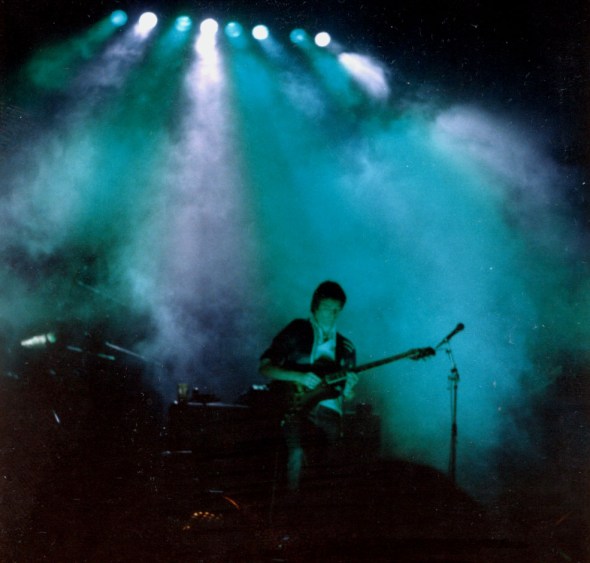 Steve Hackett in 1981 – Spectral Mornings © by wajobu
Review: Roger Eno – Ted Sheldrake

Backwater Records OLKCD023 – Time: About 42 minutes (CD & Digital Files)
Record Label Website: http://www.backwaterrecords.com/
Artist Websites: http://rogereno.co.uk/ and http://rogereno.com/
Tracks: 1) You’re Just A Bloke; 2) All In A Garden; 3) The Old Queen’s Head; 4) There’s Something Wrong With Ted; 5) The Cold Night Is Over; 6) Marrers; 7) My Old Bike; 8) You’re Just A Bloke (Ted); 9) Moon Waltz; 10) Ever True; 11) Sally; 12) Bittersweet; 13) Ted’s Funeral Music
I find it hard to believe that my original LP copy of Apollo (Brian Eno, Daniel Lanois and Roger Eno) will be thirty years old in 2013, but there it is—one of the great albums of the ambient music genre. When I think of Roger Eno’s music over the years, three words come to mind: thoughtful, quirky and sometimes playful. Whether lyric or instrumental, RE’s works tell stories that can either be tightly sewn threads or loosely knitted yarns. Often, the subjects are quiet ruminations, but they can also be spirited and cheerful. His works can also be rather enigmatic, as noted in an autobiographical analysis from his website: [He is] “On an ongoing and heterogeneous musical journey which twists and turns and goes whichever way you think it won’t.”


Roger Eno entered the professional music scene with Apollo after music lessons and college to study music (as a multi-instrumentalist and singer), as well as running a music therapy course at a local hospital. In addition to working with his brother Brian, Roger has collaborated with artists including Bill Nelson, Kate St. John, Lol Hammond, Peter Hammill and Michael Brook, and has provided soundtracks for films and advertisements.


RE’s most memorable albums for me (of his 25 or so) include: Voices (1985), The Familiar (w/ Kate St. John, 1993), Automatic and Excellent Spirits (both with Channel Light Vessel, 1994 and 1996), Lost In Translation (1995), Swimming (1996), The Music of Neglected English Composers (1997), and more recently Fragile (Music) (2005), Anatomy (2008) and Flood (2008, a reinterpretation of a soundtrack constructed for Salthouse Art Festival in North Norfolk). I hope that Roger works again with Kate St. John and Bill Nelson; their work together on The Familiar is some of the most touching and enchantingly inspired work that I have in my music collection.


Ted Sheldrake is a departure from Roger Eno’s instrumental ambient work; originally a quiet neighbor and later a friend, it’s a tribute to a life, and even though it takes place in recent times, it could have just as easily taken place a hundred years ago—in many respects it did. It’s a familiar story in literature as well. In Victorian times, Richard Jefferies told the stories of common labourers, from the farm fields in his books like Green Ferne Farm, Round About A Great Estate (both from 1880), The Life Of The Fields (1884), and in newspaper articles during that time in the late 19th century. In the first half of the 20th century Henry Williamson also wrote of life in a West Devon village known as Ham (The Village Book and The Labouring Life in 1930 and 1932, respectively) and described the country life in the narrow village streets, fields and hedgerows, “local colour”, and stories of the “everyman”.
The compiled, mostly song-oriented work traces Ted in East Anglia (Suffolk and Norfolk, UK), being from a family of hearty stock, farm labourers and fishermen, and he spent his years working on an estate and living in a village where the pace of life was slower and the work was hard, but satisfying. In his younger days Ted learned to play a melodeon (hand organ), and as the years passed he became known for composing and performing songs in local pubs and village halls. In his later years, following his retirement, TS suffered the loss of his beloved wife, and something changed in him and it comes through in his music.
The album is divided, the way I see it, into two sections (observations and then reflections) and includes a number of recordings (songs, spoken word with accompaniment, and instrumental) made on location with cast of characters and talent connected to his life.
You’re Just A Bloke is an introduction to Ted’s work through the voices of others; a group interpretation of this universal and common man. This is the first indication that Ted’s work and life isn’t embellished with ornate descriptions, he’s the “real stuff”, with genuine words. Village life includes folks gathering in thatched cob or flint-walled cottages, village halls or pubs, and the jolly and perceptive All In A Garden brings this experience to life. Ted’s songs are also a bit like tiny memoirs, recounting special occasions and getting spiffed-up for The Old Queen’s Head.
As time passes, Ted’s meager existence and loss of friends weighs on him. Some around him sense a change in his countenance. There’s Something Wrong With Ted tells the worry of a friend, layered austerely with piano and a keyboard. The Cold Night Is Over is the beginning of Ted’s reflections of melancholy and pastoral memories of the farm fields and long views to the sea. Marrers (marrows or zucchinis) is perhaps the most beautiful track on the album—deeply reflective, and one of the main reasons Ted would still rise in the morning—for his garden; at first a lone piano, then an open and sincere expression of longing. The melodic theme is expanded modestly (and somewhat cheerfully at first), this time overlaid with memories in My Old Bike. Ted’s is a simple life in the village, never needing to leave East Anglia, and now missing his dear wife.
The original version of You’re Just A Bloke is rendered by Ted—directly, perhaps even more so than Hemingway. The last section of songs (with piano) present Ted’s most personal feelings, the endearing yet untrained voice, and uncomplicated romanticism of Moon Waltz and Ever True. Sally is an instrumental tribute to his wife, which is proud and forthright. Bittersweet is apparently Ted’s last song, interpreted by an ensemble of his mates (documented by local schoolteacher Miss Kemp—Ted didn’t write music, he just played it). The final tribute to his life is the piece Ted’s Funeral Music, which sounds like it’s played on an old harmonium or church organ.
So, slow the world down, set a spell, and get to know Ted Sheldrake and his humble existence. He might turn out to be someone you know, and it’s a simply delightful chronicle.

Ted Sheldrake will be released on January 7th, 2013.
Review: Good Weather For An Airstrike – Lights
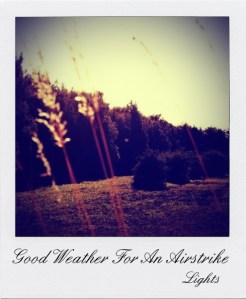
Sound In Silence SIS011 – Time: About 40 minutes (CDr & Digital Files)
Record Label Website & Contact: https://www.facebook.com/soundinsilencerecords & http://www.myspace.com/soundinsilencerecords E-Mail: soundinsilence@hotmail.com
Artist Website: http://goodweatherforanairstrike.bandcamp.com/
Tracks: 1) A Quiet Day; 2) Thinking Of You; 3) Storm Fronts Collide; 4) The King XXVI; 5) One Of These Days; 6) Escape; 7) An Ode To Fring; 8) Rescue
The sounds that keep one up at night; they could be the house creaking, babies crying, traffic on the streets, the sounds of animals stirring outdoors, and my personal favorite the hoots of owls sending messages to each other in the dark. In the case of Tom Honey (aka Good Weather For An Airstrike), what keeps him up at night is the ringing in his ears—tinnitus. So, in 2009 Tom started his GWFAA music project as a means to help him relax and get to sleep (sounds like a candidate for a Slaapwel project too). I know of at least six releases by GWFAA since 2009 (with labels Hibernate, Rural Colors, Bad Panda, Audio Gourmet, Sonic Reverie and his own Hawk Moon Records), but I’m sure that there are more, including his most recent and lovely tribute EP to his wife Lauren entitled This Is As Good A Place As Any.
His latest album Lights is to be released by the small independent Greek record label Sound In Silence (their contact information is noted above) in a hand made sleeve and is limited to 200 copies. The album is arranged a bit like a meditation session, with instrumentation including guitar, banjo, strings, piano and percussion. The sound is steadier and fuller than many recent ambient albums, and I’ll resist the temptation to compare GWFAA’s sound to the works of others.
A Quiet Day begins softly before introducing a calming and guiding pulse with a mantra first from a piano and then supplemented by gentle percussion. Once in a more focused state Lights goes deeper, into the tranquil canon-like Thinking Of You. There isn’t a feeling of yearning here for what cannot be or the unattainable; there is just an idyllic state of belonging.
Thinking Of You
As with any period of slumber, the brain still sends signals to be processed, and periodically there are voices, broadcasts and sounds that appear to be sorted-out. Dreams send flashes that are discernible and other times are fleeting and out of reach. Storm Fronts Collide returns to the time of the Paris Peace Accords and the VietNam War in 1973—voices from the past (forgotten by some and unknown to others, except those who lived through those times); the codified yet unratified tragic melancholy that sometimes enters the drifting mind. The King XXVI and One Of These Days are also brief episodes in the sequence of reverie with the sounds of the outdoors and the cheerful voices of children.
Escape is a transition to the last section of the album, an arrival at pleasant and calmer memories. The mind is no longer distracted and has returned to the center in An Ode To Fring, perhaps from halcyon recollections of East Anglia, Norfolk. Rescue closes the album, and it is both the final state of slumber and the slow return to the conscious world. The opening theme of the album is more broadly reprised like the rising sun not yet seen, but still a signal to an awakening. Enjoy your travels, and the weather.
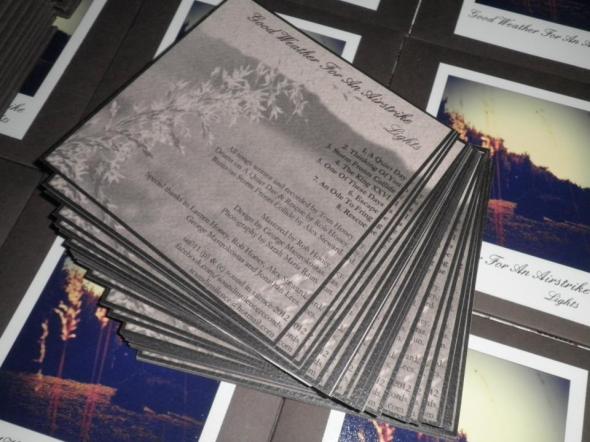
Photo Courtesy of Sound In Silence
****
This is a solicited review
Review: Will Samson – Balance *UPDATED with VIDEO*
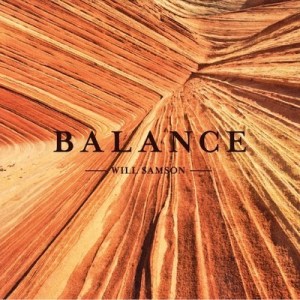
Karaoke Kalk 69LP – Time: About 34 minutes (LP, CD & Digital Files)
Record Label Website:
http://www.karaokekalk.de/ & http://www.karaokekalk.de/will-samson-balance/
Artist Websites:
http://willsamson.bandcamp.com/ & http://wsamson.tumblr.com/ & http://willsamson.co.uk/
Recorded & Mixed By: Florian Frenzel & Will Samson Mastered By: Nils Frahm
Tracks: 1) Oceans Are Wilder; 2) Cathedrals; 3) Hunting Shadows; 4) Eat Sleep Travel, Repeat; 5) Painting A Horizon; 6) Music For Autumn; 7) Storms Above The Submarine; 8) Dusty Old Plane
Some may recall my review of Will Samson’s last album Hello Friends, Goodbye Friends (there’s a link to it on the right of this page, near the bottom of the list or use the Search box). HFGF was timely; it rang like a beacon of hope. It was a pretty special thing to think that a 20-something had such an affect on this 50-something, but there are all kinds of wisdom floating around and sometimes age really doesn’t matter. I don’t mind admitting this at all, as it has been music that has helped me at many times throughout my journey in this life. So, at the first mention from Will that he had another album in the works, I was excited; resisting temptation to listen to early previews, preferring to wait for its full and formal release. So, I ordered the LP, with the striking cover photo by Scott McClarin.
It was worth the wait.
From the first celeste (vibraphone?) notes and soft vocal harmonies of Oceans Are Wilder, I knew that there was a great synergy in Will’s work with Florian Frenzel and Nils Frahm—complementing the music and lyrics so well. As the album progresses it moves from a soft state of consciousness to a deeper meditation (with one brief diversion). There is a lovely balance of instrumentation, vocals, ambient sounds and the outdoors. These are songs of friendship, strange journeys, and visits to places real and imagined. The mix of six vocal songs and two instrumental respites is a bit like Nick Drake’s second album, Bryter Layter.
Samson continues to use his upper register (and falsetto) voices prominently, although there are times when full-throated harmonies are blended. Vocals are also fuller in the mix of this album, and the overall sound is different; the result of using venerable analogue equipment, tapes (old cassettes, a Tascam 8-track) and working with Florian Frenzel’s salvaged organs, analogue tape delays and old microphones.
The ambiance of the analogue equipment is strongly present in Cathedrals, it gives a misty quality to the sound, a sense of the ancient, like the foxed pages and deckled-edges of aged books or the opening title sequence to an old film. In particular, I think the layering of sound is particularly strong, starting with simple acoustic guitar, then unadorned vocals, then vocal harmonies added ending with the lyric “That spin so separately…” and then an abrupt and lyrical chord change into “Impossible became much easier…” and shifting to an electric guitar drone to the end—it’s mystical and soulful.
Hunting Shadows is an outdoor walk, and the music and treatments take the place of moving light, shadows and the lightly moving breezes of a new day. Eat Sleep Travel, Repeat has the ambiance of being aboard a ship at sea late into the night, composing (acoustic) music by candlelight and the stars, with slow swaying movements, as does the more electric (with broad vocal harmonies) Painting A Horizon. The trombone solo in Eat Sleep is an impeccable complement as are the banjo and cello on Painting. There are similarities with the more plaintive side two of Brian Eno’s album Before and After Science, the three tracks Julie With…, By This River, and Spider and I.
Eat Sleep Travel, Repeat (Premiere Video)
The second instrumental piece (again, with cello) on the album is Music For Autumn. It’s as if the sun is lowering in the cool night sky and as the track closes, Samson adds a warming chorus of voices. The brief diversion noted above is Storms Above The Submarine, which starts playfully, with furtive notes, sounding a bit like some sonic experiments of Raymond Scott. Then a somber throaty organ mixes with Will’s overdubbed voices (which are treated to sound a bit like a mournful saxophone) and altered guitars. Dusty Old Plane (and oh so beautiful, it is) closes the album, with practically a whisper of droning keyboard, reverberant electric and acoustic guitars and Samson’s harmonies. Listen carefully; there are birds in the background. This peaceful track is a sonic blessing, and a farewell of sorts. I also note that this album is dedicated to his father.
Please keep making music Will; you have a true gift.

****
A postscript: I have only one (hopefully received as constructive) comment on what is otherwise a brilliant album, and that is to recommend to not let the desire to use aged and lumbering analogue equipment for ambiance shroud the quality and beauty of the music too much.
Flaming Pines Label
Record Label Website: http://www.flamingpines.com/
Soundcloud Page: http://soundcloud.com/flaming-pines
Bandcamp Page: http://flamingpines.bandcamp.com/
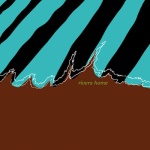
I am always looking for new and interesting music, and often works with a message or a foundation. Late in 2011, I came across a label from Sydney, Australia named Flaming Pines. I first noticed an EP release by Marcus Fischer and then realized that it was part of a series entitled Rivers Home. The first series consisted of 5 separate 3 inch CDs, each with works by a different artist (Marcus Fischer, Kate Carr, Field Rotation, Broken Chip and Billy Gomberg). There was also a common theme to the CDs, and I immediately took note of the striking cover artwork. Rivers Home (and its later Part Two with releases by The Boats, Seth Chrisman, Dan Whiting, Savaran, and All N4tural) “…celebrates the wonder of rivers at a time when many of them are particularly vulnerable. Many of us dream about rivers, ride along rivers, take ferries along rivers and sit on river banks. This series is a musical exploration of the ways we influence rivers and they influence us.” The founder of Flaming Pines it turns out is Kate Carr, whose work is also featured in the series. Kate also produces the artwork for the covers. I ultimately bought the entire set. Many of Flaming Pines’ releases are mastered by Taylor Deupree of 12k.
Marcus Fischer – Willamette River
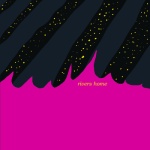
The Boats – River Calder
Recent releases include a split album by Kate Carr (Blue) and Gail Priest (Green), which is an exploration of sound and color. The last track of each side serves as a transition to the other side of the LP, and the color references are subtle (as colors are muted at dawn and dusk), and reveal the natural world with field recordings and gossamers of acoustic and electronic instrumentation and effects. The LP silences the distracting world around and reveals the many things missed in the background as the days and seasons come and go all too fast. The LP is a co-production of Flaming Pines and Metal Bitch Recordings.
Kate Carr – Excerpt from Blue
Gail Priest – Excerpt from Green
Just released in September is the next series of EPs on a theme, this time Birds Of A Feather, and the covers keep getting better! The first two are the Black Woodpecker by Iran’s Porya Hatami and Great Northern Loon by Canadian Michael Trommer. Carr notes of this series, “…the role of birds as muse, as musical guide and inspiration has been well documented in classical music, from Mozart’s pet starling to Beethoven’s birdsong filled Pastoral Symphony and Sibelius’s swan hymn to Messaien’s birdsong compositions. Birds Of A Feather celebrates the role of birds in ambient music, and the beautiful fragility of birds more generally.” Both of these EPs are deeply layered soundscapes with field recordings of the chosen birds and environs mixed with acoustic and electronic instrumentation that heighten the experience. It’s like getting lost in the woods or paddling a canoe on a hidden lake.
As with Rivers Home, Birds Of A Feather will be a series of about 12 three inch CDs released as pairs in editions of 100 over the next year. The next pair of CDs will be by The Green Kingdom and Darren McClure.
My favorite of the cover artwork thus far is the expressive Black Woodpecker.
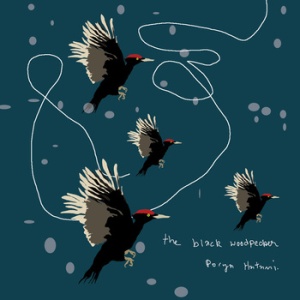
Michael Trommer – Great Northern Loon Excerpt
Porya Hatami – Black Woodpecker Excerpt
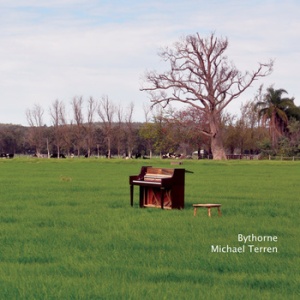
The latest October release is a debut by Michael Terren entitled Bythorne, who lives in far western Australia in Perth. In June of this year, he strapped his piano to a trailer and drove it 200 kilometers to a farm of his childhood. There he recorded this EP of six compositions (Cureaking, These Ones, All Nine of Them, Midiology, Bythorne and Dardyboys). The tracks echo the surroundings and ever-changing weather (from placid blue skies to sudden stormy weather in from the Indian Ocean) as well as the pastoral timelessness. I get a strong feeling of the sense of place from the beautiful title track. The sleeve is handmade and the EP is limited to 100 copies.
Michael Terren – Bythorne
Review: Animation – Transparent Heart

RareNoiseRecords RNR028 – Time: 76:59 (CD & Digital Files)
Label & Soundfiles: http://www.rarenoiserecords.com/jukebox/animation/transparent-heart/
Artist Website: http://www.animationismusic.com/
Band: Bob Belden: sax/flute; Peter Clagett: trumpet & effects; Jacob Smith: bass; Roberto Verastegui: keyboards & samplers; Matt Young: drums
Tracks: 1) Terra Incognito; 2) Urbanoia; 3) Cry In The Wind; 4) Transparent Heart; 5) Seven Towers; 6) Provocatism; 7) Vanishment; 8) Occupy!
Bob Belden is a composer, arranger, conductor, musician as well as past head of A&R for Blue Note Records. He is also has a strong sense of the history of Jazz, including being a scholar of the works of Miles Davis, and having received Grammy Awards for the reissues of Miles Davis’s work on Columbia Records. In his own work, Belden is a story-teller of the lives of others, whether orchestral, jazz-fusion or soundtracks.
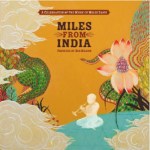

Perhaps his best known works are the 2001 Grammy Award-winning Black Dahlia (the mysterious tragic death of actress Elizabeth Short’s in 1947) and the more recent collective world jazz fusion productions (with Miles Davis alums) Miles From India (2008), and Miles Español – New Sketches of Spain (2011). In the guise of the project known as Animation, Belden released the album Asiento in 2010, a live interpretation of Miles Davis’s 1970 album Bitches Brew, along with a 2011 3D60 surround sound remix of the album, entitled Agemo (both on RareNoiseRecords).


Belden’s latest album Transparent Heart represents a shift in his work; this time the story is his own. It is a musical memoir of his life in New York City for more than the past three decades, and the dramatic changes seen since his first arrival in Manhattan in 1979 with Woody Herman’s band—the post-disco era. Not only is this album personal, it’s also a social and political history and commentary of this period. There are common threads throughout the decades (not the least of which is fear: from Communism to terrorism and the latest, the corporate takeover of America and the rise and fall of Wall Street and the financial sector and the revolt against it and corporate dominance).
During this period there was a gradual change from the mean streets of the 1970s (as depicted in the films French Connection, Dog Day Afternoon, Serpico and especially my favorite Taxi Driver) to the gentrification and commercialization of many areas throughout the five boroughs of NYC. We have seen huge changes since the 1970s in the music and arts scene, and in places like Times Square, Harlem and Greenwich Village. New York City in 1979 was a LONG way from Belden’s own home in Goose Creek, South Carolina. For Transparent Heart, Belden assembled a group of young musicians from his alma mater, the University of North Texas, ranging in age from 19 to 32.

Like the opening to a 1970s era film, Terra Incognito is the overview, the panning shot of Manhattan with its cavernous avenues of towers, and Belden’s first impressions seen wide-eyed with young optimism. It’s a majestic and confident arrival, although a view from above. By contrast, in this new city, there is another side; despite the city’s size and population there is isolation and the unknown, and living in the rough neighborhoods, a long way from home is what Urbanoia is about (and the old NYC time clock on the other end of the phone, a companion to some). The track also has a contrasting section, more up-tempo giving the impression of a city on the move; pulsing and lurching. Trumpet and soprano sax trade solos like people dodging the traffic of the rhythm section in mid-town or up-town. There are phrases in this track that remind me of works by Weather Report (funk and fusion), Miroslav Vitous’s Magical Shepard, and even sections of Deodato’s (popular at the time on the radio) 2001 Space Odyssey, a reinterpretation of Strauss.
As big as New York City is, there is also the personal side to the city, and encounters with people in need. Cry In The Wind recounts the aftermath of a woman in Belden’s neighborhood being stabbed, and him staying with her until help arrived. It’s the somber voices of solo flute and trumpet, and the isolation of the moment. Some of the hopeful opening themes are reintroduced in Transparent Heart, this time with a more turbulent undercurrent pulse of the city and stronger rhythms. This is the era of Herbie Hancock’s Future Shock (with the ground-breaking hard-hitting percussive and inventive track Rockit) and a bit later, Miles Davis’s Tutu. This was also the time when there was a great effort by NYC authorities to fight crime and clean-up the streets.
In some respects Seven Towers begins its life in February of 1993 with the first terrorist bombing on the World Trade Center. First-responder and air-traffic control radios open the track, and the undercurrent of rhythm and state of alert and fear that surrounded the south of Manhattan for eight years until September 11, 2001 when the bottom fell out of everything (security and economic). The track deteriorates into a frenzy of chaotic and searching rhythms and solos as the events unfold. Scattered electric piano, flute and drums continue in the middle of the track as if they are the ongoing cloud of debris and smoke that existed for days after the attack as determined rescuers cleared the debris and searched for survivors. The track closes with a building and re-energized rhythm and trumpet solo, as if Manhattan is determined to recover, and get back to normal.
After the 9/11 attack lower Manhattan was a different place, businesses closed, clean-up began, people were searching for missing loved-ones, and NYC was in a constant state of alert. Posters and memorials appeared spontaneously as people ventured out onto the streets to see the aftermath of the attacks. Provocatism is about the post-9/11 experience, survival, surveillance and exploration in the neighborhoods, with an energetic pace of fighting for survival. Much like the aftermath of Hurricane Katrina in New Orleans, many residents in lower Manhattan, including artists and musicians left the area and could no longer afford to return as damaged neighborhoods were redeveloped. Vanishment is the embodiment of this sense of loss; a lone flute, mournful rhythm, and the lament of a muted trumpet.
With the Recession economic meltdown of the mid to late 2000s, it was the big banks and Wall Street financial institutions that received the bailouts, not the people whose jobs, assets and homes were lost due to risky bundled investments sold by the very institutions that received the bailouts (perceived by many as economic terrorism by corporations against citizens who ultimately would pay the bill). The reaction was (and still is) the Occupy Wall Street movement that spread across America. The final track Occupy! expresses the anger and frustration of the protesters and law enforcement trying to contain the crowds. In this the full band plays the part of the crowds of protesters (sometimes organized chaos) and solos are the voices of the town halls and mike-checks interlaced with field and law enforcement recordings. Glimpses of the original (although altered and subdued) trumpet and sax theme return from Terra Incognito to illustrate that it’s still Manhattan, but things have changed with the passage of time.
Transparent Heart is an album of discovery, wide-eyed optimism, conflict, activism, conflicting ideologies, displacement, and the results of terrorism (warfare and economic) on a city, its art-scene and most of all, its people. This is not an album for sitting down and relaxing to; it’s a thoughtful, skillful and eye-opening musical diary that forces reflection about the state of our world, politics and economic foundations in the spirit of composers and activists like Stravinsky and Copland. It’s thought-provoking and riveting.
****
This is a solicited review.
Twigs & Yarn – The Language Of Flowers

Flau28 CD – Time: About 43 Minutes (Also available in 12” vinyl LP)
Artists Website: http://www.twigsandyarn.net Record Label Website: http://www.flau.jp
Mastered by: Nick Zammuto: http://www.zammutosound.com
Tracks (*Note: Track order according to iTunes readout appears to be in reverse order, although the music order is correct. The track order that follows is properly sequenced with the sound files on the CD and has been confirmed with the artist.)
1) Laverne; 2) Static Rowing; 3) If Were An Artery; 4) Conscious Strings; 5) Mermaid Wetness; 6) An Honest Moment; 7) Rosy Cheeked Pumpkin; 8) Bristle Of Mundane; 9) Flowers Thirsty; 10) Marigold Ride; 11) Strings Of Complacency; 12) Learning To Glisten
I sometimes listen to shortwave radio, late into the night, or in the early morning, as signals and sleep drift; voices and sounds emerge and disappear. Every so often my radio will lock in on a clear signal, and for a time there are voices from foreign lands, interesting new music, field correspondents reporting, or the strange sounds of open carrier frequencies waiting for a signal to fill them.
The Language Of Flowers is the enchanting (and often quirky) new album by Twigs & Yarn, and it has some parallels to late night radio listening, a mixing of familiar sounds, music and fleeting recollections. Both artists and musicians, Stephen Orsak resides in Texas, and Lauren McMurray is in Japan, and their work takes shape over the airwaves, satellites and international cables via computers and ftp servers. I didn’t discover Twigs & Yarn on my own; I have Michael Cottone of The Green Kingdom to thank for introducing me to their works. I come across new artists by exploring record label websites, visiting the few record shops that are left and (often the best method), word of mouth from musicians and friends. I don’t yet have the LP version, but the CD is packaged in a letter-pressed hand decorated collage (each one is slightly different).
The album opens with the mysteriously diaphanous Laverne, which shimmers like filtered sound-light on a bright morning, then passes quickly into the gentle swaying of Static Rowing. The fourth track Conscious Strings is both the clear reality of a solo acoustic guitar, combined with the meandering voices of a daydream. Some tracks seem to blend together as observations shift, and there is peaceful warmth in the sounds of a given day, whether inward looking as in Mermaid Wetness (with ingeniously repeated cadenced sound-samples) or outward as in the strangely discordant An Honest Moment which merges into street sounds, bells, voices, and then into a tranquil music box and electric guitar reflection in Rosy Cheeked Pumpkin reminiscent of Daniel Lanois’ pedal steel work on his album here is what is.
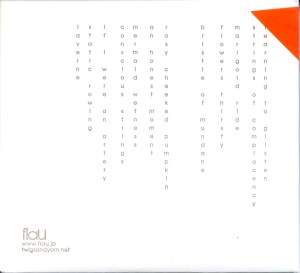
Bristle Of Mundane is an unexpected contrast, which opens with a heavily-distorted music box, eventually settling into gentle waves. The experience of late night radio listening is present in Flowers Thirsty, tuning in and out from pop-music radio samples to a distant ebb and flow of music and whispers, the mind drifts late into the night, until being awakened by the radio-alarm (this is my favorite piece on the album, mysterious and great keyboard sounds). The gentle pulsing organ of Marigold Ride contains a soft repeated vocal, flowing into acoustic guitar of Strings Of Complacency (sounding a bit like some recent solo guitar work of Ant Phillips combined with light treatments from Eno’s Julie With from the album Before And After Science). Learning To Glisten is the postlude to the album, the purest of all the tracks, with little sonic movement, and is a soothing close.
The Language of Flowers is like rotating a radio tuning knob late at night, or peering into a window overlooking a secret garden, or ephemeral visions in a dream. It’s an assemblage of existence all around, from the broadest landscapes down to the tiniest whispers, and even memories of childhood games as in the gently spirited and delightfully melodic third track, If I Were An Artery. The music, field recordings, samples and instrumentation are assembled with an idiosyncratic aplomb that yield a very cohesive and soothing quality, like a less energetic, more contemplative version of works by The Books combined with gossamers of the dearly departed Sparklehorse. So, it makes complete sense that Nick Zammuto (ex-Book) mastered this album; a symbiotic chemistry.
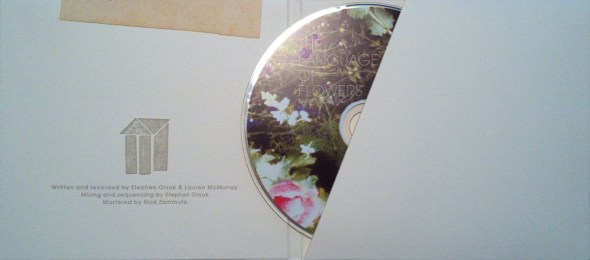
Videos
Static Rowing
Mermaid Wetness
Marigold Ride
Kane Ikin – Sublunar

12k1071 CD – Time: 53:33
Artist’s Website: http://www.kaneikin.com Record Label Website: http://www.12k.com
Tracks: 1) Europa; 2) Slow Waves; 3) In The Arc; 4) Ebbing; 5) Rhea; 6) Titan; 7) Sleep Spindle; 8) An Infinite Moment; 9) The Violent Silence; 10) Black Sands; 11) Lo; 12) Prometheus’ Tail; 13) Oberon; 14) Compression Waves; 15) In The Shadow Of The Vanishing Night; 16) Hyperion;
I don’t know exactly on what plane Kane Ikin exists, but I can tell you that I’d like to get there. There is a sense of deep mystery, the fleeting ethereal and a curious otherness in his musical travels. I’ll gladly get on his spaceship, anytime.
Kane Ikin is one half of Solo Andata (along with Paul Fiocco, both being from Australia), and he has also collaborated with other artists including David Wenngren (aka Library Tapes) on their February 2012 album Strangers (KESH017). I first encountered Solo Andata’s work in the 2009 self-titled 12k release.
Earlier this year, Ikin gave us a taster EP entitled Contrail (clear vinyl 7”, and a separate download of four tracks), and the title track alone was worth the price of the entire EP, not to mention the marvelous job that 12k did with the packaging. Also, of note, Sublunar is packaged in 12k’s new (no plastic, and I assume, recycled cardboard) sleeve design.
Ikin’s music is decidedly lo-fi in production (tape loops, altered field recordings, sampling, warped instrumental recordings), but the quality and care that he takes in combining tangible instrumentation with highly manipulated sounds gives the end result an indescribable yet comforting quality. His solo work also tends (so far) to focus on shorter format recordings (the longest track Oberon on Sublunar is 4:51). Also, while I consider his work to be highly original in form and sound; there are occasional (intentional?) references to works of others. At the risk of driving my readers bonkers, I’ll again reference Kraftwerk and their track Kling Klang from the 1972 album Kraftwerk 2, which came to mind when I first heard the gongs and bells in track (6) Titan.

Sublunar is a series of short journeys, just enough time to experience the sense of place Ikin is depicting, but not so long that one feels the urge to get to the next destination too quickly. I’m going to resist the temptation to describe each track (there’s a full single track sound file for Europa and an Experimedia sampler of excerpts from the entire album), because I think that might diminish a sense of self-exploration for the listener. Some tracks meander with little guidance from a recognizable beat, whereas others have highly treated percussion with extended decay. I especially like how Kane treats the sound of strings in the mix; he uses the entirety of an acoustic guitar’s resonance. Sublunar is a potent musical experience, and I hope Kane Ikin continues his voyages of experimentation, because I’m completely hooked.
 ****
****
Sublunar‘s Teaser Video
Experimedia’s Sampler of the Album
Marcus Fischer + The OO-Ray – Tessellations

Optic Echo – oe010 LP limited to 250 LP copies
Marcus Fischer: http://www.mapmap.ch/index.php/recordings/tessellations/
Ted Laderas (The OO-Ray): http://15people.net/ & http://eatguide.tumblr.com/The-OO-Ray & http://waveguideaudio.com/
Record Label Website: http://www.opticecho.com/OE/News.html
LP Time: about 43 minutes. Digital Time*: about 49 minutes with Track 8*.
Credits: Mastered by Taylor Deupree at 12k. Cut by Rashad at Dubplates & Mastering. Cover Design: Marcus Fischer
Tracks: 1) belong; 2) cold spring; 3) bokeh; 4) fourier; 5) unfold; 6) ghost lights; 7) tessellate (tessellation); 8) music for caverns*
Improvisation is about taking risks, experimenting and responding to the immediate results. It is the outcome of the instantaneous transition from thought to motion, and then to sound. It sometimes takes practice, and it requires chemistry between the artists; the kind of vibe evident between Marcus Fischer and Ted Laderas (aka The-OO-Ray). Music can yield a far timelier reward compared to other slower [art] forms, like in architecture or science, where the results of research and collaboration can often take years to behold.
This has been a busy year for Marcus Fischer with at least five published recordings, touring, and new projects in the works. I’ve certainly enjoyed all of them, solo and collaborative. It is thanks to Fischer’s work that I have become familiar with Ted Laderas (The OO-Ray: self-professed on his Twitter bio “Half Scientist, Half Cellist, All Shoegazer”) and his electro-acoustic chamber-drones.
Tessellations is the result of a series of long-form improvisations between the Fischer and Laderas. It was commissioned by the Optic Echo label in 2011. The instrumentation is largely stringed (acoustic and electric guitars, cello, lap harp) with percussion, loops, processing and minimal synthesizers. The album has a dynamic richness with a combination of soothing observation and introspection. I also appreciate that this is an album of largely non-electronic instrumentation, not necessarily a rejection of sequenced analog or digital electronics, but a return to earlier tangible instrumental roots, and a sense of the ageless. It kind of takes me back to some of Kraftwerk’s oft-forgotten earlier works from Kraftwerk 1 and 2, and Ralf and Florian; like the guitar portions of Tongebirge (Mountain of Sound) from 1973.
The album opens with belong, rising like the sun on a dewy morn; crisp and hopeful with a gentleness that avoids any sense of melancholy. Stark and mysterious is the ambience of cold spring with OO-Ray’s cello seeking the edges, and hints of Harold Budd’s Boy About 10 from the album By The Dawn’s Early Light. The largo metronomic of the bass line maintains the focus of bokeh as cello, keyboards and other instrumentation blurs the musical depth of field.
The shifting of sounds, interlocking, matching and then contrasting (much like a moiré pattern) is the sense presented in fourier, which is perhaps the most densely packed and expansive of the tracks. By contrast, unfold is perhaps the most peaceful track on the album, a private [waterside] contemplation with gently flowing cello, meandering lap harp layered and a soft droning veil. Then, the mystical and shimmering reverb of ghost lights emerges, and is reminiscent of the recent Unrecognizable Now album (Fischer’s collaboration with Matt Jones, KESH018) Two Rooms, with shifting chords and bowed strings (and has some of the sound I noted earlier in Tongebirge).
tessellate is the longest (about 10 minutes) and most subtle of the tracks on the album (titled tessellation on the download). It has the most nuanced transitions, with Fischer and Laderas trading themes and responses, and weaving phrases back into the fabric of the piece. It brings the LP to a placid close. *music for caverns is the bonus track with the digital download, and is a warm postlude to the day that started with belong, and in some respects is similar to the closing tracks of Eno, Lanois & Eno’s album, Apollo: Atmospheres and Soundtracks—one of my favorite of Eno’s collaborative works.
Marcus Fischer + The OO-Ray have deftly assembled in their collaborative improvisational work both a cohesive sonic realism, and impressionistic vision with a timeless authenticity.
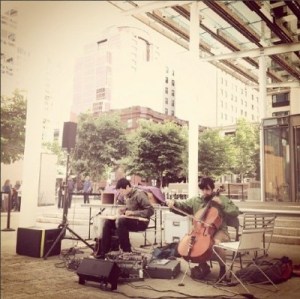
Marcus Fischer + The OO-Ray – Photo by Seth Chrisman
Review: Almost Charlie – Tomorrow’s Yesterday

Words On Music – WM33: CD Time: 42:17
Record Label Website: http://words-on-music.com/
More on this release:
http://words-on-music.com/WM33.html & http://words-on-music.com/almostcharlie.html
Artist Website: http://www.almostcharlie.com/
Available at: http://darla.com/
1) Hope Less; 2) Open Book; 3) Sandsong; 4) Man Without A Home; 5) A Nice Place To Die; 6) Tomorrow’s Yesterday; 7) Still Crazy ‘Bout You After All These Years; 8) Cummings; 9) Youth Is Wasted On The Young; 10) Undertow; 11) When Venus Surrenders
I have a broad rotation of albums, all sorts of genres (I listen to more than ambient and electro-acoustic works, despite what some might think from my reviews). Since its release in 2009, Almost Charlie’s album The Plural Of Yes (TPOY) hasn’t been too far away from my CD player. It’s a great album of songs written in the tradition of Elton John and Bernie Taupin or Burt Bacharach and Hal David, musician and lyricist working separately. In the case of Berlin’s Dirk Homuth (singer and multi-instrumentalist) and New York City’s Charlie Mason (lyricist), they still haven’t met in-person and aren’t separated by “two rooms”, but two continents and an ocean. It’s evident, however, from their work together that they communicate well, no matter what the distance.
Tomorrow’s Yesterday is the latest release, and I’m really happy that Almost Charlie has returned after three years with more beautifully crafted and skillfully recorded songs. There are familiar faces in the band: Sven Mühlbradt on bass and Pelle Hinrichsen on drums and percussion with the addition of Bert Wenndorff on piano as well as other supporting musicians.

For those unfamiliar with Almost Charlie, I find similarities to the songwriting and sound of bands like The Beautiful South, The Autumn Defense and some of the less raucous songs of the Fountains of Wayne. I’d even compare some songs to works by 10cc (either written by Eric Stewart/Graham Gouldman or Kevin Godley/Lol Creme). Similarities to the Beatles are also unmistakable (especially the voice of John Lennon with a bit of George Harrison on the track Still Crazy ‘Bout You After All These Years). There are marvelous wordplays, edges of wit and subtle metaphors in the lyrics resulting in this latest collection of musical gems.
The feeling of Tomorrow’s Yesterday is a bit more pensive and acoustic than TPOY, but there are upbeat, playful and spirited tracks too. Instrumentally, the foundation of most of the songs is guitar, bass, drums and piano, but many of the tracks are delightfully punctuated with brass, woodwinds, sitar and dobro guitar. Some of the finest moments are simply acoustic guitar and Homuth’s vocal harmonies, as on Sandsong, which is a bit melancholy and reflective. In this album there are songs of relationships, a sense of realism, but not resignation; acceptance and contentment, but also a feeling of hope as in Cummings. I also appreciate that the recording is crisp and sounds like a live performance in the studio with minimal processing. There was only one point (at the end of the last track) where the recording was sounding saturated on my equipment, but I stress this is a minimal issue.
Hope Less (a song of setting expectations) begins with acoustic guitar and harmonies and then advances into a march of sorts. This and Open Book are great examples of the smart wordplay in the lyrics, double-meanings, literary references and a deft efficiency of expression. Man Without A Home and Youth Is Wasted On The Young are ironically upbeat ruminations with shades of The Byrds (electric guitars), syncopated rhythms and are gently arranged with brass and strings respectively. A Nice Place To Die has a lively rhythm and bluegrass roots-music vibe with dobro and violin solos. Tomorrow’s Yesterday is a stark and melancholy observation on the passage of time, and perhaps more than any other track Homuth is channeling John Lennon’s voice (literally and figuratively).
Undertow (a favorite of mine) has power in its symbolism and realism; the words and music combined are indeed greater than the sum of their parts. The passage “The more I try to fight it; Its grip on me is tightened…Overwhelmed by the undertow” is about as close to perfect as it gets. The closing track When Venus Surrenders builds from a quiet beginning, and is the longest and most ambitious song on the album, similar to the spirit of The Monster and Frankenstein from TPOY with a nod, I think, to The Beatles’ Let It Be.
As The Plural of Yes was in 2009, Tomorrow’s Yesterday is one of my favorite song-albums of 2012. Perhaps next time lyrics could be included in the package, since they are such an integral part of the songs. The Homuth and Mason formula works, the chemistry is still there, and I hope they continue to write songs together and we hear much more from Almost Charlie in years to come.

Anthony Phillips & Andrew Skeet – Seventh Heaven

CD1 & CD2 #VPD555CD: Total Times: 46:43 and 51:08 Released 2012
Artist Website: http://www.anthonyphillips.co.uk/
Artist Website: http://www.andrewskeet.com/
Record Label: http://www.voiceprint.co.uk/
Tracks CD1: 1) Credo In Cantus (vocal by Lucy Crowe); 2) A Richer Earth; 3) Under The Infinite Sky; 4) Grand Central; 5) Kissing Gate; 6) Pasquinade; 7) Rain on Sage Harbour; 8) Ice Maiden; 9) River of Life; 10) Desert Passage; 11) Seven Ancient Wonders (vocal by Belinda Sykes); 12) Desert Passage (reprise); 13) Circle of Light; 14) Forgotten Angels; 15) Courtesan; 16) Ghosts of New York; 17) Shipwreck of St Paul; 18) Cortege
Tracks CD2: 1) Credo In Cantus (instrumental); 2) Sojourn; 3) Speak of Remarkable Things; 4) Nocturne; 5) Long Road Home; 6) The Golden Leaves of Fall; 7) Credo; 8) Under The Infinite Sky (guitar ensemble version); 9) The Stuff of Dreams; 10) Old Sarum Suite (five parts); 11) For Eloise; 12) Winter Song; 13) Ghosts of New York (piano version); 14) Daniel’s Theme; 15) Study In Scarlet; 16) The Lives of Others; [sic] 18) Forever Always
When many think of the music of Anthony Phillips, often they first remember his association with the early days of the band Genesis, even though it has been more than forty years since he left that band. After formal music training in the early 1970s, Ant did continue to collaborate with Mike Rutherford on The Geese and the Ghost and Smallcreep’s Day, in addition to Ant’s other solo works such as Wise After The Event and Sides in the mid to late 1970s. Ant has released about thirty albums to the general public, in addition to the many compilations of his extensive catalog.

Anthony Phillips
The younger Andrew Skeet has worked as an arranger and orchestrator for George Michael, Suede, Unkle, Sinead O’Connor and Hybrid. Since 2004 Skeet has worked with Neil Hannon of The Divine Comedy on three albums as musical director, arranger, and playing piano as well as touring throughout Europe. Andrew Skeet also established the music production company Roxbury Music with Luke Gordon (former Howie B collaborator) and together their music has been featured in film, television and commercials: The Apprentice, Dispatches, and Banged Up Abroad. Skeet has also orchestrated and conducted scores for The Awakening and Upstairs Downstairs. The album The Greatest Video Game Music was produced in 2011 by Andrew Skeet along with the London Philharmonic Orchestra and has been one of the most successful classical releases in many years.

Andrew Skeet
Ant and Andrew crossed paths when Universal Publishing Production Music commissioned Ant to write a collection of cinema-related music for UPPM’s Atmosphere label. Much of Ant’s music career for the last twenty or so years has been writing what is often referred to as “library music” or stock music composed for use in films, television or commercials in addition to other commisioned and self-produced works. Periodically Ant has collected these tracks, edited and in some cases re-recorded them for his Private Parts and Pieces, Missing Links or other album releases that are available to the general public (primarily through the Voiceprint and Blueprint labels).
It is always of particular interest to me to dig through Ant’s music to find the roots of some of his library work. I do miss the days of his more rock-oriented albums and singing, but recognize that getting that kind of work published these days is not easy or commercially viable. Ant goes through periods where his work is more keyboard oriented, but in 2005 he released a gorgeous double CD entitled Field Day filled with varying acoustic guitar work written and recorded from 2001 to 2005 (the exception being a re-recording of his 1975 piece Nocturne from PP&PP2 Back to the Pavilion…one of my favorite albums of his earlier solo works).
Field Day forms the basis for portions of Seventh Heaven where some of the solo guitar works have been orchestrated in addition to pieces that Ant and Andrew co-wrote later. Ant is credited with having written ten of the thirty-five compositions. The orchestrated pieces from Field Day that I can identify include: Credo, Nocturne, River of Life, Sojourn, Rain on Sag Harbour and the exquisite Kissing Gate. Each of these pieces is lightly orchestrated and perfectly complements the original to heighten the sentiments of the composition.
For fans of Ant’s prog-rock work this album might be a stretch, but if listeners enjoyed the album Tarka (the orchestral collaboration with Harry Williamson released in the late 1980s) then I think this Phillips and Skeet collaboration will be well received. The orchestration and recording is lush yet is not overdone. Many of the compositions are quite visual and evoke certain moods or a sense of place. The orchestrations vary from solo instrument (guitar, piano) to full orchestra, chamber or ensemble.
There are some really gorgeous tracks, from the opening of CD1 Credo In Cantus (based on Ant’s Credo from Field Day) and the transition into A Richer Earth and the dramatic Under The Infinite Sky. Grand Central evokes a sense of motion as in a view taken from the station in New York on a busy morning. Desert Passage by contrast is a stark and dramatic piece based around (I think) a mandocello with Middle Eastern themes along with woodwind soloist (and collaborator from PP&PP6 New England) Martin Robertson.
CD2 opens with an instrumental reprise of Credo In Cantus and ties the two discs together. A spirited orchestral version of Sojourn follows and then the mysterious piano of Speak of Remarkable Things links to the poignant and beautiful guitar Nocturne from long ago—it has an ageless quality to it. Long Road Home has the image of a beginning (and it is quite cinematic in its breadth) with first full orchestra followed by solo woodwinds and closing with piano. The Golden Leaves of Fall continues a similar piano theme and to me the two pieces seem strongly connected. Mid-disc is Old Sarum Suite in five short movements and it has a brilliant range of instrumentation and themes, and shows the versatility of Phillips and Skeet’s collaboration. It has an historic feel to it similar to Henry: Portrait From Tudor Times from “Geese”. CD2 closes with an introspective piece Forever Always, (a common thread, reflection, in Ant’s own work since “Geese” Collections/Sleepfall: The Geese Fly West).
There are extensive liner notes with the CDs as well as photographs of the recording sessions with the orchestras and biographies on the soloists and principal players (John Parricelli, Belinda Sykes, Martin Robertson, Lucy Crowe, Paul Clarvis and Chris Worsey). The works were recorded in three phases (from 2008 through late 2011), with the City of Prague Philharmonic Orchestra and Choir in Prague, then with string section at Angel Studios and then some tracks were re-recorded at Abbey Road along with recordings at Ant’s studio. The only quirk that I noticed is that CD2 actually has seventeen tracks, although it skips from 16 to 18 in the liner notes (typo!).
Seventh Heaven is both a collaborative work with Anthony Phillips as well as a splendid introduction to the work of Andrew Skeet. Whether a fan of Anthony Phillips’s prog-rock, instrumental or library compositions, I think this is a great addition to his oeuvre. Seventh Heaven is an expansive, sophisticated, and elegant work.
Review: Michael Franks – Time Together

CD – Shanachie 5189 – Sleeping Gypsy Music – June 2011
http://www.shanachie.com/ & http://michaelfranks.com/
1) Now That the Summer’s Here, 2) One Day in St. Tropez, 3) Summer in New York, 4) Mice, 5) Charlie Chan in Egypt, 6) I’d Rather Be Happy Than Right, 7) Time Together, 8) Samba Blue, 9) My Heart Said Wow, 10) If I Could Make September Stay, 11) Feathers From an Angel’s Wing
****
“Why must the present…Turn to past…So fast? The disappearing now…” from the song “Time Together”
****
This is long overdue, but better late than never…
While not always the case, some of the best songwriters, filmmakers and artists (in my opinion) have a solid foundation in literature and writing—having the ability to clearly express thoughts and emotions, regardless of the medium. I think it is also true that one’s own work is improved by knowing limitations and collaborating with others. Michael Franks’ work is a prime example of this, being a writer of finely crafted songs that tell stories, many of which include a variety of arrangement techniques brilliantly suited to a given song.
In his teen years in California he discovered poetry, picked up a guitar, and went on to study English at UCLA while learning independently about and listening to music: Brubeck, Getz, Gilberto, Jobim and Davis, among many others. For a time he wrote songs as a freelancer, and I learned only recently that his works appeared in films including Zandy’s Bride (starring Liv Ullmann and Gene Hackman). Others recorded his earlier songs and in 1973 he released an eponymous work (on Brut Records…my original copy long ago worn out) that was later reissued as “Previously Unavailable”.
I first became familiar with Franks’ work after he had relocated from California to New York when a friend recommended that I purchase “Burchfield Nines” (released in 1978). From there I went back to his first three albums “Michael Franks”, “The Art of Tea” (known best for “Popsicle Toes”) and “Sleeping Gypsy”. In total, Franks has released seventeen separate studio albums and there have been a variety of reissues and compilations including a 1980 live album “Michael Franks with Crossfire Live”. Most of his work has been recorded with Warner/Reprise (1975 through 1995), one release on Windham Hill in 1999 “Barefoot On The Beach”, 2003’s “Watching The Snow” on Rhino (then Koch Records) and “Rendezvous in Rio” on Koch Records in 2006.
Throughout his career, aside from Franks’ songwriting and singing (with his almost whispering mellow vocals), also of interest to me has been the variety of musicians, producers and arrangers he has collaborated with—a group of incredibly talented musicians and vocalists, too many to list here such as, Joe Sample, Larry Carlton, Wilton Felder, Astrud Gilberto, Peggy Lee, the Yellowjackets, the Brecker brothers, and producer/arrangers such as, Russell Ferrante, Jimmy Haslip, Matt Pierson, Jeff Lorber, Tommy LiPuma, John Simon, Rob Mounsey, Walter Becker, Chuck Loeb, Charles Blenzig, Mark Egan, and (my favorites) Gil Goldstein and Ben Sidran.
And mysteriously deposited throughout his albums have been songs from a (perhaps forever…waiting patiently) forthcoming Broadway musical “Noa Noa” based on the life of artist Paul Gauguin who spent time in the 1890s in Tahiti and wrote a journal of the same name. Many contemporary artists of the same period appear in the songs, like Vincent Van Gogh. Franks’ work ranges from acoustic to electric Jazz contemporary vocals, some funk and fusion (like with Jeff Lorber) to work that skims the edges of pop vocals (“Your Secret’s Safe With Me” from the album “Skin Dive”). Much of his most successful work has skillful wordplay, innuendo and humor (like “When Sly Calls” from 1983’s “Passionfruit”), but his most haunting and beautiful are my favorites like his duet with Peggy Lee (one of her last recorded works) “You Were Meant For Me”, exquisitely arranged by Ben Sidran.
With some minor exceptions, the album “Time Together” instantly became a favorite of mine this past summer. “Now That Summer’s Here” and “Summer In New York” setting an upbeat mood for a delightfully mellow summer, as Franks can do so well. Will we ever know if “One Day in St. Tropez” is fact or fiction?—a story of hitchhiking in France in 1963, narrator picked-up by Brigitte Bardot in a Jaguar XKE; the poetry and timing in this is light-hearted, romantic and the fantasy of it all, like a dream. “Mice” is a delightfully humorous statement on how perhaps the “lower” species can teach humanity about better behavior. For the first time (as far as I know), Franks dipped his toe into politics with “Charlie Chan in Egypt” reporting on the tragic state of affairs America found itself in as a result of recent military incursions. The album continues with other memories and romances of summers past as in “Samba Blue” and subtle advice on keeping things positive in “I’d Rather Be Happy Than Right”. Then the melancholy of summer, drawing to a close, as expressed in “If I Could Make September Stay”. My favorite of all 11 songs is the tender and loving tribute to the Franks family’s departed (rescue) dachshund Flora in the title track “Time Together” (Franks being a devoted animal lover and supporter of various animal rescue organizations). In this, Gil Goldstein’s arrangement is just stunning and a perfect complement to the lyrics and sentiments being expressed.
Here it is: Time Together:
Michaels Franks’ voice and music certainly are not for every listener, but I think that this is one of his best albums since 1993’s “Dragonfly Summer” or 1995’s “Abandoned Garden”. An album for any season, and especially for a gloomy and chilly winter morning as it is, as I write this…

 wajobu