
Review: North Atlantic Drift – Monuments

Sound In Silence #sis015 Limited Edition of 200 CDr in hand numbered sleeve w/ insert
Band: http://northatlanticdrift.com/ & http://northatlanticdrift.bandcamp.com/ & https://soundcloud.com/northatlanticdrift
Label: https://www.facebook.com/soundinsilencerecords?fref=ts & http://soundinsilencerecords.bandcamp.com/
Tracks: 1) Passing Time, 2) Monuments, 3) Concrete Oceans, 4) Sandlab, 5) I Have Never Seen The Light, 6) Scholars Of Time Travel (part 2), 7) Sun Dial, 8) So Long As They Fear Us (on the CDr only)
The overlapping musical origins of Mike Abercrombie and Brad Deschamps have led to a sound that shifts between music genres: Mike’s roots being in electronic music and Brad’s in post-rock. They share common interests in the works of Eno, Satie, Stars of the Lid and others, and their music is soothing yet with a clarity of awareness of the out there beyond what is often the prosaic miasma passing these days as ambient instrumental music. It’s kind of like lightly sleeping with one eye open; taking in a view and related sounds while acknowledging what might lurk in the underneath or the above. At first, the presence of a musical fabric sets a scene and then a transformation to what might be a song in search of a lyric or even a deep transitional groove—it fits well.
At times the change in sound can be more than just a nudge (an unforeseen entrance of percussion or a back beat as in the middle of I Have Never Seen The Light—a wake-up of sorts, as if to ask: “Are you paying attention?—Don’t drift off just yet!”). It appears like a coalesced awareness from within a dream or as if sleeping in the warm sun when a cool breeze unexpectedly but pleasantly arises (a well known Canadian experience, I suspect).
There are threads between pieces on the album (and also to North Atlantic Drift’s first EP) like with the common sonic roots in Passing Time and Monuments (the undercurrent that binds) with the themes further developed with sustained and reverberant electric guitars. I’m somewhat familiar with their previous album Canvas as well as their two EPs Amateur Astronomy and their first work Scholars of Time Travel, the root of the sixth track SOTT (part 2) on Monuments. Part 2 is the awakened day to the original EP’s quiescent night with first an undertow of processed piano, and then the Sun rises as the undisguised piano is revealed.
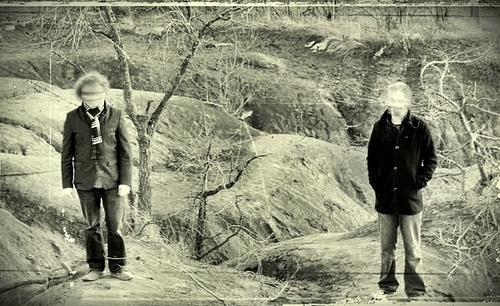
I find that North Atlantic Drift’s music has a stronger connection to recent work by Robin Guthrie (Cocteau Twins) as opposed to Eno, Satie or SotL, yet the overall sound is more rooted in tangible instrumentation; the alignment with Guthrie’s work being that moods are set with an opening wash of sound (while a spring is being gently wound) and then a release to a fuller rhythmic soundscape. The most visually reflective track on the album is Sun Dial, the slow sweep of shadows passing as the light and activity waxes and wanes with the field-recorded ephemeral sounds of a day. The extra track So Long As They Fear Us on the CDr (not the digital download) is a return to the quietude, like sitting on a porch (in the dark) on a comfortable rainy night with a safely distant thunderstorm.
And don’t forget to go back to their album Canvas—copies are still available.
Recent Discography
Amateur Astronomy: http://northatlanticdrift.bandcamp.com/album/amateur-astronomy
Canvas (first full album): http://northatlanticdrift.bandcamp.com/album/canvas
Scholars of Time Travel: http://northatlanticdrift.bandcamp.com/album/scholars-of-time-travel
*****
This is a solicited review.
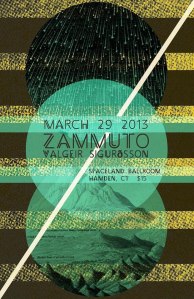
Concert: Zammuto with Valgeir Sigurðsson and Nadia Sirota at the Spaceland Ballroom, Hamden, CT March 29, 2013

Zammuto
http://zammutosound.com/home.cfm http://www.thebooksmusic.com/ http://temporaryresidence.com/
Nick Zammuto – Guitar and Electronics, Nick Oddy – Guitar and Keyboard
Mikey Zammuto – Bass, Sean Dixon – Drums
Valgeir Sigurðsson
http://valgeir.net/ & http://www.bedroomcommunity.net/artists/valgeir_sigurdsson/
Nadia Sirota
http://www.nadiasirota.com/ & http://nadiasirota.bandcamp.com/
Promoter and Venue
http://www.manicproductions.org/ & http://spacelandballroom.com/


I missed the last Zammuto tour in 2012, so I was determined to go see them this time around—and it was a great coincidence that they ended up stopping so close by in Hamden, Connecticut at the new Spaceland Ballroom with promotion by Manic Productions from nearby New Haven. Valgeir Sigurðsson (producer and founder of Iceland’s Bedroom Community record label and Greenhouse Studios) and violist Nadia Sirota started the evening’s show with an introspective and sensitive performance of work from Nadia’s latest album Baroque and Valgeir’s album Architecture of Loss (in addition to some earlier VS work). I think that the performance would’ve been enhanced all the more with a better piano and subwoofer system, but their performance ranged from the contemplative (my son says “chill”) to visceral. I’m less familiar with Sigurðsson’s and Sirota’s individual works, but this performance was a great introduction. My only other hope for this new venue is that the lighting improves to allow one to see the musicians better during their performances (and perhaps some more tables and chairs).


I’ve followed Nick Zammuto’s work since his days with The Books, and have appreciated his mining for music and inspiration in unexpected places, whether from old or new family home movies to skillfully edited (often bizarre) instructional videos. The humor and wordplay also makes his work all the more attractive. The difference (to my ears) between The Books and Nick’s latest incarnation in the band Zammuto is that the music is even more rhythmically infectious and at times, downright joyful. I also appreciate that Zammuto has created in their first eponymous album music created by artists staying true to themselves and their work—always pushing the boundaries and seeking inspiration from the most unlikely of places…making the serious silly and the mundane musical…and to be doing it in beautiful Vermont is all the more enticing. Their work is also an example of what I see as a proper usage of auto-tune technology—not to correct a singer who can’t sing, but to enhance the statement of the art and sound.


Last night’s set was tight, energetic and enhanced by a multimedia show of short films synchronized to the music. Much of the songs were taken from the latest Zammuto album on the Temporary Residence (independent) label. We were also treated to some songs from The Books era, a Paul Simon cover and some unreleased tracks. This was the second performance by new guitar/keyboardist Nick Oddy and he has immediately absorbed the often intense and delightfully quirky parts that Gene Back (up until recently) contributed to the band—bravo!

Zammuto Set List: 1) Groan Man, Don’t Cry, 2) The Shape Of Things To Come, 3) Idiom Wind, 4) Too Late To Topologize, 5) Zebra Butt, 6) FU-C3PO, 7) Harlequin, 8) Fifty Ways To Leave Your Lover by Paul Simon, 9) Yay, 10) The Stick, 11) Tahitian Noni Juice – That Right Ain’t Shit – from The Books The Lemon of Pink, 12) Classy Penguin, 13) The Greatest Autoharp Solo of All Time – A remarkable bit of video/sound editing!, 14) Smells Like Content – from The Books – Lost And Safe and the non-encore 15) The Fig and the Finger

If you haven’t seen Zammuto live yet, go see them—it was a very memorable concert. The link to their current tour is noted above, and I’m told that Nick is working on material for a new album.
****
Please note that all photos are by wajobu.com unless the image is suffixed with “IAB”, in which case it’s by Isaac Burns. We retain all copyrights to the images, but if you choose to borrow or share an image, please at least credit one or both of us. Thank you.
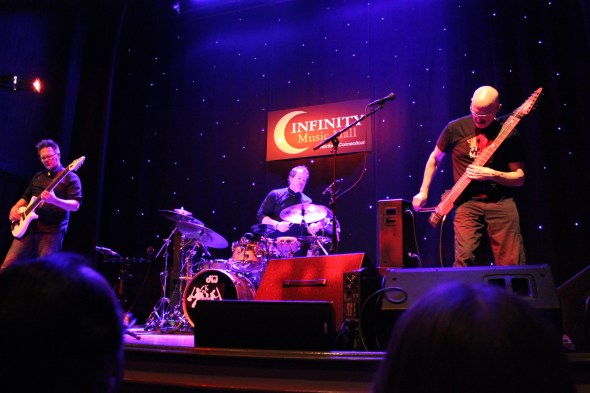
Concert: Stick Men – Infinity Hall and Bistro – March 27, 2013
Stick Men: https://www.facebook.com/stickmenofficial
Tony Levin: http://www.papabear.com/
Pat Mastelotto: http://patmastelotto.com/
Markus Reuter: http://www.markusreuter.com/
Stick Men dot Net will take you to: http://iapetus-store.com/album/deep

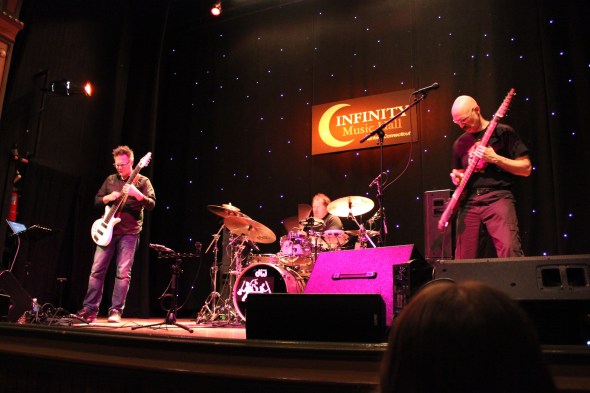
I’m not often prone to numerical connections, but it occurred to me last night on the long quiet drive home from the woods of northwestern Connecticut that here I was in year 13 of this century and it has been (almost to the day) 31 years since I had last seen Tony Levin on stage in Syracuse, New York with the 1982 incarnation of King Crimson (Fripp, Bruford, Belew and Levin) in support of their incredible return album Discipline. Although Tony Levin might disagree, to my eyes his energy and spirit hasn’t aged a day in those 31 years. Last night’s concert in Norfolk, Connecticut was an incredible display of musicianship, sound and an intimate connection between the musicians and the audience (especially in a small hall like Infinity with great acoustics, sound system and a beautifully restored historic building).
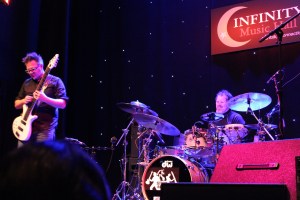
In one way or another this trio of Tony Levin, Pat Mastelotto and Markus Reuter all have a connection to King Crimson (and Robert Fripp) in various incarnations and ongoing KC ProjeKcts, but Stick Men while embracing KC’s influential work, have continued to develop their own voices in progressive rock including vital relationships with other bands, artists in addition each members respective solo work.
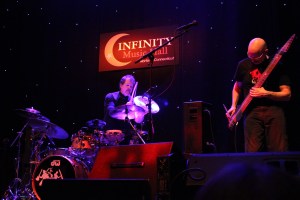
The Bows Come Out!
The set list last night was largely from their new album DEEP (all but two tracks) in addition to some real treats. Tony Levin made a special point to express appreciation to the audience for being so receptive to the new material, rather than insisting on hearing only the old (including many King Crimson favorites)–in effect progressive rock music…PROGRESSES. One thing that I wanted to see after listening intensively to DEEP is just how much of the melodies each instrument would take, and I was surprised to see that many sections that I thought were coming from Reuter’s Touch Guitar turned out to be melody exchanges between Reuter and Levin (the Chapman Stick being an extremely versatile instrument—not just for the bass line). Here are the tracks (along with some brief notes…not on every track, and nothing that I can write will do justice to the intensity and clarity of the sound last night–something to be experienced first-hand!):

1) Nude Ascending Staircase: As is the beginning of the album DEEP, this performance set the tone for the entire night, a seriously raucous (and fun) sound with deep visceral notes from Levin’s stick.
2) On/Off
3) Crack In The Sky

4) Breathless (from Robert Fripp’s 1979 solo album Exposure): This Fripp album is incredible, and it’s still as vital as when I first placed the LP on my turntable in 1979. This was an absolutely shredding performance of this piece. Markus Reuter’s faithful interpretation of Fripp’s work (searing guitar) was just chilling. The trio seriously cooked on this.
5) Cusp
6) Infinity Improv (free improvisation): Tony Levin noted that they record each of their performances (and I had noticed some stage and ambient microphones on stage before the show) in the hopes that some of the improvisations and recordings could lead to future releases.
7) Horatio: Thunderous!

8) Whale Watch: Tony Levin noted that despite his many years of having played the Chapman Stick, he was still learning more about what the instrument could do (and its often unpredictable results). He noted that some nights Whale Watch could turn out differently, depending on whether the instrument needed to be wrestled to the ground (I’m paraphrasing). It’s the story of being on a whale watch, from the start of an ocean journey to spotting, pursuit and arrival to see a whale up-close.
9) Industry (from the 1984 King Crimson album Three of a Perfect Pair): The growl and electronic percussion.
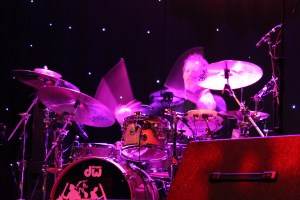
Pat is A-blur
10) Hide The Trees: The growing tension, exchange and release in this piece is deliciously enticing.
11) Open, Pt. 3 (from Stick Men’s 2012 improvisation-based album Open)
12) Larks’ Tongues in Aspic, Part 2 (from the 1973 King Crimson album Larks’ Tongue in Aspic): It was exciting to hear this piece live again, as it was in the concert in 1982 (and previous KC concerts that I had attended)—also, on the heals of the recent 40th anniversary release of the re-mastered album.
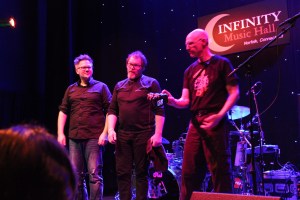
Tony Levin playfully taking a stage photo for the ongoing Crimson Chronicles
13) Encore: A Stick Men arrangement of Stravinsky’s Firebird: Let’s hope that this ends up on a future live album—a forceful and experimental rendition of Stravinsky’s 1910 work.

After the Encore
It was a real treat to observe the persona of each musician on-stage: Tony Levin’s classic broad stance and kinetically expressive movements (resulting in many blurry photos!), Markus Reuter’s calm scanning of the crowd as he switched from touch-fingering his guitar to using it in a more conventional guitar-stance, and Pat Mastelotto’s highly expressive performance on percussion and electronic devices—and just when I thought that he had no more tricks in the bag, out he’d pull even more paraphernalia, including a bow!
At one point during the night Tony Levin noted that King Crimson was still alive, not broken-up, yet (somewhat comically) Levin noted that Robert Fripp had recently attended a Stick Men show (and paid for his ticket, despite a guest pass) and in response to a question about when a King Crimson tour might occur again, Fripp responded “Pain.” I think Mr. Fripp has moved on, and is enjoying his semi-retirement and over-seeing of the re-mastering and re-releasing of their massive archive of concerts and other recordings.

If you’re within striking distance of a Stick Men show—please go see them! They’re appearing at the Iridium Jazz Club this Friday (March 29) and Saturday (March 30) nights in New York City. I’m sure they’ll be on the road again soon. Bravo and thank you to the Stick Men! Oh, and buy their new album DEEP–see also this great review of the album by my friend over at Horse Bits: http://horsebits-jrc.blogspot.com/2012/11/deep-by-stick-men.html
****
Note: Click on any photo to see an enlarged version. Please contact me if there are any factual errors in what I have written above. I have many other high resolution photos of the show, and if you chose to copy or repost any of the photos, please credit me “wajobu.com”. You can’t see them, but the photos ARE watermarked.

Cheerful Pat!
Review: William Tyler – Impossible Truth

Merge Records CD MRG465 – Time: About 54 minutes
http://www.mergerecords.com/artists/tyler%20william and http://www.sebastianspeaks.com/
Tracks: 1) Country Illusion, 2) The Geography Of Nowhere, 3) Cadillac Desert, 4) We Can’t Go Home Again, 5) A Portrait Of Sarah, 6) Hotel Catatonia, 7) The Last Residents Of Westfall, 8) The World Set Free
I posit that William Tyler is a thinker, and is perhaps more comfortable expressing himself with music than with words (although his spoken thoughts on the Merge teaser video have a distinct and interesting clarity). Tyler has worked in a number of bands prior to his solo albums including the Silver Jews, the ongoing experimental collective Hands Off Cuba and Lambchop (in addition to his record label, Sebastian Speaks). Tyler’s work brings a wide range of colors and moods to Lambchop’s sound, where he has been a principal guitarist for many years. Impossible Truth seems to me to be a more cohesive and mature work than his last solo album on the Tompkins Square label, Behold The Spirit. Nonetheless, I urge readers to seek out this very strong album.

The titles of the tracks on this album are like the names of short stories, and from the moment the cord is pulled on the first note of a track we are thrust right into the middle of the scene, without shyness or any lack of confidence. It almost feels like Tyler propels a well-worn yet vibrant flywheel at the start of each piece, and from that moment he is shaping and sculpting the sound and mood until the story is told.
Country Of Illusion starts mysteriously and sounding rather exotic (as if from a foreign land, sitar-like). There are sweeping passages envisioning a changing scene and then there are pauses (almost like a moment of contemplation) before moving through a sonic curtain and then the next passage of the tale. Some tracks show a greater tenderness (with solo acoustic guitar) than others like We Can’t Go Home Again or A Portrait Of Sarah (although musically the latter is quite adventurous, as are many relationships). The Geography Of Nowhere has a resonant otherness of being on the edge of consciousness and sensing the tangible without being able to actually reach it. There are others like Cadillac Desert and Hotel Catatonia that present vistas as broad and intense as a Montana sky (and I never knew what a big sky looked like until I saw one). The fretwork, picking and phrasing are tracing the landscapes and wrapping the listener in the gentle or gusty breezes of sound.
The Last Residents Of Westfall sounds like a scene from a dying or deserted town as the music pans to each of the buildings in the village, all with their own story to tell, some jaunty and others subdued. The closing track of the album, The World Set Free is the most reflective, but it enlivens joyfully as the track progresses—the acoustic bass being a steady and forthright heartbeat, and finally William Tyler releases to a growling close. I am trying to resist comparisons, but the opening section is similar to the instrumental sections of Nick Drake’s Bryter Layter.
Tyler disguises his guitars as many different instruments, and his musicianship and intense fingerings give a sense that more than one set of hands is at work, yet there is never a sense of Tyler playing a guitar hero—my guess is that he sees himself as quite the opposite. Just like Lambchop, William Tyler blurs the distinction of musical genres; first this is an instrumental acoustic and electric guitar album, there are hints of twang, country and roots in it, but also some blues, folk and rock and roll. Merge Records has a wide ranging catalog of musicians and has been around for more than two decades. I just finished reading and thoroughly enjoyed their biography of the first twenty years of Merge, Our Noise. Even though William Tyler has been part of the Merge family for many years in his work with Lambchop, I’m thrilled that he has released this latest brilliant solo album with Merge. This is an album that I highly recommend.
Merge Records just posted this reinterpretation (homage?) to the film Two Lane Blacktop with A Portrait of Sarah as the soundtrack.
Marsen Jules – The Endless Change Of Colour

12k Label – 12k1074 – CD Time: 47:00
Website: http://www.12k.com/index.php/site/releases/the_endless_change_of_colour/
When I was younger and had a completely untrained eye for seeing, as in art of any form, I didn’t realize how many colors went into what I saw, whether in a landscape or an object (same in the musical parallels). It was later, seeing artwork at a museum (paintings up-close), dramatically enlarged photos, and a friend’s work in college (artist, Allen Hirsch) that I started to understand the density and complexity of color–as well as in sound and music, the overtones, harmonics and phasing in addition to the pure waves.
The Endless Change Of Colour affects me in two ways, creating a state of peaceful timelessness (wondering where that nearly-an-hour went) as well as producing a state of nearly motionless cascades of blending sounds that transmute into a sense of relaxing in a stream bed of flowing water on a warm summer’s day–when all else falls away and what remains is that moment. All of this from a generative piece of music built from a single phrase on an old jazz record split into three audio stems. The sounds (and side-effects) that without closer examination and contemplation, we wouldn’t normally sense except for the benefit of the time that this work seems to warp and retrograde during its existence.
There are brief moments when almost familiar sounds enter, only to be absorbed back into the metamorphosing blend. I hear some parallels to the effects created by Nicholas Szczepanik’s brilliant album Please Stop Loving Me, although the feeling in Endless borders on that of a gentle voice on the edge of a dream–a peaceful sense of belonging.
Birds of a Feather – Part 3 – Broken Chip and Simon Whetham
Available at: http://www.flamingpines.com/

The Wonga Pigeon by Broken Chip
Sometimes there are things that I don’t want to end, but then they do, far too soon.* This is how I feel about Broken Chip’s dreamy and elusive The Wonga Pigeon contribution to the latest pair of CD3s released in the Flaming Pines label Birds Of A Feather Series. Broken Chip is one of the musical personas of Martyn Palmer, who is from the Blue Mountains of Australia. Broken Chip has contributed to other Flaming Pines releases, and Palmer’s other nom de plume is Option-Command, for more electronic oriented works. The Wonga Pigeon musically recounts a first mysterious encounter with an unknown bird. Time passed and then the bird reappeared to finally be identified. Despite the presence of (what appear to be) bird calls within the recording, it’s a piano (in my opinion) that takes on the guise of this particular avian creature. All sounds, initially, are distant in the recording, indescribable, and ethereal. Gradually, the identity coalesces, only to disappear back into the ether after a brief second chance encounter.
* – And so, I hit repeat!

The Phoenix by Simon Whetham
The Phoenix is the second CD3 of this latest pair of Birds…, and starts off like a shower of humidity encountered when disembarking from a plane in a distant land—the sudden shock of relocation. The wall of omnipresent sound of the outdoors is from Phoenix Island in Cambodia and at first it is intense (mind your amplifier’s volume control!). Eventually, the body and mind adjusts to this extraordinary new environment, and the sounds around eventually calm, and the vision of what was once like a blinding light comes into focus. Water, wooded areas, bells and gongs can be heard from sound recordings made by Whetham in June, 2012. In a way, the piece starts off with the fervor of the war endured by Cambodia and VietNam not so long ago, and the gradual calming could symbolize the peace that has slowly returned to these environs; The Phoenix rising, symbolically. As with the previous releases in this series, I love the cover illustrations.

Landing Lights by Kate Carr
Also, of note (and I have only heard these samples thus far), I am intrigued by Kate Carr’s latest new album Landing Lights. I quite like the contrast of the growl of her guitar juxtaposed against the soft, floating keyboards as in the track My Brother Came To Stay…I wonder who the brother could be, in the mix? I can’t imagine. 😉 Some samples from Landing Lights are below, so I am definitely interested in hearing more.
My Brother Came To Stay
Thunderstorm
Invention, Influence and Innovation – Bryan Ferry and Steven Wilson
When is a musical work true invention? When is it referential? When is it derivative? Can a work influenced by previous work still be considered original or innovative? I suppose these are questions that could spark a (sometimes heated) discussion like: “What audio speakers sound the best? Is it the east coast or west coast sound?” Often, the proper answer is: “What ever speakers sound best to one’s own ears.”
Generally, I think that most art, design and music works are built on the foundations that came before them and there really is little actual invention, more on the side of innovation or variants of an original. Dig deeply enough and one even can see that Frank Lloyd Wright’s and other modern architectural works (many seemingly original) have been influenced by the works of others or by some reference to design in nature or distant history (like many of Wright’s LA houses of the 1920s being highly influenced by ancient Mayan temples).

I’m certainly not an expert on the extensive back catalogs of Roxy Music, Bryan Ferry, Porcupine Tree and Steven Wilson (including Wilson’s various side projects), but I have enough of their music in my collection to know that I generally like their respective work (some albums, in my opinion, being better than others—that’s the subjective part, like the what speakers sound better question). Bryan Ferry and Steven Wilson are from two different musical generations and have been influenced by different works and people, but there is some overlap.
Ferry has noted that much of his seminal listening, writing and songs were influenced by early and mid-20th century instrumental jazz (including Charlie Parker and Ornette Coleman): “I loved the way the great soloists would pick up a tune and shake it up – go somewhere completely different – and then return gracefully back to the melody, as if nothing had happened.” With these influences and those of The Beatles, The Rolling Stones, The Who, Pink Floyd, King Crimson and others, Ferry’s band Roxy Music (with a number of different musicians, including Brian Eno and later Eddie Jobson) would go on to create quite innovative and often influential art-glam-pop-progressive rock works in the 1970s and early 80s in addition to Ferry’s distinctive solo works.
Steven Wilson works within a cauldron of many genres (progressive rock, metal, ambient and jazz fusion), and it’s clear from his remixing/remastering work (such as the King Crimson back-catalog, most recently Larks’ Tongues in Aspic) that he has both a deep affection for those influences as well as a respect for the history behind them. Wilson’s latest album The Raven That Refused To Sing is steeped in a mind-bending brew of musical influences, yet stays safely on the side of creatively paying homage while avoiding pastiche or cliché. Throughout the album he tips his hat with musical phrases and instrumental sounds that have kept me looking back into my music collection for their roots (a most welcome research project).
Steven Wilson – Luminol
Steven Wilson – The Raven That Refused To Sing
Whether it’s a soaring guitar bend of Pink Floyd, a vocal introduction reminiscent of McDonald and Giles’ Tomorrow’s People, a Mellotron phrase from Genesis’ Watcher of the Skies, an electric guitar intro akin to the band Focus, acoustic guitar phrases of Ant Phillips’ The Geese and the Ghost or flute phrases of Jethro Tull, Wilson and his current band blend these deftly into the rather sullen tale of The Raven… I can also hear more recent parallels in the menacing track The Holy Drinker, to the works of (Miles Davis scholar) Bob Belden’s jazz-fusion Animation project (the recent post-9/11 track Provocatism from the album Transparent Heart). The musical and sonic success of this album is also thanks to the great live studio engineering care of Alan Parsons and gifted musicians Nick Beggs, Guthrie Govan, Adam Holzman, Marco Minnemann, Theo Travis and Jakko Jakszyk who have interpreted Wilson’s vision into a cohesive and often stunning recording. The dynamics and emotions are broad, from the aggressive percussion/bass opening to the somber balladic close of the title track. There are minimal overdubs on the album, except for using an original King Crimson MKII Mellotron (recorded at DGM).
The Bryan Ferry Orchestra – Do The Strand
In contrast, Bryan Ferry is reinterpreting his own past work with vocals removed, leaving the melodies and harmonies of the original songs, and they’re are filtered through a time machine that brings the listener back to Ferry’s earliest musical influences—the sound, orchestration and recording techniques of the roaring and often buoyant 1920s. Some fans of Roxy Music or Ferry’s original work don’t seem to appreciate the effort (especially the sound treatment, and the monaural recording), but being that I enjoy original pre-and jazz-age acoustic recordings, I think it’s a favorable re-examination of Ferry’s work while avoiding the temptation reissue yet another compilation for the sake of churning a back-catalog. In fact, the recording sounds almost identical to the hi-fidelity of that period, a Victor Orthophonic reproducer and Victrola.
The Bryan Ferry Orchestra – The Jazz Age – The Reinterpreted Tracks
Bryan Ferry – The Jazz Age – The Original Tracks
I like both of these albums very much, for different reasons, and while they are clearly influenced by works before them, they stand very well on their own. Are either as groundbreaking as King Crimson’s In The Court Of The Crimson King? No (again, my subjective opinion). On the positive side, after a somewhat cool start, Steven Wilson’s album has been growing on me (my favorite track, by far, is Drive Home), whereas I liked Ferry’s album almost instantly—I was hooked by Do The Strand. Are either of these albums what I would consider the best of 2013? It’s a bit early for that–let’s wait and see.
Steven Wilson – Drive Home
Review: Cory Allen – The Great Order and Pearls
http://quietdesign.us/ and http://www.cory-allen.com/
Musicians: Cory Allen: Piano, Mike Vernusky: Bowed Classical Guitar, Nick Hennies: Bowed and Struck Vibraphone, Brent Fariss: Double Bass, Henna Chou: Cello
The Great Order: A: Movement I: 17:53; B: Movement II: 15:38
I enjoy listening to the Quiet Design podcasts with Cory Allen and Mike Vernusky (available free through iTunes). They discuss observations on art, the world around, how music affects them and their sources of inspiration as well as the musicians and artists they interview, to date: Lawrence English, Simon Scott, Duane Pitre, Taylor Deupree, Sun Hammer, Wide Sky and others. The topics are wide-ranging, often very entertaining and thought provoking. I also appreciate the reflective consideration that Cory Allen brings to the development of his work, and to his experimentation with instrumentation (extant and invented).

From the first sedate piano note of The Great Order, to the almost shy conversation between guitar, vibraphone, cello, and double bass, there is a respectful and somber discipline, a regimen to this largo in two movements. It is evident that there is a prescribed yet restrained foundation to this all-acoustic instrumental work. This is an album about relationships and exploration: the musicians to their instruments, the instruments with each other and how the sounds sustain and resonate both in the recording and ultimately in the listening space (or headphones) and the ears of the listener. No one instrument dominates, and it’s as much about the spaces between the music as it is about the sound. The first movement is somewhat hushed, and the second movement has a slightly increased density of statement-response and layering among the instruments. This is an album that also cleanses the mind and encourages contemplation. The recording has a clarity and live presence that feels as if one is sitting in the room with the musicians, making it all the more intimate.
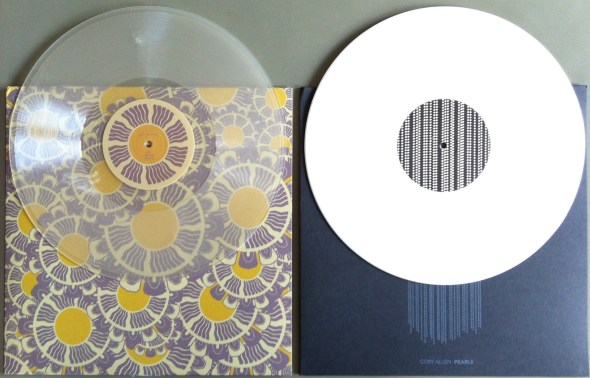
The album art and design are by Cory Allen, who has done an impeccable job with the entire package (the covers printed by Stumptown Printers in Portland, Oregon). The limited edition LP is pressed in translucent clear vinyl. Also, in conjunction with the release of The Great Order, Cory Allen has issued an LP version of his serene, beautiful and introspective album Pearls (from late 2010). The first 100 copies of Pearls are pressed in white vinyl and 400 copies in black vinyl. For a limited time, both LPs can be purchased at a special price from the Quiet Design website. I’m also looking forward to Cory Allen’s ongoing experiments with his recently created multi-stringed instrument (a sound sample is below).

Pearls: A: Strange Birds, Lost Energizer 17:09; B: Isozaki Clouds, Blue Eyes 18:52
What’s Spinning – Deep Winter Edition
I need some warmth on these cold winter days…
Ron Sexsmith – Forever Endeavour

I love Ron’s work (another thoughtful Canadian songwriter—imagine that?!). He writes such great songs. My problem with his work, at times, is that sometimes his songs are just too sad, but Ron has a gift for making a sad song curiously uplifting, like Michael and His Dad from his last album Long Player Late Bloomer. I started listening to Ron’s work in 1997 with his third album Other Songs (produced by Mitchell Froom and Tchad Blake—coincidentally Froom produced Suzanne Vega’s Nine Objects of Desire the previous year, another favorite album of mine). Forever Endeavour is sparsely arranged, but strings, horn, percussion, pedal steel or electric bass are right there when they’re needed. Other than that, the songs are Ron’s voice, and his acoustic guitar. He has a gift for wordplay and expressing emotions with a deft efficiency that flow so naturally with his melodies. Some songs on Forever Endeavour are ironically upbeat, like Nowhere Is and Snake Road—in a sense, keeping the faith.
The CD has two bonus tracks (songs written with Don Black and recorded by Don Kerr), Life After A Broken Heart and Autumn Light, and they are just plain gorgeous additions to this album.
Nowhere To Go
Lorna – Heart of Wire

http://www.words-on-music.com/index.html and http://lornatheband.com/bio/
This is Lorna’s third album on the Words On Music label. The collective from Nottingham, UK creates dreamy contemplative songs with shy vocals and delicate harmonies. I’ve read of some comparisons to Yo La Tenga, but Lorna’s instrumentation tends to be more complex, and chamber-like at times. I think that this is their most direct album of the three for Words On Music—their sound is more confident, but they haven’t lost the softness and (at times) melancholy of their lyrics. I think the strongest songs on this collection are As She Goes By, Old Shanklin Sunset and Mina and Marco (with a delightful melodic phrase sample borrowed from composer Edward Elgar).
Daphne Lee Martin – Moxie

http://daphneleemartin.com/ and http://telegraphrecordingcompany.com/
A woman after my own heart—part record store owner, part musician; for many years, Daphne has been part of the New London, Connecticut-based band Raise The Rent. Moxie is the first of two releases (the forthcoming being Frost), and is a sultry collection of songs of the (only mildly) lurid backstreets of her imagination (with the added bonus of occasional Mellotron accompaniment!). There are shades of the cheekiness of the Squirrel Nut Zippers and the “heat” of mid-1970s Maria Muldaur in this well-produced album. I have an idea for what to expect from Frost—counterpoint!
Heligoland – Sainte Anne

http://heligoland.org/ and http://heligoland.bandcamp.com/
Sainte Anne is the latest EP from the Paris-based Australian quartet known as Heligoland. Their work in the last few releases has come under the wispy spell of producer and musician Robin Guthrie (who also plays occasional keyboards and bass), so it was only natural that I try their work. My favorite tracks on this EP are Sleepless and 22 Miles—peaceful ethereal guitar and bass balanced with gently pulsing drums and Karen Vogt’s warm and full vocals (channeling, at times, the sound of Christine McVie with a bit of vibrato). Other band members are Dave Olliffe (guitars and keyboards), Steve Wheeler (bass) and new member Antti Mäkinen (drums and percussion). Their previous albums and EPs include: Bethmale (recorded in 2010 and released in 2012), All Your Ships Are White (2010) and A Street Between Us (2006).
Corazón from their album All Your Ships Are White
And even more wonderfully creative releases from the Flau label in Japan… I can’t possibly buy them all, so one must be…somewhat…selective.
http://flau.bandcamp.com/ and http://www.flau.jp/top.html
The Boats – Our Small Ideas (2012 Edition)

http://oursmallideas.tumblr.com/
I have thoroughly enjoyed the various releases by The Boats (Craig Tattersall and Andrew Hargreaves with Danny Norbury, Chris Stewart and others). Our Small Ideas is a re-release and enhancement of an original 2008 CD-R. Contained in this work are the often quirky and sometimes fragile and nascent threads of pieces to be released later (and some are quite recognizable). This album is not unlike the approach of CD #1 of Tape Loop Orchestra’s The Words On My Lips Is Your Name/The Burnley Brass Band Plays On In My Heart.
Sound samples are here (since The Boats seem to eschew Soundcloud): http://www.flau.jp/releases/r09.html
El Fog – Reverberate Slowly

This is a solo project of Berlin-based vibraphonist Masayoshi Fujita, a light blend of acoustic instrumentation with a tranquil late night aura of electronics and subtlest of glitchy rhythms.
Masayoshi Fujita – Stories
Stories is an album of solo acoustic vibraphone works (with occasional violin and cello). Whether struck gently (as in Snow Storm) or bowed (as in Cloud), Fujita paints vivid, yet tender sound pictures. Some pieces are rhythmically playful, and could form the foundations for musical conversations (much like those between Bill Bruford and Michiel Borstlap on their album Every Step A Dance, Every Word A Song). This is an appropriate soundtrack for gently falling snow. The album is beautifully mastered by Nils Frahm.
Swan and Morning Dews
Graham Gouldman – Love and Work

http://www.grahamgouldman.info/
Graham Gouldman has been writing songs since the days of The Yardbirds (For Your Love), and many others like Wayne Fontana and the Mindbenders, before formally crossing paths with Eric Stewart, Lol Creme and Kevin Godley (Hotlegs) who later became 10cc with a long string of albums with sharp, witty and often sardonic songs. Love And Work is an album of twelve beautifully crafted and wide-ranging songs.
The album dedicated to the memory of Andrew Gold, and the song Daylight is about Andrew. They worked together as the duo Wax and earlier on some of 10cc’s later albums.
I’ve seen Graham and Ron Sexsmith appear together on BBC Songwriters Circle programs. Perhaps Graham and Ron will work together someday…
For Your Love
Happy Listening–Stay Warm!
Celer – Black Vinyl Series – Parts 4 and 5
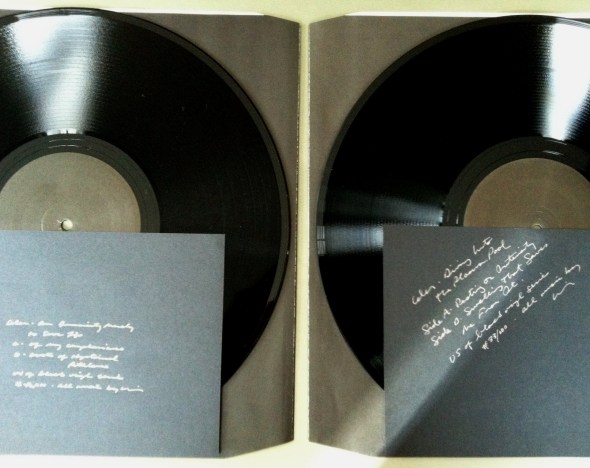
Diving Into The Plasma Pool – Part 5 Black Vinyl Series
Side A: Resting On Intensity 20:33 Side B: Swelling That Saves Me From It 20:10
An Immensity Merely To Save Life – Part 4 Black Vinyl Series
Side A: Of My Complaisance 18:27 Side B: Gusts of Hysterical Petulance 19:05
Self-released Limited Edition of 100 copies on black vinyl with matte black paper sleeve with handwritten credits
Celer’s Websites: http://thesingularwe.org/celer/ & http://celer.bandcamp.com/music

Insert for Diving Into The Plasma Pool
I almost missed them entirely, but something appeared on my screen in late January, and within 5 minutes I was transported to a perfect sunny day, in the middle of a gently rolling sea, on a reach in a sailboat, and to a sonic warmth that dissolved the doldrums of my winter reality. It was Diving Into The Plasma Pool, the latest (and I think last) of the five part Black Vinyl Series by Celer (Will Long). For whatever reason, I missed parts 1 through 3, but as soon as I heard a sample from Resting On Intensity (Side A), I looked to see if there were other LPs still offered—and indeed, Part 4 was (and is) still available. Part 4, An Immensity Merely To Save Life starts a bit darker with Of My Complaisance (Side A) and then softens with Gusts of Hysterical Petulance (Side B).
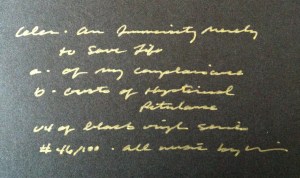
Insert for An Immensity Merely To Save Life
The subtle enmeshed loops of Diving Into The Plasma Pool flow like Debussy’s Nuages and yearn (although more gently) like Nicholas Szczepanik’s Please Stop Loving Me—they are waves that crest, hold onto a pleasurable edge and then dissolve. The chords and sounds are right in my sweet-spot. But enough from me; just listen—better yet, buy one or both of them. They’re gorgeous, full and resonant—simply magical.
Part 5 (available here): http://celer.bandcamp.com/album/diving-into-the-plasma-pool
Part 4 (available here): http://celer.bandcamp.com/album/an-immensity-merely-to-save-life
Catching The Groove with Martin Schulte
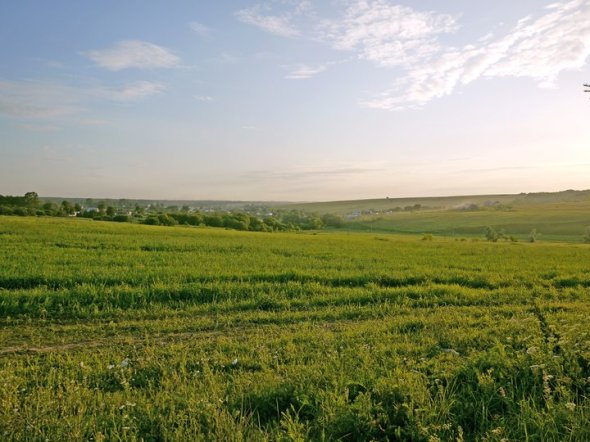
More information on Martin Schulte: https://soundcloud.com/martinschulte
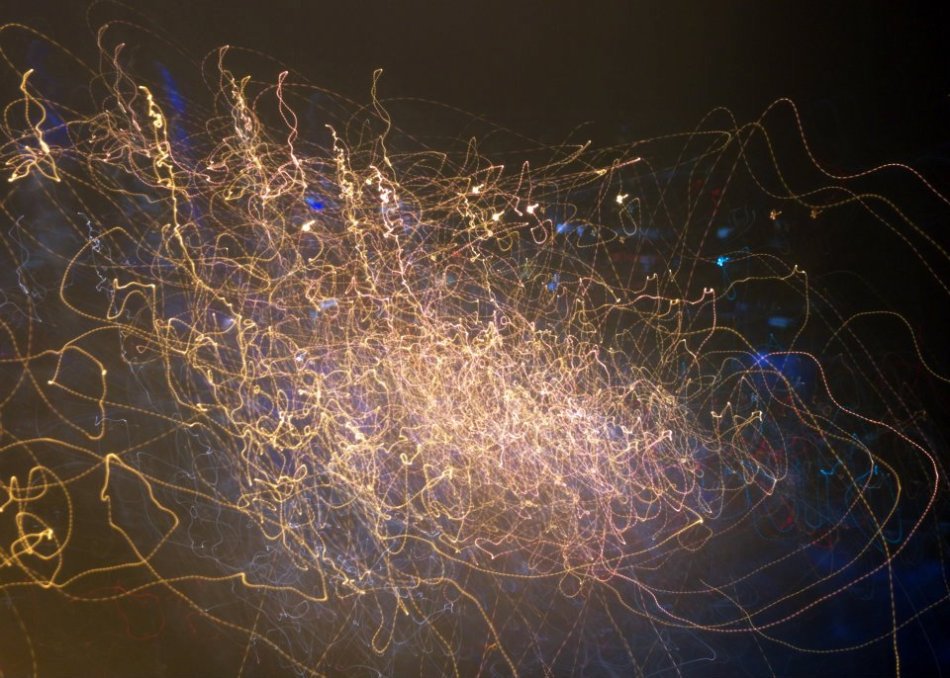
His music is solidly rooted in analog modular sequenced synthesizer works (latter day Kraftwerk, for example). His latest album Slow Beauty is inspired by photography and memories, including images he has taken of the beautiful landscapes near his home (in sharp contrast to the stark winter vista depicted on some of his previous albums). Some tracks have deep visceral* grooves, others are more delicate, sampled and atmospheric, but there’s always infectious motion involved. I have favorites on all four of his albums that I’ve referenced—excellent soundtracks for all sorts of places and experiences.
Since I’m rather old-fashioned, and prefer physical releases, to date I have four of Martin Schulte’s CDs, three released on Lantern/Nature Bliss and one on RareNoiseRecords. All are available at Darla Records (US Distributor). There are many other releases available, including some live recordings (see links at his Soundcloud page). Samples of each of his albums are shown below.
* – Although not essential, a subwoofer is a beneficial accessory for the full effect.
Slow Beauty (2012):
Treasure (2011):
Silent Stars (2010):
Odysseia (2009):
****
Please Note: With the exception of the cover of the album Silent Stars, all images are by Marat Shibaev and are used with the permission of Marat Shibaev who retains all rights, credit and copyrights to these images.
Chris Dooks / Machinefabriek – The Eskdalemuir Harmonium

LP Title: The Eskdalemuir Harmonium

EP Title: Non-Linear Responses of Self-Excited Harmoniums
Komino K0M1N0-004 (Vinyl LP & Digital w/ EP) Time: LP About 36 Minutes EP About 13 Minutes
Record Label: http://kominorecords.com/
Chris Dooks: http://www.dooks.org/ More on the LP trilogy: http://www.idioholism.com/
Machinefabriek: http://www.machinefabriek.nu/
Tracks LP (LP & Digital): 1) The Pike Knowes The Loupin’ Stanes; 2) Betamax and Dictaphones; 3) Ewe Knowe The Girdle Stanes; 4) Settlement
Tracks EP (Digital): 1) Steady States and Transient Oscillations; 2) Aerodynamic Excitation of the Harmonium Reed; 3) The Motion of Air-Driven Free Reeds
Authentic, synthetic, living, languishing, animate, inanimate, well, ailing, history and the now: these are the explorations of the latest collaboration of Chris Dooks and Rutger Zuydervelt (Machinefabriek). Like many, I have always been drawn to the old and mysterious, wanting to know more about the history of things, the times in which they existed (and in this case, what hands and feet brought these venerable machines to life). Harmoniums are vestiges of another time (mostly from the late 18th C through the middle 20th C), inanimate objects, strangely biomorphic in their inner workings that are revived with physical exertion, air in their bellows (the lungs) and resonant metal reeds producing the sounds (the vocal chords). Neglected harmoniums often mournfully creak and object to being revived after long slumbers. A friend of mine once used the term “lumbering harmonium” to describe his relic on an instrument—curiously descriptive in both reality and material (when the verb is used as a noun).
These soundtracks depict a retreat of solitude into the Scottish countryside, one of a series of three projected works and part of Chris Dooks’s PhD research in sound art and medical humanities, as well as response to a chronic illness; the search for comfort and rest through improvised sonic threads (passed between Dooks and Zuydervelt during their development) that were crafted from music, field and voice recordings. The resulting drone-like ambiance is a fascinating and relaxing journey with sociological, archaeological and radio documentary parallels. Thanks to the on-location recordings, there is a strong sense of place and memory imbued into this album.

The recordings, liner sleeve and notes, photographs and graphics are impeccably produced as is the ruby red vinyl LP. This is the second Komino Records LP that I have acquired (the first being Kyle Bobby Dunn’s In Miserum Stercus, which I reviewed in late 2012). The digital EP presents additional serene field and harmonium recordings—a beautiful production overall.
The next album in the series will be Three Hundred Square Miles of Upwards.
Pre-Master Recordings from Three Hundred Square Miles of Upwards
The third album will be CIG{R}LES.
Pre-Master Samples from CIG{R}LES
Review: Celer – Without Retrospect, the Morning

Glacial Movements Records – GM015 (CD) Time: 52:13
Artist Websites: http://thesingularwe.org/celer/ & http://celer.bandcamp.com/music
Record Label: http://www.glacialmovements.com/ & https://soundcloud.com/glacial_movements
Tracks: 1) Holdings of Electronic Lifts; 2) A Small Rush into Exile; 3) Dry and Disconsolate; 4) Variorum of Hierophany; 5) A Landscape Once Uniformly White; 6) Distance and Mortality; 7) With Some Effort, the Sunset;
Although not as indiscriminate as is denoted by the term, I am often a completist when it comes to collecting the works of selected authors and musicians. Yet, I would be hard-pressed, given his massive output of creative work, to even begin to collect all the music of Will Long in the guise of Celer. By now, I probably have a dozen or so of Celer’s recordings, but if I had to recommend one and only one recent work, it might just be this almost mystical and entrancing album. I’m also drawn to this release since it fulfills one of the most significant inspirations for why I listen to music—it takes me somewhere, and the images and sensations are vivid.
Album Samples
This is the third work in a trilogy based on water (to some, water symbolizes comfort and freedom). The two previous albums are Cursory Asperses (2008) and Escaping Lakes (2009)—the former alluding to the slow movements of small streams and the latter to the calmer depths. The music on this album being inspired in part by Will’s trip to southern Alberta in 2009 (documenting the wilderness in photographs for a local Park Service).
Without Retrospect, the Morning is different from the first two in the series in that it has distinct tracks (versus a continuous thread of sound) and it captures water (or the sense of it) in a different state—a chilled desolation, at times at the edge of an existence where the potential energy is stored and released ever so sparingly in a landscape yearning for Sun and warmth. It’s therefore appropriate that this album landed at the Glacial Movements record label, a self-proclaimed “glacial and isolationist ambient” label. I also appreciate that the recording has been mastered with a softness that retains the intricate clarity of the many layers of sound buried in the crystalline strata (to heck with the loudness wars!). There are also hidden sonic depths, and some passages might be felt before they are heard (as in Dry and Disconsolate).
A lateral effect of this CD is that it triggers (for me) some pleasant, albeit quirky, sonic memories from long ago. I’m a fan of the original 1960s Star Trek. There was some great incidental music and ambient sounds used in that series that, to my ears, are recalled in a track like Distance and Mortality (see if you hear the resonance of the wind from the pilot episode, The Menagerie or the sound of the transporter beam).
Distance and Mortality
So find a quiet room, bundle-up, get comfortable, and explore stunning breadth of this vast hyperborean landscape. Just remember to turn the volume back down on your amplifier before you change the sources on your preamp or pop-in another CD.
A List Too Small – My Favorites of 2012
Thank you to all the artists and record labels for such wonderful and diverse music.
This is one list of many, it’s my list, and it leaves off many other favorites that I have enjoyed over the year in addition to the thousands of other albums and single tracks that make up music throughout the World. What has helped me arrive at this list is what I have always loved about music: Does it move me? In addition, is it creative, well recorded and produced with a degree of care that makes me pay attention to it? There was a time when I was obsessed with highly produced and tightly engineered works, then I learned about artists such as East River Pipe and Sparklehorse, and many other genres of music were opened to me.
If you don’t see your favorite album on this list (or even your own album), it doesn’t mean a thing. If an album has been reviewed on my website this year, it’s meaningful to many others and me, but this is only a very, very small slice of the music world. Often people ask me about new music, and what I recommend. When I started this website in late January, 2012 it was first a means to write about music that I enjoyed, but also to get to know other artists and learn about new music that they create, so I could pass it on. Often, the best new music is that referred by a friend. Please feel free to send me your comments and recommendations.
Special note: There are still three or four late 2012 releases that are either enroute to me, have yet to be released or have just arrived. I need to spend proper time listening to and absorbing these albums. Rather than delaying this list further, and if after listening to those last 2012 releases I feel that they hit a sweet spot, I’ll review those albums in early 2013. I know of at least two 2012 releases that I’ll likely not receive until 2013.
I have three categories: Albums (12), Individual Tracks (6), and Special Releases (3) that don’t necessarily fit into a category.
Albums (Artist – Album Title – Record Label)

1) Twigs & Yarn – The Language of Flowers – Flau

2) Lambchop – Mr. M – Merge Records

3) Zammuto – Zammuto – Temporary Residence
4) Steve Hackett – Genesis Revisited II – Inside Out Music

5) Taylor Deupree – Faint – 12k

6) Billow Observatory – Billow Observatory – Felte
7) Gareth Dickson – Quite A Way Away – 12k

8) Pill-Oh – Vanishing Mirror – Kitchen. Label

9) Brambles – Charcoal – Serein

10) Almost Charlie – Tomorrow’s Yesterday – Words On Music
11) Cody ChesnuTT – Landing On A Hundred – One Little Indian
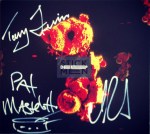
12) Stick Men – Deep – Stick Men Records
Individual Tracks (from other albums)
[vimeo http://vimeo.com/46499688]
1) Library Tapes – Sun peeking through (from the album Sun peeking through) – Self Released
2) Cock & Swan – Orange & Pink (from the album Stash) – Lost Tribe Sound
3) Alex Tiuniaev – Daylight (from the album Blurred) – Heat Death Records
4) Kyle Bobby Dunn – In Praise of Tears (from the album In Miserum Stercus) – Komino
5) Kane Ikin & David Wenngren – Chalk (from the album Strangers) – Keshhhhhh
6) Olan Mill – Bleu Polar (from the album Paths) – Fac-ture
Special Releases
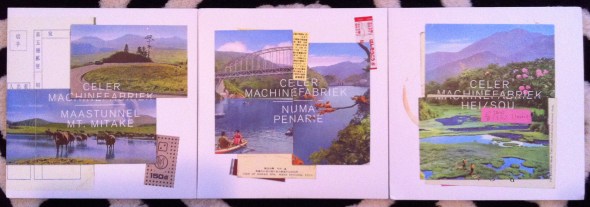
1) Celer & Machinefabriek: Maastunnel/Mt. Mitake, Numa/Penarie, Hei/Sou – Self Released

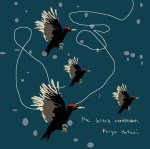


2) Birds Of A Feather: Michael Frommer – The Great Northern Loon, Porya Hatami – The Black Woodpecker, Darren McClure – The Black Kite, The Green Kingdom – The Great Blue Heron – Flaming Pines

3) Simon Scott, Corey Fuller, Marcus Fischer, Tomoyoshi Date and Taylor Deupree (Recorded live in Japan October, 8, 2012) – Between (…The Branches) – 12k
Record Labels Noted Above
Flau: http://www.flau.jp/
Merge Records: http://www.mergerecords.com/
Temporary Residence LTD: http://temporaryresidence.com/
Inside Out: http://www.insideoutmusic.com/
12k: http://12k.com/
Felte: http://www.feltesounds.com/
Kitchen. Label: http://www.kitchen-label.com/
Serein: http://www.serein.co.uk/
Words On Music: http://www.words-on-music.com/
One Little Indian: http://indian.co.uk/shop/landing-on-a-hundred-1.html
Stick Men Records: http://stick-men.net
Library Tapes: http://librarytapes.com/
Lost Tribe Sound: http://www.cockandswan.com/ Note: I have not listed the weblink to the record label as Google has noted that the website MAY be compromised.
Heat Death Records: http://www.heatdeathrecords.co.uk/
Komino: http://kominorecords.com/
Kesh (Simon Scott’s label): http://www.keshhhhhh.com/
Facture: http://www.fac-ture.co.uk/
Machinefabriek & Celer: http://machinefabriek.bandcamp.com/ & http://www.thesingularwe.org/fs/
Flaming Pines: http://flamingpines.com/
Review: Benjamin Dauer – The Pace of Which

Twice Removed Records – Time: About 39 Minutes – Limited Edition CDr (50 copies)
Record Label: http://twiceremovedrecords.blogspot.com/ & http://twicerememberedtwiceremoved.bandcamp.com/
Artist Websites: http://www.benjamindauer.is/ & https://soundcloud.com/benjamindauer
Tracks: 1) Anchors and Roots; 2) Either By Storm Or Low Frequency; 3) With Closed Mouth; 4) Melting Tines; 5) Waiting for the Rain; 6) From Ebb To Flow
Coming from Twice Removed Records on January 1, 2013 (a small label in Perth, Australia that releases short-run limited editions) is the latest (third) solo album from Benjamin Dauer. I have great admiration for the various interests that BD pursues. He has diverse accomplishments, from his design and digital media day-job at NPR (National Public Radio) in Washington, DC to raising awareness and environmental activism projects like Save The Pollinators.
I also appreciate BD’s musical pursuits as both a multi-instrumentalist solo artist and collaborator (with other musicians near and far), including his active participation with the Disquiet Junto (an ongoing music-making project where restrictions are used as a catalyst for inspiration). Recently, I’ve been following with great interest the sound-sketch development (posted on SoundCloud) for a forthcoming album by The Dwindlers (his ongoing collaboration with poet Michelle Seaman).
From what I have heard of Benjamin’s previous solo work, it tends to be less rhythmic, a bit darker and more saturated than his (often Jazz-rooted) work with The Dwindlers. There is an enmeshed yet subtle grittiness recalling earlier analog electronic and instrumental works (like the 1970 soundtrack to Frederic Rossif’s documentary L’Apocalypse des animaux by Evangelos Papathanassiou), while continuing to explore new aural horizons and narratives. BD has an interesting quote at his website, which I think reveals that his solo work is less about an arrival at a particular sound, but more about the journey:
“As a musician & composer, I explore the boundaries of modern music through experimentation and play.”
In The Pace of Which, BD seems to be investigating different methods of creating musical atmospheres by blurring distinctions between musical genres (such as ambient, drone or others). Each track takes a different approach, but there are some common elements in varied intensities. Some of the pieces focus more on background with minimal foreground, whereas others the foreground elements are more pronounced, as well as the in between.
The background is predominant in Anchors and Roots. The sound is broad, resonant on the edges, and heavily blended. There are subtle placements of keyboards into the foreground, along with gentle clicks. At a point where there seems to be a recognizable rhythm or melody, it disperses back into the haze.
Either By Storm Or Low Frequency takes time to develop; initially it has more hushed surroundings, with distance pulses and slow waves. Sounds are buried down deep, almost immersed in rolling surf, reminding me of the analog warmth of Tangerine Dream’s album Rubycon (one of my favorite TD albums). BD is quite good at disguising the instrumentation—sounds seeming to be more keyboard-based, with purer tones entering the sound-mantra and slowly dissolving as if being pulled back into a sonic undertow.
The foreground takes a more prominent role in With Closed Mouth. The contrast of far and near is sharper. The more dominant sounds could be the concurrent mechanics of the music being created, or blended field recordings. There is interplay between reverberant sustained guitar and muted keyboards. The result is a feeling of suspension, yet with some of the most tangible sounds on the album. Melting Tines returns to clustered tones. It’s a gentle wall of sound, punctuated by an almost reluctant guitar, and then veiled appearances of a piano. An environmental-dominant foreground opens Waiting for the Rain. It could be an early morning street scene of a city coming back to life on a gray morning with placid breezes. The album closes with From Ebb To Flow, which again blends the sounds of the outdoors with an expanding tonal haze and an undercurrent of low frequency pulses before fading.
Since I tend at times to prefer more discreet sounds in mixes, I found that there were brief moments (particularly in the last track) where I was distracted by a “tape-saturated” ambience, but I stress that this is a particular quirk of mine. I listen to music in the ambient and drone realms as vehicles to either clear my mind or to transport to a different (and often more pleasurable) zone. Listening to works on the drone side of the spectrum, however, tends to be a more sensory intensive experience, even if the desired end result is a more numbed state of being.
Benjamin Dauer’s explorations in The Pace of Which will take you to many places with transformative and lush fabrics of sound—his work blurs the edges of the recognizable with richness beyond expected musical genre norms. I’m looking forward to the further results of his experimentation and play.
***
More on Benjamin Dauer’s band The Dwindlers here: http://thedwindlers.com/
The Pelican and the Girl – From Allegories
Review: Kyle Bobby Dunn – In Miserum Stercus

Komino Records – K0M1N0-003 (12” LP & Digital) Time: About 36 Minutes
Artist Website: https://sites.google.com/site/kylebobbydunn/ & http://kbdunn.tumblr.com/
Record Label, Etc.: http://kominorecords.com & http://store.standardform.org/
Tracks: 1) Buncington Revisited; 2) Lake Wapta Rise; 3) In Praise Of Tears; 4) Meadowfuck; 5) The Milksop
A sesquidecade ago, I had a pretty regular gig as a lone passenger in a twin-engine Piper Seneca. I sometimes had work to do as I traveled, but often I was able to sit in the co-pilot seat and put on a closed-ear headset with a microphone and either listen to radio chatter, talk with the pilot or sit silently and look at the scenery. The travels took me over a mountainous wilderness. The pilot was a pretty quiet guy, with a very steady hand in rough weather (and we saw some—snow storms too). I was fortunate to even get a few short flying lessons during the trips, but mostly what I appreciated was the solitude of the vistas, leaving the towns and cities behind.
The views were broad landscapes of largely unpopulated forest areas. Whether I had a headset on or not, focusing on what I was beholding would often silence the noise of the plane’s engines. Every so often I’d get distracted and the sound of the synchronized engines would enter my consciousness. At times the engines would have a slight harmonic pulse, as their RPMs fluctuated in the crosswinds.
Those halcyon memories of soaring above the wilds return when listening to Kyle Bobby Dunn’s latest album (self-deprecatingly titled) In Miserum Stercus. About 5 minutes into Buncington Revisited is one of those points of distraction, and the harmonic of the Twin Sixes enters the picture, and then is gone and the passing landscape and feeling of seclusion returns. KBD has his own distinct sound; it’s often just off in the distance and rarely head-on, but despite this tangential nature there is clarity. And although he sometimes disguises the intent of his work in irony, I feel like there are often lucid memories evoked of places, especially in Lake Wapta Rise*, northwest of Banff, in British Columbia. The landscape there in many ways is like what I saw on my journeys, although even more dramatic. There is an expansive desolation in the restrained and blended sounds of this track, although the tones become purer and stronger, before fading.
Machismo apparently isn’t one of KBD’s distinct musical qualities, and so a layer of his thick outer skin is washed away to reveal some lachrymose tendencies with In Praise Of Tears. Measured, peaceful and resonant waves calm the scene, before leading into the not-so-gently titled Meadowfuck. Oh the irony of Mr. Dunn. Although somewhat hushed, this track seems to be making an announcement with its rolling and distant brass-like atmosphere. It builds, and then dives swiftly into The Milksop, which is staunch and paradoxically titled. Have a listen…
***
So, buckle-up, enjoy the views and happy flying. Oh, and KBD, don’t be so hard on yourself 😉
***
* Postscript: I have since been given a geography lesson, on the finer specifics of Calgaric Locus–operative term “Rise”, which just so happens to be one Province east in the plains of Alberta, but I’ll cling to the romantic notion of the mountains.
Review: Taylor Deupree – Faint

Record Label Website and Links: http://www.12k.com/ & http://www.taylordeupree.com/
http://www.12k.com/index.php/site/artists/taylor_deupree/
Taylor Deupree’s Discography: http://www.taylordeupree.com/music/
12k2025 (CD, Deluxe CD & Digital)
Tracks: CD1 57:17 1) Negative Snow; 2) Dreams of Stairs; 3) Thaw; 4) Shutter; 5) Sundown & CD2 38:38 1) Thaw (Reprise)
Whether it’s his music, photography, collaborations, and even the work from his record label 12k, Taylor Deupree is an Artist (emphasis on capital A). I’m a relative late-comer to his work, and I’m not even quite sure how that I came across his work or the 12k label, but I think that it had something to do with a 12k sampler CD, and then as I often do, I took a dive into his back catalog, focusing on physical releases (since those tend to be my preference—I’m old fashioned that way).
While Deupree has an extensive solo output, he also is an active collaborator with a wide range of artists (follow the discography link I noted above) in addition to many other musicians not listed for concerts and tours. He also actively experiments with new approaches and directions in his work—reinvention invigorates. Just as in his musical works, there is a peaceful desolation in his photography. I’m drawn to many of his photos, especially his landscapes (I’m fortunate to have a copy of his book of photos and CD Sea Last), but this is one of my favorites:
Moss, Kyoto (linked from Taylor Deupree’s website)
I also enjoy his Instagram photos posts, many of them are taken on outings in the woods, the fields and a reservoir nearby his home. It’s evident in his mastering of his own work and those of other musicians that the quality of the sound is important too (I often seek out music, not only for the artist, but the studio, sound engineer, producer and mastering engineer). Each release by 12k, whether CD, LP, standard or deluxe edition, receives special attention in the design, execution and promotion of the work. I admire this greatly—the time and attention is worth the money and the effort.
Faint is Taylor Deupree’s new album. It’s available in the latest 12k packaging as a standard release, as digital files or in a deluxe edition (pictured here) with a second CD of extended version of the track Thaw as well as twelve prints of photos taken by Deupree with a handmade camera. Faint overall is more restrained and pared-down to elemental sounds (though not at all stark) compared to his other recent work, yet it has a warmth that makes this album deeply comforting (hints of this are in the track titles). I’m not sure of the timeline in the recording of this album (beyond that it was recorded over a two year time span), but there are similarities in Negative Snow to the environment in Simon Scott’s expansive album Below Sea Level. It’s like taking a walk in a field that still has a foot in Winter, but the cold is subsiding in the sun and streams are returning to refill vernal pools.
Dream of Stairs is a gorgeous track with a lightly guiding keyboard thread (sounding like a Fender Rhodes piano) weaving through whispers of treatments, gentle guitars, remote looped voices, and ephemeral sounds of an almost intangible reality that might be captured on the edges of a dream.
Thaw (with a longer reprise on CD2 in the deluxe issue, akin to Brian Eno’s Thursday Afternoon) has a broader aura, like a fog lifting on an very early Spring morning where the air is warmer than the still-frozen ground. There is an ethereal suspension into which a distant organ-like sound appears and retracts back into the haze—like gentle waves on a flat sand beach. It has an ancient and mysterious sound like that in Creation du Monde, a very early post-Aphrodite’s Child soundtrack by Vangelis. Shutter has a hazy analog-reverberant foundation behind a placid and heavily treated electric guitar solo that is later joined by gentle reminders of Dream of… Sundown at first is a like a quiet seascape, watching distant ships passing and hearing far-off signals as a day draws to a close. Closer sounds enter to illuminate the scene, like fleeting afterglows that fill a sky once the sun disappears below the horizon—nature’s reverberation of what was, before entering darkness.
It’s a restful and warm journey.

Review: Naked Truth – Ouroboros
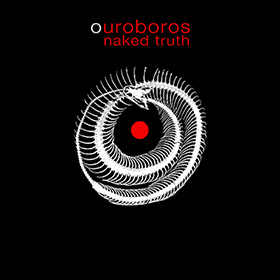
RealNoiseRecords RNR029 (CD & Digital) Time: 49:51
Record Label Websites: http://www.rarenoiserecords.com/
Sound Samples: http://www.rarenoiserecords.com/jukebox/naked-truth/ouroboros/
Tracks: 1) Dust; 2) Dancing With The Demons Of Reality; 3) Garden Ghosts; 4) Orange; 5) Right Of Nightly Passage; 6) Yang Ming Has Passed; 7) In A Dead End With Joe; 8) Neither I
Ouroboros, the eternal consuming and replenishing serpent can be seen in the singular (nothing outside of itself) or in a broader societal context. In this case, my interpretation is more of a collective urban consciousness. This is an album of motion, not of rest, an album of experiences, not of contemplation (at least until after the intense experience is over). It’s a fusion-brew of industrial, urban and cosmic sounds, and a potent follow-up to the 2011 album Shizaru (the lesser-known fourth primate of see, hear, speak, and DO no evil).
Graham Haynes has joined the Naked Truth quartet on electric cornet and trumpet (following Cuong Vu’s departure) along with original members, King Crimson alum drummer Pat Mastelotto, English keyboardist Roy Powell, and Italian Lorenzo Feliciati on electric bass and guitars.

Shizaru from 2011
First a warning: Prepare your audio system (and your ears) for a workout. Ouroboros will shake out the cobwebs. The opening track Dust is the warm-up, the testing of the systems. It’s a more keyboard dominant, brass punctuated bookend before entering the fuzzed sonic maelstrom. It has the atavistic fibers of many eras, and I’m old enough to have been around for the many incarnations of King Crimson, Weather Report and other Jazz-Fusion, Progressive Rock variants, and it’s all there–the solid musicianship and the sometimes angst-filled drive. There’s also a hint of Miroslav Vitous’s 1976 spacey funk inspired album, Magical Shepherd.
Track One: Dust
Next, place yourself in a traffic jam with an impetuous case of not-so-mild road rage (in the aggressive spirit of KC’s Neurotica, sans vocals), and that’s Dancing With The Demons Of Reality. The pauses are the waiting at traffic lights, restoring momentary sanity, but tension builds with pressurized chromatics, electronics and percussion before subsiding. Garden Ghosts is a respite; at first a progression of sonic fragments, a meandering prepared piano, percussion and fuzz-bass. The trumpet is the roaming spirit joined by a languid beat, murky electronics and guitar background; ultimately it ends as a brass-teasing percussive danse macabre.
At the start of Orange it’s disguised as an atmospheric piece, a quiet evening perhaps—serenade with cornet, but then diverts quickly with syncopated rhythms (bass, guitar and keyboards reminiscent of Kazumi Watanabe’s work), before returning to the more sedate themes. Right Of Nightly Passage is an instrumental recasting of the driving rhythmic “heat in the jungle” anagram. Clustered horns interlace with the cadence of the frenetic scene. The spirit of Miles Davis’s later more electronic work is channeled in Yang Ming Has Passed. It’s a menacing and deeply rhythmic piece (sounding like it could be dock-side in a shipping yard) with traded riffs between bass, percussion and trumpet meshed together by a high-cover of electronics.
The heavy backbeat continues in the darkly raucous In A Dead End With Joe. The trumpet soars and trills against the syncopated drums, electric guitar and keyboard phrases. Neither I is the other keyboard-textured closing bookend of the album. It displays some Far Eastern influences, and is more experimental and atmospheric with clustered brass, melodic percussion and roving piano before finding its beat. By contrast to the rest of the album, it closes with a gentle yet furtive purity.
Ouroboros is an adventurous and deliciously brash album that reveals glimpses of the eternal and sometimes daunting cycle of existence from different perspectives. Naked Truth is a sturdy, tight and vibrant quartet, and I’ll be very interested to see and hear where they take us next.
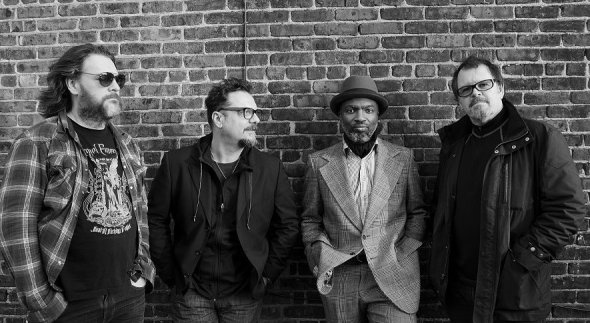
Naked Truth – courtesy of RareNoiseRecords
****
This is a solicited review.
Updated: What’s Spinning Today – Robin Guthrie, Olan Mill, Machinefabriek and A Winged Victory For The Sullen

Robin Guthrie – Fortune ***Updated with Souncloud link sample***
Soleil après minuit – SM1203CD – CD and 300 copies forthcoming on Vinyl
Robin Guthrie, long ago, moved on from his work with Cocteau Twins. Some fans want him to keep looking back, but frankly, I’m glad that he has continued on with his own work (albums and EPs) and numerous collaborations with Harold Budd, Eraldo Bernocchi and others as well as film soundtracks. Don’t get me wrong, I still enjoy my CT albums, and nothing is more searing, emotionally than the CT track (from their last album, Milk and Kisses) Violaine.
Fortune is a personal work, putting his life, emotions and experiences into his layered, chorus-and-echo-filled guitar sound. I sense intense memories too. I find that Guthrie’s work is filled with sound-color, which is also why I am so drawn to it. My favorites include the languid ladybird, the refreshing like water in water, the tender and deeply-toned melody of perfume and youth, and and so to sleep, my little ones, which picks up where the EP Songs To Help My Children Sleep leaves off—enchanting.
Artist Website: http://robinguthrie.com/
Available also at: http://darla.com/?fuseaction=item_cat.ecom_superitem_detail&item_cat_id=41313
****

Olan Mill – Home
Preservation CIRCA512 – limited 300 copy CD release and Digital
With each Olan Mill release, I am drawn all the more to their work. There is a subtle lag between rhythms, melodies and harmonies that gives a tidal flow, similar to some works of Ralph Vaughn Williams or Claude Debussy. Also, I’m not sure how this will be taken by some current listeners of this genre, but some of Olan Mill’s work reminds me of early to mid 1970s compositions of Evangelos Papathanassiou’s, especially the soundtrack to the Frédéric Rossif film La Fête Sauvage.
Record Label: http://www.preservation.com.au/product/olan-mill-home
Album overview at Experimedia:
****

Machinefabriek – Secret Photographs
Important Records – IMPREC366 – CD and Digital
This is a three track (more than 70 minute) soundtrack for a forthcoming film about Alvin Karpis (notorious bank robber and longest serving prisoner at Alcatraz Prison) by Mike Hoolboom. Karpis was released from prison in 1969, moved to Spain and wrote a memoir. He took photographs in the closing years of his life, and never shared his work with anyone until the collection was found for sale on ebay. Rutger Zuyderfelt’s response to the work is separated into three parts (black and white, color and black and white). It is a subtle guitar and electronics-based composition that gives the sense of taking a hushed and private tour through chambers of secluded memories.
Artist Websites:
http://www.machinefabriek.nu & http://machinefabriek.bandcamp.com/album/secret-photographs
****

A Winged Victory for the Sullen – A Winged Victory for the Sullen
Erased Tapes – ERATP032 – Vinyl, CD and Digital Files
Released about a year ago, the eponymous A Winged Victory for the Sullen album is the work of Stars of the Lid’s Adam Wiltzie and LA composer Dustin Halloran. I didn’t realize that there was a connection between Adam and Mark Linkous (Sparklehorse), but it was ultimately that connection and colleague Francesco Donadello that brought …Winged Victory… together. Large spaces, grand pianos, string quartets and delicate woodwinds and brass are the framework for this lush and stunning album.
Artist Website: http://www.awvfts.com/
Record Label: http://www.erasedtapes.com/artists/biography/16/A+Winged+Victory+For+The+Sullen
Some Recent Kitchen. Label Releases

Record Label Website: http://www.kitchen-label.com/
Soundcloud Page (Excerpts of Albums): http://soundcloud.com/kitchen-label/sets
Available at: http://www.darla.com/
I am always on the lookout for new music, especially from record labels that are doing something different, something special, and I don’t mind spending extra money for well crafted, limited or richly illustrated art editions. In a way, it’s my reaction against the trend of digital only releases, which include not only music, but e-books (I still prefer finely crafted, bound books).
I’ve missed some of Kitchen. Label’s earlier releases that have gone out of print, but to date I have acquired four albums from their US distributor, Darla (their first release being in 2008 and they are an outgrowth of their design firm Kitchen, founded in 2005). K.L is based in Singapore and specializes in releasing art-editions of talented emerging artists, and label founders Ricks Ang and April Lee take great care in all aspects of their work, from the engineering of the recordings to the diverse and creative designs.
***
ASPIDISTRAFLY – A Little Fable – Kl-007 – 2011
ASPIDISTRAFLY is composer and vocalist April Lee and producer Ricks Ang, and their work tells charming and delicate stories. Their second album A Little Fable was released in 2011 and it has the presence of a secret garden. I find the depth and airy quality of Homeward Waltz to be particularly enchanting–it’s like chamber music. Their first album I Hold A Wish For You was also released on K.L.
Homeward Waltz
Landscape With A Fairy
***
FJORDNE – Charles Rendition – Kl-006 – 2011
FJORDNE is the solo project of Tokyo-based composer, Fujimoto Shunichiro. His work has a timeless richness that is brought to life with acoustic instruments and a laptop computer. Music for a quiet night of contemplation. Charles Rendition is his 5th album.
Constellation Live
Gathering
***
Pill-Oh – Vanishing Mirror – Kl-010 – 2012
Pill-Oh consists of electronic artist Hior Chronik and classical pianist Zinovia Arvanitidi, both from Greece have been working together since 2009. They each have established solo careers of composing for theater, film, documentaries, and art performances. Zinovia is recording her 2nd solo orchestral album, to be released within 2012. Their album Vanishing Mirror is like the soft and hopeful first-light of a spring day. The feeling is sometimes reflective, but not sentimental. In this music there is restful comfort along with accomplished musicianship. The track Melodico is my favorite.
February Tale
Melodico
***
Szymon Kaliski – From Scattered Accidents – KL-011 – 2012
Szymon Kaliski is a multi-media artist from Poland. From Scattered Accidents is his fourth album. His work combines familiar acoustic and invented instrumentation. His work has a tranquility that often evokes a suspension of time within a vast sonic depth of field.
Of Symmetry
Interlude I (with Peter Broderick)
***
The music at Kitchen. Label is never strident, but it can challenge some norms of straight-up ambient, post-classical or electro-acoustic genres. There are even some jazz influences (FJORDNE, especially), yet the compositions are often ethereal and filled with memories of nature and surroundings of daily life—rediscovering the forgotten in the familiar.
Review: Steve Hackett – Genesis Revisited II

InsideOut Music 0506240 (Ltd 2 CD & Book, also 2 CD & 4 LP)
Time: CD 1: 73:18 CD 2: 71:27 minutes
Record Label Website:
http://www.insideoutmusic.com/ & http://www.insideoutmusic.com/artist.aspx?IdArtist=458
Artist Websites:
http://www.hackettsongs.com/ & http://hackettsongs.sandbag.uk.com/
Photos of Musicians on the Album:
http://www.hackettsongs.com/gallerySub/gallery82.html
Tracks CD 1: 1) The Chamber of 32 Doors; 2) Horizons; 3) Supper’s Ready; 4) The Lamia; 5) Dancing With the Moonlit Knight; 6) Fly on a Windshield; 7) Broadway Melody of 1974; 8) The Musical Box; 9) Can-utility and the Coastliners; 10) Please Don’t Touch
Tracks CD 2: 1) Blood on the Rooftops; 2) The Return of the Giant Hogweed; 3) Entangled; 4) Eleventh Earl of Mar; 5) Ripples; 6) Unquiet Slumbers for the Sleepers…; 7) …In That Quiet Earth; 8) Afterglow; 9) A Tower Struck Down; 10) Camino Royale; 11) Shadow of the Hierophant
It has been 16 years and many life changes since the last Genesis Revisited album by Steve Hackett (subtitled Watcher of the Skies) in 1996. Although the span of time recounted musically is similar, 1971 through 1976; the breadth of the work on GRII is far more comprehensive. It’s also worth noting that in 1987 Steve was a special guest on an orchestral reinterpretation album of Genesis work, We Know What We Like: The Music of Genesis (led by arranger David Palmer conducting The London Symphony Orchestra), although in that case it includes works after Steve had left the band (from albums And Then There Were Three and Duke). On that album is perhaps the best example of how well the work of Genesis transfers to an orchestral format: Can-utility and the Coastliners. As much as I love the instrumental section with waves of Mellotron on the original recording, the full orchestra adds great depth and power to that track.
I’ve read (and I’m paraphrasing) that Steve didn’t want to literally re-record these works (as some Genesis tribute bands so painstakingly perform), rather enhance them with the lens of time, since many were recorded somewhat hastily between concert tours in the 1970s. Another added benefit is that some recording technologies have improved, and this is quite clear in the warmth and clarity of GRII. Frankly, I rather liked many of the reinterpretations on the last GR album, and there was the added track Déjà vu originally penned by Peter Gabriel and SH, then set-aside, to be revived and beautifully completed with Paul Carrack’s vocals.
As much as I wanted the limited 4 LP vinyl set, I opted for the 2 CD version along with the extensively illustrated and annotated small format hardbound book—a quite worthy trade-off (designed by Harry Pearce of Pentagram Design). It’s clear that this album was an enormous undertaking (with a special mention for the co-production, recording and mixing by collaborator and keyboardist, Roger King), with some 30 guest musicians and vocalists (including brother John Hackett, SH Band alum Nick Magnus, and the members of the most recent touring and recording SH Band: Roger King, Gary O’Toole, Nick Beggs, Amanda Lehmann and Rob Townsend). I have provided a link above to a page on the SH Website showing a complete list (with photos) of all who participated on GRII. A matrix of the album track performers in included in the credits.
Throughout the album there are a number of acoustic guitar introductions (like the opening to the potent The Chamber of 32 Doors), variations and electric guitar solo fills by Steve that are not on the original recordings; they reflect journeys and musical influences from his many years as an artist. Horizons and Supper’s Ready are preserved in their pairing from the original Side B of Foxtrot. The solo acoustic guitar of Horizons has long been a mainstay of Steve’s live shows since the early days of his solo career, and here it’s just as pure, unrushed and striking as a morning sunrise or evening sunset at one’s favorite place to be. The vocals and instruments on Supper’s Ready are powerful, clear and Steve’s guitar is “up” in the mix (as it is on much of the album). The treatment greatly invigorates the original, and made me want to take the time to listen to the entirety of the track repeatedly. The Apocalypse in 9/8 and the closing section of As sure as eggs is eggs (aching men’s feet) just sends chills up the spine as from those concert days long ago.
The purity of Nik Kershaw’s vocals on The Lamia is different from Peter Gabriel’s more raspy treatment of the song, and to my ear it’s a stunning performance (brighter than the original). Again, the instrumentals have a clarity superior to the original (although, I’ll never turn my back on the Charisma/ATCO recording of The Lamb Lies Down on Broadway—too many aural historic memories there). SH’s closing solo echoes the original while adding a smooth lyricism. I’d be interested in knowing how and why Kershaw was chosen for the track. After a brief acoustic guitar link of Greensleeves, Francis Dunnery’s (It Bites et al) vocals on Dancing With the Moonlit Knight are probably the closest to channeling Peter Gabriel and the Selling England by the Pound performance as on any of the album’s tracks. As has been the case during recent concerts, drummer Gary O’Toole performs the vocals on the Lamb’s two tracks Fly on a Windshield and Broadway Melody of 1974. Both are broad and authoritative performances. O’Toole’s voice is his own.

I have always wondered why Anthony Phillips isn’t credited as a songwriter on The Musical Box, since he and Mike Rutherford wrote and recorded the early demos in 1968, when the track was known as F Sharp, but anyway… TMB opens with an almost Raymond Scott-like musical box fantasy, before entering into the realm of the long ago Nursery Cryme album. Sung by Nad Sylvan (who also provides vocals on Chamber and Eleventh Earl), this interpretation has an intimate sound, chamber-music-like, with clustered and freer vocals, before breaking into the raucous guitar-centric bridge and to the familiar closing that was performed in concerts during the mid to late 1970s.
As noted above, I think one of the most powerful and diverse Genesis tracks from the early days, which is frequently overshadowed by Watcher of the Skies or Supper’s Ready, is Can-utility and the Coastliners. Steven Wilson (solo and Porcupine Tree) provides the vocals. This version has the “soft bits and loud bits” and combines the oceanic strings (violins/violas) and bass pedals with the rawness of Foxtrot. Please Don’t Touch (from the 1978 album) closes CD 1 and was a track originally to have been linked with the instrumental Wot Gorilla on the 1976 album Wind and Wuthering. One of the reasons SH left Genesis (well documented) was he felt at that time his contributions to the band were being overlooked, so when he appeared officially as a solo artist, this track was the perfect, aptly named, composition to strike out on his own. It has had many incarnations, including sections of a 1986 track Hackett to Bits from the eponymous GTR album with Steve Howe et al. I remember concerts from the late 1970s and early 80s that would end with this track at ear-splitting volumes. This version is dark and authoritative.
CD 2 contains many tracks co-written with single Genesis members rather than the full band (exception is Hogweed and In That Quiet Earth), and one of my personal favorites is the timeless (and still topical) track penned with Phil Collins, Blood on the Rooftops. For years, SH played small sections of this track as a teaser during his acoustic “breaks” at concerts, and then in the early 2000s, the full track appeared in concerts and live recordings. This piece has a great deal of meaning to me—like entering a time machine to another place. Steve opens with a small fantasy on his nylon string guitar before the track begins, and I consider it a great gift to his fans that it has been recorded again (vocals by Gary O’Toole and woodwinds by Rob Townsend).
The Return of the Giant Hogweed is a different type of track in the Genesis oeuvre that starts with an attack (or rather, an infestation!). It also displays SH’s early fret-tapping technique. Although this video is not the recording from the album, it has a similar spirit and same vocalist, Neal Morse (taken from the 2010 High Voltage Festival by Transatlantic with SH as the guest guitarist).
Entangled was written by Hackett and Tony Banks—the dreams and nightmares of an altered mind. The vocals (fuller than on A Trick of the Tail) are by Jakko Jakszyk with backing vocals by Amanda Lehmann (guitarist and vocalist in the SH Band, and Jo Hackett’s sister). Eleventh Earl of Mar (Banks, Hackett, Rutherford) has a much deeper and clearer sound that I always found lacking in the original recording (and all of the reissues…for some reason the David Hentschel engineering that sounded so great in the Seconds Out live album, just sounded so flat and compressed). Nad Sylvan also adds layers to the spirit of the original Phil Collins vocal harmonies and channels the voice of Noel McCalla at times. Nick Beggs’ bass energetically drives the piece. Amanda Lehmann skillfully adapts the Collins’ vocals on Ripples, adding lyrical depth to the chorus (also a tribute to the engineering, recording and mixing of co-producer Roger King). The instrumental sections are faithful to the original. Lehmann returns again on the closing track Shadow of the Hierophant, which was co-written by SH and Mike Rutherford on Hackett’s first solo album from 1975, Voyage of the Acolyte.
Grouped together are (Hackett and Rutherford’s) Unquiet Slumbers for the Sleepers…, followed by the group-written …In That Quiet Earth, and Tony Banks’s deeply melancholic Afterglow, the closing tracks of the last official album that Hackett recorded with Genesis (excluding the 1977, 12 inch EP Spot The Pigeon). SH improvises more freely on his guitar in …Quiet Earth and the solos that close (including Rob Townsend’s soprano sax) are more rugged than the original. The strong and familiar voice of John Wetton anchors the close of the trio from W&W.
It’s exciting to hear a reinvented A Tower Struck Down (from 1975’s VotA) with a true orchestral opening (Dick Driver on double bass, Rachel Ford on cello, Christine Townsend on violin and viola and John Hackett on flute). The solid bones of the Tower from Acolyte are present, but in a completely different, even darker skin. Steve Hackett notes that he had dreams of Genesis playing the chorus of Camino Royale (written by SH & Nick Magnus). This track dates from the 1982 solo album Highly Strung, and was always a great concert piece, from when Nick collaborated with Steve in the late 1970s and 1980s—full of spirit and rhythmic precision, a great addition to this collection. This track also includes jazz influences from the Hungarian band Djabe (Steve has collaborated with Djabe on some of their recent albums and concerts). As does Voyage of the Acolyte, Genesis Revisited II closes with Shadow of the Hierophant. This version is more up-tempo and potent, and Rob Townsend’s flute peregrinates throughout the shadows. It closes as it has since it was first recorded with the hierophant traveling on the long journey of seeking and interpreting the sacred and the arcane.
The one thing some (purist) listeners might find missing in GRII is the grittiness of the original recordings, but the defects of these compositions from long ago have been deftly exorcized, and the sonic foundations treated with such care that Hackett not only preserves the legacy of his former band, but enhances it for future listeners. These recordings are not meant to replace the originals; they are akin to variations by composers of the past. In a way, Steve Hackett is the archivist of the musical spirit of Genesis from that time. Sit back and enjoy this brilliantly crafted set of recordings with all the 21st century enhancements. You will not be disappointed.
The Hackett Band will be on tour with many of these recordings in Europe, the UK and America in 2013. I can’t wait!
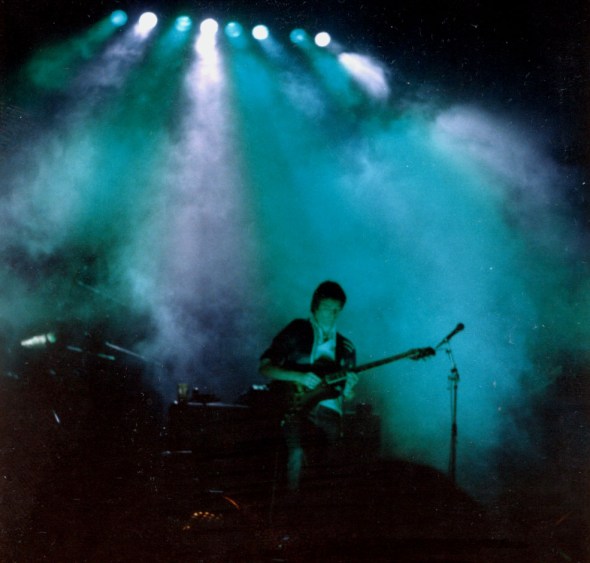 Steve Hackett in 1981 – Spectral Mornings © by wajobu
Review: Roger Eno – Ted Sheldrake

Backwater Records OLKCD023 – Time: About 42 minutes (CD & Digital Files)
Record Label Website: http://www.backwaterrecords.com/
Artist Websites: http://rogereno.co.uk/ and http://rogereno.com/
Tracks: 1) You’re Just A Bloke; 2) All In A Garden; 3) The Old Queen’s Head; 4) There’s Something Wrong With Ted; 5) The Cold Night Is Over; 6) Marrers; 7) My Old Bike; 8) You’re Just A Bloke (Ted); 9) Moon Waltz; 10) Ever True; 11) Sally; 12) Bittersweet; 13) Ted’s Funeral Music
I find it hard to believe that my original LP copy of Apollo (Brian Eno, Daniel Lanois and Roger Eno) will be thirty years old in 2013, but there it is—one of the great albums of the ambient music genre. When I think of Roger Eno’s music over the years, three words come to mind: thoughtful, quirky and sometimes playful. Whether lyric or instrumental, RE’s works tell stories that can either be tightly sewn threads or loosely knitted yarns. Often, the subjects are quiet ruminations, but they can also be spirited and cheerful. His works can also be rather enigmatic, as noted in an autobiographical analysis from his website: [He is] “On an ongoing and heterogeneous musical journey which twists and turns and goes whichever way you think it won’t.”


Roger Eno entered the professional music scene with Apollo after music lessons and college to study music (as a multi-instrumentalist and singer), as well as running a music therapy course at a local hospital. In addition to working with his brother Brian, Roger has collaborated with artists including Bill Nelson, Kate St. John, Lol Hammond, Peter Hammill and Michael Brook, and has provided soundtracks for films and advertisements.


RE’s most memorable albums for me (of his 25 or so) include: Voices (1985), The Familiar (w/ Kate St. John, 1993), Automatic and Excellent Spirits (both with Channel Light Vessel, 1994 and 1996), Lost In Translation (1995), Swimming (1996), The Music of Neglected English Composers (1997), and more recently Fragile (Music) (2005), Anatomy (2008) and Flood (2008, a reinterpretation of a soundtrack constructed for Salthouse Art Festival in North Norfolk). I hope that Roger works again with Kate St. John and Bill Nelson; their work together on The Familiar is some of the most touching and enchantingly inspired work that I have in my music collection.


Ted Sheldrake is a departure from Roger Eno’s instrumental ambient work; originally a quiet neighbor and later a friend, it’s a tribute to a life, and even though it takes place in recent times, it could have just as easily taken place a hundred years ago—in many respects it did. It’s a familiar story in literature as well. In Victorian times, Richard Jefferies told the stories of common labourers, from the farm fields in his books like Green Ferne Farm, Round About A Great Estate (both from 1880), The Life Of The Fields (1884), and in newspaper articles during that time in the late 19th century. In the first half of the 20th century Henry Williamson also wrote of life in a West Devon village known as Ham (The Village Book and The Labouring Life in 1930 and 1932, respectively) and described the country life in the narrow village streets, fields and hedgerows, “local colour”, and stories of the “everyman”.
The compiled, mostly song-oriented work traces Ted in East Anglia (Suffolk and Norfolk, UK), being from a family of hearty stock, farm labourers and fishermen, and he spent his years working on an estate and living in a village where the pace of life was slower and the work was hard, but satisfying. In his younger days Ted learned to play a melodeon (hand organ), and as the years passed he became known for composing and performing songs in local pubs and village halls. In his later years, following his retirement, TS suffered the loss of his beloved wife, and something changed in him and it comes through in his music.
The album is divided, the way I see it, into two sections (observations and then reflections) and includes a number of recordings (songs, spoken word with accompaniment, and instrumental) made on location with cast of characters and talent connected to his life.
You’re Just A Bloke is an introduction to Ted’s work through the voices of others; a group interpretation of this universal and common man. This is the first indication that Ted’s work and life isn’t embellished with ornate descriptions, he’s the “real stuff”, with genuine words. Village life includes folks gathering in thatched cob or flint-walled cottages, village halls or pubs, and the jolly and perceptive All In A Garden brings this experience to life. Ted’s songs are also a bit like tiny memoirs, recounting special occasions and getting spiffed-up for The Old Queen’s Head.
As time passes, Ted’s meager existence and loss of friends weighs on him. Some around him sense a change in his countenance. There’s Something Wrong With Ted tells the worry of a friend, layered austerely with piano and a keyboard. The Cold Night Is Over is the beginning of Ted’s reflections of melancholy and pastoral memories of the farm fields and long views to the sea. Marrers (marrows or zucchinis) is perhaps the most beautiful track on the album—deeply reflective, and one of the main reasons Ted would still rise in the morning—for his garden; at first a lone piano, then an open and sincere expression of longing. The melodic theme is expanded modestly (and somewhat cheerfully at first), this time overlaid with memories in My Old Bike. Ted’s is a simple life in the village, never needing to leave East Anglia, and now missing his dear wife.
The original version of You’re Just A Bloke is rendered by Ted—directly, perhaps even more so than Hemingway. The last section of songs (with piano) present Ted’s most personal feelings, the endearing yet untrained voice, and uncomplicated romanticism of Moon Waltz and Ever True. Sally is an instrumental tribute to his wife, which is proud and forthright. Bittersweet is apparently Ted’s last song, interpreted by an ensemble of his mates (documented by local schoolteacher Miss Kemp—Ted didn’t write music, he just played it). The final tribute to his life is the piece Ted’s Funeral Music, which sounds like it’s played on an old harmonium or church organ.
So, slow the world down, set a spell, and get to know Ted Sheldrake and his humble existence. He might turn out to be someone you know, and it’s a simply delightful chronicle.

Ted Sheldrake will be released on January 7th, 2013.
Review: Good Weather For An Airstrike – Lights
Sound In Silence SIS011 – Time: About 40 minutes (CDr & Digital Files)
Record Label Website & Contact: https://www.facebook.com/soundinsilencerecords & http://www.myspace.com/soundinsilencerecords E-Mail: soundinsilence@hotmail.com
Artist Website: http://goodweatherforanairstrike.bandcamp.com/
Tracks: 1) A Quiet Day; 2) Thinking Of You; 3) Storm Fronts Collide; 4) The King XXVI; 5) One Of These Days; 6) Escape; 7) An Ode To Fring; 8) Rescue
The sounds that keep one up at night; they could be the house creaking, babies crying, traffic on the streets, the sounds of animals stirring outdoors, and my personal favorite the hoots of owls sending messages to each other in the dark. In the case of Tom Honey (aka Good Weather For An Airstrike), what keeps him up at night is the ringing in his ears—tinnitus. So, in 2009 Tom started his GWFAA music project as a means to help him relax and get to sleep (sounds like a candidate for a Slaapwel project too). I know of at least six releases by GWFAA since 2009 (with labels Hibernate, Rural Colors, Bad Panda, Audio Gourmet, Sonic Reverie and his own Hawk Moon Records), but I’m sure that there are more, including his most recent and lovely tribute EP to his wife Lauren entitled This Is As Good A Place As Any.
His latest album Lights is to be released by the small independent Greek record label Sound In Silence (their contact information is noted above) in a hand made sleeve and is limited to 200 copies. The album is arranged a bit like a meditation session, with instrumentation including guitar, banjo, strings, piano and percussion. The sound is steadier and fuller than many recent ambient albums, and I’ll resist the temptation to compare GWFAA’s sound to the works of others.
A Quiet Day begins softly before introducing a calming and guiding pulse with a mantra first from a piano and then supplemented by gentle percussion. Once in a more focused state Lights goes deeper, into the tranquil canon-like Thinking Of You. There isn’t a feeling of yearning here for what cannot be or the unattainable; there is just an idyllic state of belonging.
Thinking Of You
As with any period of slumber, the brain still sends signals to be processed, and periodically there are voices, broadcasts and sounds that appear to be sorted-out. Dreams send flashes that are discernible and other times are fleeting and out of reach. Storm Fronts Collide returns to the time of the Paris Peace Accords and the VietNam War in 1973—voices from the past (forgotten by some and unknown to others, except those who lived through those times); the codified yet unratified tragic melancholy that sometimes enters the drifting mind. The King XXVI and One Of These Days are also brief episodes in the sequence of reverie with the sounds of the outdoors and the cheerful voices of children.
Escape is a transition to the last section of the album, an arrival at pleasant and calmer memories. The mind is no longer distracted and has returned to the center in An Ode To Fring, perhaps from halcyon recollections of East Anglia, Norfolk. Rescue closes the album, and it is both the final state of slumber and the slow return to the conscious world. The opening theme of the album is more broadly reprised like the rising sun not yet seen, but still a signal to an awakening. Enjoy your travels, and the weather.
Photo Courtesy of Sound In Silence
****
This is a solicited review
Review: Will Samson – Balance *UPDATED with VIDEO*
Karaoke Kalk 69LP – Time: About 34 minutes (LP, CD & Digital Files)
Record Label Website:
http://www.karaokekalk.de/ & http://www.karaokekalk.de/will-samson-balance/
Artist Websites:
http://willsamson.bandcamp.com/ & http://wsamson.tumblr.com/ & http://willsamson.co.uk/
Recorded & Mixed By: Florian Frenzel & Will Samson Mastered By: Nils Frahm
Tracks: 1) Oceans Are Wilder; 2) Cathedrals; 3) Hunting Shadows; 4) Eat Sleep Travel, Repeat; 5) Painting A Horizon; 6) Music For Autumn; 7) Storms Above The Submarine; 8) Dusty Old Plane
Some may recall my review of Will Samson’s last album Hello Friends, Goodbye Friends (there’s a link to it on the right of this page, near the bottom of the list or use the Search box). HFGF was timely; it rang like a beacon of hope. It was a pretty special thing to think that a 20-something had such an affect on this 50-something, but there are all kinds of wisdom floating around and sometimes age really doesn’t matter. I don’t mind admitting this at all, as it has been music that has helped me at many times throughout my journey in this life. So, at the first mention from Will that he had another album in the works, I was excited; resisting temptation to listen to early previews, preferring to wait for its full and formal release. So, I ordered the LP, with the striking cover photo by Scott McClarin.
It was worth the wait.
From the first celeste (vibraphone?) notes and soft vocal harmonies of Oceans Are Wilder, I knew that there was a great synergy in Will’s work with Florian Frenzel and Nils Frahm—complementing the music and lyrics so well. As the album progresses it moves from a soft state of consciousness to a deeper meditation (with one brief diversion). There is a lovely balance of instrumentation, vocals, ambient sounds and the outdoors. These are songs of friendship, strange journeys, and visits to places real and imagined. The mix of six vocal songs and two instrumental respites is a bit like Nick Drake’s second album, Bryter Layter.
Samson continues to use his upper register (and falsetto) voices prominently, although there are times when full-throated harmonies are blended. Vocals are also fuller in the mix of this album, and the overall sound is different; the result of using venerable analogue equipment, tapes (old cassettes, a Tascam 8-track) and working with Florian Frenzel’s salvaged organs, analogue tape delays and old microphones.
The ambiance of the analogue equipment is strongly present in Cathedrals, it gives a misty quality to the sound, a sense of the ancient, like the foxed pages and deckled-edges of aged books or the opening title sequence to an old film. In particular, I think the layering of sound is particularly strong, starting with simple acoustic guitar, then unadorned vocals, then vocal harmonies added ending with the lyric “That spin so separately…” and then an abrupt and lyrical chord change into “Impossible became much easier…” and shifting to an electric guitar drone to the end—it’s mystical and soulful.
Hunting Shadows is an outdoor walk, and the music and treatments take the place of moving light, shadows and the lightly moving breezes of a new day. Eat Sleep Travel, Repeat has the ambiance of being aboard a ship at sea late into the night, composing (acoustic) music by candlelight and the stars, with slow swaying movements, as does the more electric (with broad vocal harmonies) Painting A Horizon. The trombone solo in Eat Sleep is an impeccable complement as are the banjo and cello on Painting. There are similarities with the more plaintive side two of Brian Eno’s album Before and After Science, the three tracks Julie With…, By This River, and Spider and I.
Eat Sleep Travel, Repeat (Premiere Video)
The second instrumental piece (again, with cello) on the album is Music For Autumn. It’s as if the sun is lowering in the cool night sky and as the track closes, Samson adds a warming chorus of voices. The brief diversion noted above is Storms Above The Submarine, which starts playfully, with furtive notes, sounding a bit like some sonic experiments of Raymond Scott. Then a somber throaty organ mixes with Will’s overdubbed voices (which are treated to sound a bit like a mournful saxophone) and altered guitars. Dusty Old Plane (and oh so beautiful, it is) closes the album, with practically a whisper of droning keyboard, reverberant electric and acoustic guitars and Samson’s harmonies. Listen carefully; there are birds in the background. This peaceful track is a sonic blessing, and a farewell of sorts. I also note that this album is dedicated to his father.
Please keep making music Will; you have a true gift.

****
A postscript: I have only one (hopefully received as constructive) comment on what is otherwise a brilliant album, and that is to recommend to not let the desire to use aged and lumbering analogue equipment for ambiance shroud the quality and beauty of the music too much.

 wajobu