
Review: David Wenngren & Jonatan Nästesjö – Below
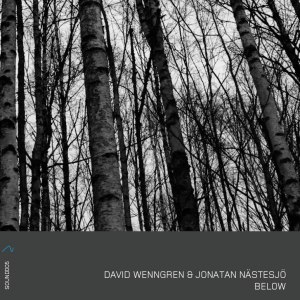
Soundscaping 005 CD: About 34 minutes
Label: http://www.soundscaping.net/
David Wenngren: http://librarytapes.com/ Jonatan Nästesjö: http://jonatannastesjo.com/
Tracks: 1) Something There, 2) Feel Nothing, 3) Before I Leave, 4) Still Nothing Moves You
Writing reviews is a tricky business. One tries to be objective and in the end arrives at mostly subjective. Try writing a review for audio equipment, like for speakers, often the quickest way to create a flame-out with audiophiles (even with qualitative test data)*. Writing about different types of music is also a challenge; some folks just don’t like Bluegrass, Jazz or Folk music, for example. Writing about Ambient, Electro-Acoustic, Electronic or other types instrumental music often proves to be the most challenging. Many listeners just can’t grasp (we’ll call it generically) “ambient” music since there are often limited tangible melodies, lyrics or other references unless there’s an artist’s statement or a known concept behind a given work. I find that when writing about instrumental music, it’s most helpful to reference the work of other artists (who might be familiar reference points) or try and describe how the music makes me feel, or what I see or where it takes me.
Often, music enhances experiences, and at times nothing is better than a restful sonic journey to the quietude, and Below helps to get us there.
I’m more familiar with David Wenngren’s work as Library Tapes, Murralin Lane and other collaborations, but Jonatan Nästesjö’s work is new to me (and he also has used the nom de plume Woodchucker for some of his earlier work). Both are from Sweden. Instrumentation in this work is not readily identifiable compared to most of what I know of David Wenngren’s work, but as a point of reference I’d place Below closest to Wenngren’s recent collaboration with Kane Ikin entitled Strangers.
From the first gentle whispers of the ineffable Something There to the broadest fullness of choral passages of Still Nothing Moves You this album presents an ever-changing yet serene oasis of sound. There is mystery within, and a sensitive audio system is almost essential for this album (*-you pick whether the music is through speakers or headphones, and no, I won’t advise on what system is best). Throughout Something There are fleeting ethereal apparitions that emerge from high up and then they are absorbed back into the haze. Part way through the piece there is a moment where the dream subsides, and seemingly the mind reaches back into the scene to complete it, before it disappears into the ether.
Feel Nothing appears as if from the edge of a drifting consciousness—at times the faintest of voices can be heard. One floats through time, soft sound-light appears and diminishes and there are moments when a tangible clarity focuses, but it’s still gentle as one moves through the broad spaces created by the music (hence the term often used to describe this type of music: “cathedral electronic music”), yet this album resists being majestic.
Before I Leave is more intimate and centered initially, and then almost undetectably a tide (of organs, perhaps) builds on loops and expands as if rising and withdrawing on a broad sandy coast before receding slowly back to the horizon. Still Nothing Moves You closes this sonic novella with veiled choral and Mellotron-like flute passages and after building the sound is gradually lost in the distance. The effect is reminiscent of Holst’s Neptune [The Mystic] from The Planets.
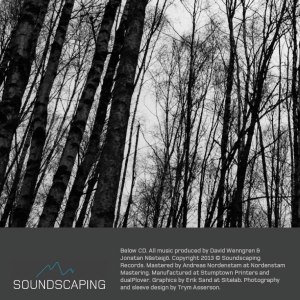
Whether leaving a listener with a feeling of walking through a quiet forest (as depicted on the album’s cover), on foot in gentle breezes at a beach or escaping to another realm, Below is a fulfilling and tranquil way to leave the here, for the there.
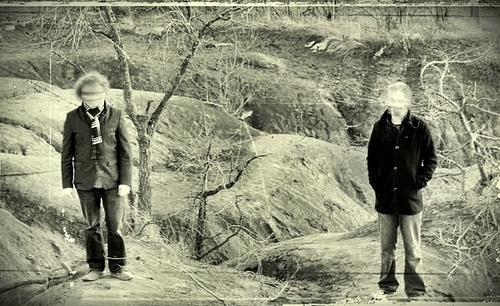
 Photo of Jonatan Nästesjö and David Wenngren courtesy of Soundscaping
****
This is a solicited review.
Review: Cock & Swan – Secret Angles

Hush Hush Records # HH011 CD: About 38 minutes
Band: http://www.cockandswan.com/ and http://dandeliongold.bandcamp.com/
Label: http://www.hushhushseattle.com/ and http://hushhushrecords.bandcamp.com/
Tracks: 1) Following, 2) Secret Angle, 3) Animal Totem, 4) Night Valley, 5) Looking Out, 6) Red Touch, 7) Inner Portal, 8) Kicking In, 9) Melt Down, 10) I’ve Got A Feeling, 11) Night Rising, 12) Myself Inside
I’m thrilled that Cock & Swan have a new album. With each release it’s apparent that their confidence is growing, and even better, they’re still experimenting. From their earliest albums like Drawing From Memory (2007) and Unrecognize (2010) their sound ranged from rough synthesized foundations, tape and microphone experiments to nearly extreme lo-fi acoustic recordings. The 2012 album Stash (I reviewed early last year) had moved their sound from more electronic towards “…a record focused on acoustic instrumentation…” For their forthcoming album (to be released on September 10th) Secret Angles they are combining the acoustic instrumentation with more of their electronic roots—the sound is fuller, rhythmically engaging and more up-beat. Secret Angles moves between many different genres: progressive, electronica, acoustic and electric folk, house, dance and many others—it doesn’t dwell in one realm for long, but the album is not at all disjointed—it’s quite cohesive.
The acoustic and analog roots of Cock & Swan are still strong, and they appear as Following begins with the sound of tape mechanisms and immediately a seductive pulse, electric guitar riffs and Ola’s soft voice initiate their hypnotic spell. By contrast the title track shifts to a darker, looped and gritty electronic foundation (and we are awakened briefly from our pastoral spell). Animal Totem is quite reminiscent of the latter day Everything But The Girl’s track Before Today from their album Walking Wounded, when ETBG’s music shifted from coffee house to a darkened house vibe, but C&S’s Animal Totem is earthier and more acoustic with broad clarinet washes added by Hungerford.
With Night Valley, the album shifts to an even glitchier more experimental sphere where Ola’s voice and some of the instrumentation are bent and shifted and the sound enters a mysterious territory. Looking Out continues with electronic, vocal loops, an almost Mellotron Brass sound and what I call “heavy drums.” As I noted with their album Stash—tracks like these are reminiscent of King Crimson’s earlier work as on In The Wake of Poseidon. The album also contains some short instrumental and vocal links (Red Touch and I’ve Got A Feeling) which are samples disguised elsewhere in other tracks.
Tracks often start with samples and a vibe that are then absorbed into the mix of a song; Inner Portal illustrates this with Ola’s vocal and breath loops coupled with what almost sounds like a ship’s steam-powered horn and it’s woven together with a heavy dub beat and coarse under-pinnings. The chorus adds an acoustic guitar (a contrast of the heavy with the delicate). This is a great track and one of my favorites on the album, along with the first three. By comparison Kicking In is quite stark in its percussion and rhythm section before gathering momentum into the vocals. Melt Down is the most electronically layered of the songs, and Ola’s vocals calm the mood and fill the spaces.
Only once did I feel like I had a sense of some monotony drifting in during the track, Night Rising—after a while it didn’t really take me anywhere…a bit like some of Edgar Froese’s (Tangerine Dream) solo work of the late 1970s. It’s a vocal and rhythm-section drone. The album closes with Myself Inside, which harkens back to Cock & Swan’s stark early work—an acoustic guitar (in the character of a child’s toy piano), a simple rhythm and Ola’s vocals layered with deep breathing.
Since I’m working with a promo recording, I don’t have access to the lyrics or the personnel list for the album, so I’m not sure if there are other musicians on the album besides Johnny Goss and Ola Hungerford. It’s also worth noting that Johnny Goss provides engineering and recording support for other Seattle-based musicians, including one band that recently caught my attention, La Luz (absolutely infectious 60s surf-pop) fronted by Shana Cleveland.
After Secret Angles, I’ll be very interested in hearing where Cock & Swan takes us next. Don’t miss this album, and seek out a copy of their last, Stash too.

Cock & Swan – Ola Hungerford and Johnny Goss – Photo by Angel Ceballos
****
This is a solicited review
Review: John Scofield – Überjam Deux
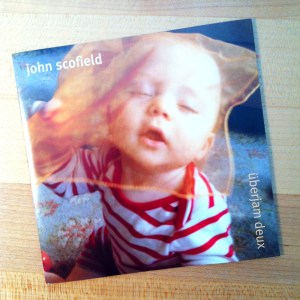
CD: Emarcy B0018605-02 Time: About 62 minutes www.johnscofield.com
Band: John Scofield: Guitar, Avi Bortnick: Guitar and Samples, Andy Hess: Bass, Adam Deitch: Drums, Louis Cato: Drums, Special Guest: John Medeski: Organ, Wurlitzer and Mellotron
Tracks: Camelus, Boogie Stupid, Endless Summer, Dub Dub, Cracked Ice, Al Green Song, Snake Dance, Scotown, Torero, Curtis Knew, Just Don’t Want To Be Lonely
Between his solo and collaborative work, John Scofield has appeared on more than a hundred albums since the 1970s (including his early work with Miles Davis). His first Überjam album was released in 2002. As with the first album, Scofield moves all around and in between music genres, Jazz, Rock, Blues and Funk. Many of the tracks on Überjam Deux start with a sound or rhythm sample and the quartet (switching between drummers Adam Deitch and Louis Cato) build a groove and just chill there or get their funk-on. My two favorite tracks are Boogie Stupid (which reminds me of Roy Buchanan’s work) and one of the five tracks with John Medeski Curtis Knew, where Medeski brilliantly has his way with a Mellotron—just delicious. In recent years I’ve greatly enjoyed Scofield’s collaborative work with Medeski, Martin & Wood. Überjam Deux is a joyful album and I can’t help but think that John Scofield was sending positive vibes to his son Evan during the recording of this album earlier this year (Evan died far, far too young in July, from a rare form of cancer). A bitter-sweet album, yet excellent for a road trip or listening at home.
Rest in Peace, Evan.
More on the album in this video
Curtis Knew
Review: Brainkiller – Colourless Green Superheroes

RareNoiseRecords CD RNR033 Time: 45:53 (LP version coming soon)
http://www.rarenoiserecords.com/brainkiller-store
Tracks: 1) The Vindicator Returns, 2) Scribble, 3) Empty Words (featuring Coppé), 4) Top Of The World, 5) Orange Grey Shades, 6) A Piedi Verso Il Sole, 7) Plates, 8) Noodlin, 9) Labratorio, 10) Secret Mission, 11) Otaku Goes To A Rave, 12) Viv, 13) To Be Continued
Band: Jacob Koller: Piano/Fender Rhodes/Keyboards, Brian Allen: Trombone/fx, Hernan Hecht: Drums
Wit and subtlety are often hard to find in much of what passes for music today. Then there’s music that takes itself so seriously that it might collapse under the weight of its own ponderous self-importance. Music isn’t always about the sound, it’s sometimes about the spaces and the silence—it doesn’t necessarily have to be a full-frontal assault on the senses.
A few years ago Brainkiller released their first album The Infiltration on RareNoiseRecords (#RNR010). Initially, this album caught my attention because it was a trio with a trombone, their music sounded playful and quirky, and it had some roots in other artists whose work I admired (Frank Zappa, King Crimson, Brand X, Godley-Creme, Weather Report, Return To Forever). Here’s a sample track, Casketch from their first album:
Casketch
Colourless Green Superheroes is a series vignettes (some atmospheric like Empty Words, and some funky) exploring melodic, rhythmic and at time ethereal motifs and the tracks don’t rest long on a given theme before shifting direction. In a way, this album is a soundtrack in search of a film. There is also a restful ease throughout the album (making it perfect for a languid summer day or when the night is young), but there are moments when cool breezes blow and there is a jaunty awakening, as in Scribble. The spirited Fender Rhodes opening phrases take me back to Brand X’s Disco Suicide*. There is, however, an unexpectedly laid-back funky response from trombone and percussion, a bit like The Tortoise and the Hare—as if the Tortoise retorts, “Chill, I’ll get there…”
Scribble
The themes introduced in the anthemic opening track The Vindicator Returns are explored further in Top Of The World, at first on a solo piano before the full trio plays off the rhythms and melodies. As in their first album, there are moments of recorded studio banter or live voices, which add a sense of spontaneity—also evident in the veiled conversations during the furtive Orange Grey Shades (my favorite track on the album). One can make up their own story to accompany the music.
The Vindicator Returns
There are times when the album is more contemplative as in A Piedi Verso Il Sole, a reflective lament of sorts. Yet the album shifts (before the vibe gets too heavy) to more raucous themes in Plates. The mood lightens further with Noodlin—a spirited piano solo (think a leisurely evening at a night club…at first), before moving to lighthearted voices (steering the improvisation), muted trombone solos and ultimately a vigorous trio romp. The upbeat repartee continues with the march-like Labratorio and perhaps the most vigorous track on the album Secret Mission (like a chase scene from one of the Bourne films)—see the video below for an excerpt.
Earlier themes are again revisited in the closing tracks of the album Otaku Goes To a Rave (my other favorite track on the album) mixing in some Scribble[s] and polyrhythms from the drums and piano. There’s an interesting combination of 1970s-era electric piano work combined with energetic phrasings similar to what the band Zammuto (ex-The Books) is working on these days. The album closes with the peculiar and brief Viv—a prepared piano musing, followed by To Be Continued, a reflective and somewhat subdued “roll credits” piece.
This album functions well as both incidental music or for straight-on listening and as soon as it ends I wonder where the time has gone…and so, REPLAY!

Photo of Brainkiller Courtesy of RareNoiseRecords
* – For those curious about Disco Suicide by Brand X: http://www.youtube.com/watch?v=FdAPEEW-OUA
***
This is a solicited review.
Review: Silmus – Ostara
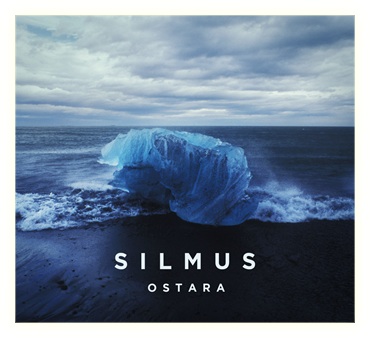
Volkoren #46 – CD Time: 29:00
Available at: http://www.silmus.com/ & http://www.youmakemusic.com/music/cd/silmus-ostara
Label: http://volkoren.com/ Photography by: Jan Borger
More Information: https://www.facebook.com/pages/SILMUS/159349577522537?fref=ts
Tracks: 1) Birth 2) Bright 3) Fortunate, My Child 4) Mono No Aware 5) Song For You 6) Clearing Up 7) Lives Lighted Out 8) Ostara 9) Disappearance (The Horse Ride) 10) Storm Lay Down
Some observed rituals are ancient and have roots in far away and nearly forgotten times, and various natural orders remain mysterious until the moment when one is firmly planted within the experience—there is no book to be read (although advice might be given) yet somehow deeply planted instincts guide…trusting that it will all turn out as we hope. There may be unexpected turns, but that is part of the adventure…the journey through life. If I have my history correct, Ostara is a pagan goddess of fertility and referred to centuries ago during the annual Festival of Easter—rebirth, the cycle of life and in some languages ostara also translates as “loop”.
Bright
Silmus is Dutch musician Gert Boersma (acoustic and electric guitars, bass, ukelele, vocals), and along with producer Minco Eggersman (guitars, mandolin, percussion and synthesizer), Jan Borger (piano, bass, synthesizer, Hammond, accordian) and Mirjam Feenstra (vocals), Boersma has created a sonic novella of the anticipations, sensations and emotions of becoming a parent—the delight of wonderment and discovery.
Clearing Up
Released in late 2012, this debut album (which is beautifully recorded, mastered and illustrated) contains often dream-like vignettes displaying tenderness and crystalline musicality that guide the narrative without any self-absorbed sentimentality—themes are developed, explored and nimbly resolved. There is an enchanting innocence as the sounds coalesce with ethereal movements in the electric and acoustic instrumentation and occasional subtle voices. This album is curious in that it allows moments of deep and absorbing reflection, yet one is not cast into the depths to awaken in a chilled haze (despite the album artwork); instead the feeling is the presence of warmth and refreshing clarity after the music has gently departed.
Ostara
A few have placed Silmus’ work in the canon of some well-known ambient artists, but I think his work is more engaging, closer to some instrumental works of Anthony Phillips, selections from albums like New England and Dragonfly Dreams. My favorite track on the album is the nearly-mystical Mono No Aware.
Let’s hope for more from Silmus.

This is a solicited review.
Review: Yellowbirds – Songs From The Vanished Frontier
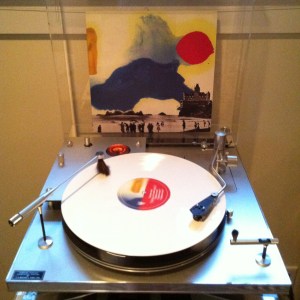
The Royal Potato Family – RPF 1312 – LP, CD, Digital – About 35 Minutes
http://royalpotatofamily.com/ and https://www.facebook.com/YellowbirdsMusic
Songs: Side A: Stop Tonight, Mean Maybe, Love Stories, Young Men Promise, The Ceiling Side B: The Vanished Frontier, Julian, For Girls Who Love To Sing, What’s Out There
Sam Cohen: Vocals, Guitar, Bass, Organ; Annie Nero: Vocals; Brian Kantor: Drums, Percussion, Vocals; Josh Kaufman: Guitar, Organ, Vocals
Something different…and even better it has an excellent sleeve design and is available in white vinyl…
The new Yellowbirds album is: mysterious, drifting, lush, orchestrated, cheerful, danceable, hopeful, syncopated, witty, retro, autoharpy (I know, not a word, but very 10cc*), uplifting, sonorous, jangly, toe-tapping, catchy, spirited, amorous, languid, romantic, edgy, bathed in reverb, fuzzy, harmonious, bluesy, intimate, ragged, orchestral, stark, melancholy, reflective, sad (but wait!), buoyant, lively, driving, dramatic, thoughtful, inviting, tuneful, lyrical, spacey, philosophical and inventively melodic.
I love the combinations of organ, guitars, bells, zither, Mellotron, strings, bass-lines, and the (at times) witty vocals. Yellowbirds’ last album, The Color was exceptional, but this album is even better. Deftly crafted songs, and an supportive record label that takes care of its customers.
Buy it.
*Autoharpy: http://www.youtube.com/watch?v=2zW2wmna2sg&feature=youtu.be&t=4m18s
Review: Harold Budd – Jane 1-11 *Updated with Jane 8 Video*
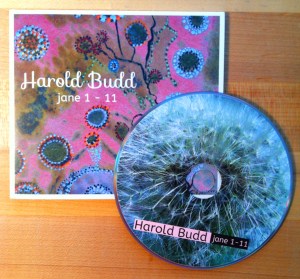
Darla Records – DRL 281 CD Time: 59:18
Available here: http://darla.com/?fuseaction=item_cat.ecom_superitem_detail&item_cat_id=41841
Tracks: Jane 1, Jane 2, Jane 3, Jane 4, Jane 5, Jane 6, Jane 7, Jane 8, Jane 9, Jane 10, Jane 11
Harold Budd is not complacent and I am thankful that rumors of his retirement actually turned out to be false (he briefly tired of writing and recording). He is (at 77) producing some of the most interesting work of his long and varied career. In a way, he is like Frank Lloyd Wright was at about the same age when Wright was hitting his stride with highly original and innovative works like the Kaufmann House (best known as Fallingwater)—always exploring and seeking new edges. Many might connect Budd’s work almost exclusively with solo piano pieces or his first collaboration with Brian Eno, Ambient 2: The Plateaux of Mirror, but his discography is remarkably varied, and including his joint releases, he has contributed to or been the solo artist on over forty albums since 1971.
The music alone on this album is divine, and even better there will be a DVD later this year including video collaborations with artist Jane Maru (who also produced the beautiful artwork for this album). Earlier this year a version of the furtive and at times skittering Jane 9 was quietly released on youtube—it’s just a hint of what to expect from this album.
This is a work of contrasts; some tracks tease the senses (like the unexpected and at times shrill Jane 1 or sharp-edged Jane 5 or the visceral and ghostly Jane 7) and then the pleasurable counter-effects are later intensified as the music ebbs and flows (as in Jane 2, Jane 3, Jane 4 and the sublime Jane 8). Moods and spaces change, first grounded and up-close and then transform into expansive and liberating flights. Budd is also exploring new sounds, instrumentation and treatments on this album (percussion [like chimes], electric piano, droning electronics, celeste and harp). I won’t say why, but Jane 6 evokes some very pleasant childhood memories. Jane 8 reminds me a bit of Anthony Phillips’ recent work Watching While You Sleep—deeply moving and one of those tracks I don’t want to end. The expansive Jane 10 is almost a reverse overture, recapitulating variations of sounds and themes from the previous tracks, as if reliving the experiences. To me, Jane 11 is the reappearance of the spirit of Jane 8—that which I didn’t want to end earlier, returned. How did Budd know that this is what I wanted?
Harold Budd has an uncanny gift for expressing so much with so little, a poet who just happens to use music instead of words.
Review: Roger Eno and Plumbline – Endless City/Concrete Garden
LP/CD or Digital Time: 37:43 Hydrogen Dukebox Records: Duke 157djv
Released May 20th in Europe and July 2nd in US and Canada
Label and Album: http://hydrogendukebox.com/ and http://www.endlesscityconcretegarden.com/
Roger Eno and Plumbline: http://www.rogereno.com/ http://www.neutralmusic.com/
Tracks: Side A: 1) Taking Steps, 2) Geometry, 3) Codewords, 4) Suspended Animation, 5) Ulterior Motives, Side B: 6) The Weather Inside, 7) Back to the Beginning, 8) The Artificial Cat, 9) Pulling Strings, 10) Beauté de Passage
Time plays tricks as one gets older…what used to seem like an eternity might now seem like months, weeks or even a blink of an eye. In the proper hands, time can bend under the spell of music. Transparencies, the last album by Roger Eno and Plumbline (Will Thomas) appeared about six years ago…seems like a while ago, but the memory of it is clear enough that hearing their new album Endless City/Concrete Garden, is like picking up a conversation with an old friend that paused mid-sentence and then continued, flow uninterrupted after an unexpected reappearance—like they never left. But something is different, new experiences have somehow changed things.

A paradox exists in this album, on one hand there is an apparent idée fix of love, loss and tragedy (as noted by reference to the curiously obscure works of the poetess Arlette Feindre) yet the album is not gloomy; it is woven with ethereal moments of warmth, reflection and comfort, beginning with the familiar gentle cascades of piano in Taking Steps. There are scenes of rhythmic playfulness, as in Codewords, with a gamelan-like opening. Also an ironic solitude is present in some tracks like Pulling Strings where one could be walking alone late at night in a city full of people and noise, yet remain focused on more powerful inner thoughts (a strange loneliness in a crowded place). Despite the calming softness to this album, it isn’t amorphous; it has a purposeful direction.
Like their album last together, Endless City/Concrete Garden has taken its form across an ocean and between time zones, the contrasts of cities (New York City and Los Angeles) and the countryside of East Anglia in the UK. The pieces this time around often have a foundation in more recognizable instrumentation: piano, guitar and even a koto, with arrangements including violin, cello, percussion and electronic treatments. Percussive mantras also form the basis of some pieces as in The Artificial Cat. Treated field recordings make appearances throughout (I could swear there is a train horn hidden within The Weather Inside). It’s not always clear from whose hands the sounds are created, but Roger Eno’s piano work is unmistakable, as in Back to the Beginning…it starts out like an etude and then moves on to tell a story. The haunting Beauté de Passage appears to open with what sounds like Frippertronics, but with closer listening, I think it could be a treated accordion…how appropriate, how French. C’est tragique, mais enchantant aussi.
***
Note: The album is being released as an LP with CD included or as digital files. It’s not yet clear to me if the CD will be available on its own—no word from the record label on this.
Review: HearCapeCod – SoundSignals and Upstream

Volume One – SoundSignals – #HCC001
Notes and Detailed Credits: http://hearcapecod.org/soundsignals/
CD 1 (Time: 39:08): Sound Signals: Act 1: On Land, Act II: On Water, Act III: A Year, Coda: Route Six
CD 2 (Time: 46:24): Signals Remixed: 1: Goldmund, 2: Marcus Fischer, 3: Loscil, 4: Taylor Deupree, 5: Neara Russell, 6: FourColor, 7: Steve Wilkes, 8: Simon Scott, 9: FourColor & SoundSignal

Volume Two – Upstream by Fordham Wilkes – #HCC002
Notes and Detailed Credits: http://hearcapecod.org/upstream/
CD (Time: 37:08): 1) Gates of Summer, 2: The Language of Birds, 3: GP Road Resonator, 4: Dive Down, 5: Upstream, 6: June, 7: Shifting Sand, 8: Fog, 9: The Message
Websites: http://hearcapecod.org/ & http://www.fordhamwilkes.com/
Sound Archive: http://www.hearcapecod.org/ListView.php
Recordings mastered by Taylor Deupree at 12k Mastering
Since the middle of 2011, Berklee College of Music professor, percussionist and Blue Man Group alum, Steve Wilkes has been working on a project to capture the sounds of Cape Cod over a year and to map those sounds as an aural history of the region (the far eastern end of Massachusetts in the northeastern United States). The project was funded in part by the Newbury Comics Faculty Fellowship. The region has undergone many environmental and man-made changes, from rising sea levels and coastal erosion to residential development. It was Wilkes’ feeling that the region is measured and analyzed in many ways (like bird population counts, temperature and sea levels), but there was yet to be a base-line environmental sound analysis examining animal, environmental and cultural activity in the region.
At this point, the project consists of 3 CDs: 1, a collection of regional sounds; 2, the sounds remixed by a number of musicians who will be familiar to many, and 3, a song-cycle inspired by the region at various times throughout the year (which also incorporates many of the environmental sound recordings and the detailed credit links give an excellent overview of the variety on-location recordings). The album artwork evokes pleasant memories of worn edged blue-green beach-glass.

CD 1 is a sonic time capsule, and at first it reminded me of a number of sound effects and spoken word recordings of the 1940s and 50s, and for a brief moment, I thought I was hearing a snippet of the old records by Bert and I. It also had the immediate effect of taking me back in time to the days when I summered on “The Cape” as a child with my parents in the early 1960s. The documentation of the region also harkens back to some of the expansive sound archive work by Alan Lomax. This CD chronicles the sounds of land, water and activities that mark the course of a year from a First Night Noise Parade to the calming summertime beach surf. It closes with the reading of the poem Route Six by Stanley Kunitz (being the road that travels down the center of the “flexed arm” of Cape Cod, reaching out into the Atlantic Ocean).
Having lived in a beach-town region in nearby southern Connecticut, I am also reminded that a resort region like The Cape has two lives—the times when the summer-folk occupy and the off-season when only the locals remain. The off-season is the time when locals can take long walks on the shore beaches and see very few people. Life goes on in a different way after the tourists have left in the autumn.
Taylor Deupree’s Remix
Wind Chimes Field Recording That Inspired TD’s Remix
CD 2 is a sensitively created set of interpretive remixes by many well known artists in the current electro-acoustic, ambient and electronic music communities (see list above). The field recordings from CD 1 are delightfully co-mingled with the offerings from each of the artists (well documented at the web link also noted above). I was immediately struck by the opening notes of the first track by Goldmund (Keith Kenniff), the piano melody being very reminiscent of Anthony Phillips’ Death of a Knight from Henry: Portrait from Tudor Times (from the album The Geese and The Ghost), before drifting into a dream-state with seaside, night-time crickets and Morse Code pulses.
FourColor Remix
Field Recording for FourColor Remix
Most of the remixes are by artists who have done work strongly connected with outdoor environs and water (as in the Flaming Pines label Rivers Home series), like Marcus Fischer, Taylor Deupree and Simon Scott (to name a few). The character of this disc ranges from contemplative to glitchy (FourColor) to playfully rhythmic (as in Loscil’s remix). The remix by Steve Wilkes includes the first HearCapeCod recording made in Truro at Corn Hill Beach in the summer of 2002. The CD closes with a collaboration of FourColor and SoundSignal (Wilkes) and is the most melodic and rhythmic of the tracks of the album. This CD forms a strong connection to the foundation provided by Wilkes’ research and recordings. As much as I’m tempted to suggest that this CD be made available separately, after spending time with the entire set, it is actually a quite inseparable part of the whole.
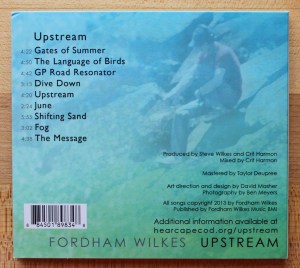
CD 3 Upstream, is a song cycle by the duo Fordham Wilkes (Ginny Fordham: vocals, Steve Wilkes: drums with Crit Harmon: guitars and Keiichi Sugimoto: guitars) and is inspired by years of memories of time on Cape Cod and it is the most personal of the three discs. Fond recollections of places run deep for many and they have different effects on people. This is where the project transforms from being objective (CD 1) to the most reflective and personal (while avoiding sentimentality).
The album has a sense of welcoming and ease, enjoying summer breezes, wading in tidal pools, walking in sanctuaries or along beaches. There is no heavy foreboding or hand-wringing of what was or could be; the feeling is that of the now and hopefulness, and Ginny Fordham’s voice brings a relaxing calm to the album. Gates of Summer opens CD3 and is forms an instrumental and melodic transition from the last track of CD2. The Language of Birds plays rhythmically with a juxtaposition and syncopation of the instrumentation and avian field recordings.
GP Road Resonator
The Field Recording Forming Basis for GP Road Resonator
The ever-present drone of automobile traffic is also a reality of summers on The Cape (whether passing over the Sagamore or Bourne bridges before necking down to Route 6 or at the half-way point to Provincetown, in Eastham) and these sounds are merged with fleeting views to salt marshes in the pensive GP Road Resonator. As in CD 1, there are songs of Land as well as Water, as in Dive Down and Upstream (as much a metaphor for returning to and rebirth of the area as it is the traffic on Route 6 that one is “swimming” against!).
CD 3 is also a reflection of CD 1’s A Year, The Cape in song over the course of a single circumnavigation of our Earth around the Sun. As the album progresses through the summer and into the end of a year (June, Shifting Sand and Fog) it grows more contemplative with the advancing of the calendar, melding dreams with reality. Each Spring many look forward the approaching time outside and then seemingly in the blink of an eye, Summer is over. The album closes with The Message, an inspiration left in a voicemail, which ultimately is the beacon announcing the sense of place of The Cape that inspired the HearCapeCod project.
****
The release date (May 28, 2013) for this set is at the unofficial “gate of summer” season, just after Memorial Day weekend. These albums will be available at: Booksmith Musicsmith, Orleans, MA: https://www.facebook.com/BooksmithMusicsmith , Muir Music, Provincetown, MA: https://www.facebook.com/muirmusic5 , The Cape Cod Museum of Natural History: http://ccmnh.org/, CD Baby: SoundSignals On CD Baby, iTunes: http://www.apple.com/itunes/ and Amazon.com: http://www.amazon.com/
Review: Berserk! (Lorenzo Esposito Fornasari and Lorenzo Feliciati)
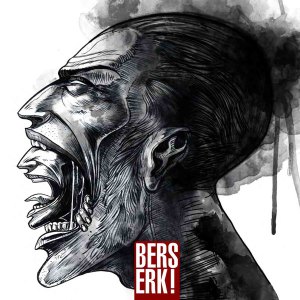
RareNoise Records CD RNR031 Time: 49:41 (vinyl soon and hi-res digital)
http://www.rarenoiserecords.com/berserk and www.facebook.com/berserkband
Tracks: 1) Macabre Dance, 2) Fetal Claustrophobia, 3) Blow, 4) Not Dead, 5) Clairvoyance, 6) First, 7) Dream Made Of Wind, 8) Wait Until Dark, 9) Latent Prints, 10) Dream Made Of Water
Band: Lorenzo Esposito Fornasari (Voice, Electronics, Organ, Guitar) and Lorenzo Feliciati (Electric and Upright Bass) with: Gianluca Petrella: Trombone & Effects (tracks 1,2,4,5,7,10), Fabrizio Puglisi: Piano & ARP Odyssey (6,8,9), Jamie Saft: Keyboards (1,2,9), Eivind Aarset: Guitars (3,4,7,9,10), Sandro Satta: Alto Sax (3,9), Cristiano Calcagnile: Drums & Effects (4,5), Pat Mastelotto: Drums & Effects (6,8,9), Simone Cavina: Drums (1,2)
Lorenzo Esposito Fornasari aka LEF and Lorenzo Feliciati form the core of Berserk!, along with some other familiar names in the RareNoiseRecords stable, including Feliciati’s fellow Naked Truth bandmate Pat Mastelotto.
We all need a venting catharsis now and then—some folks resort to primal scream therapy, but generally I’ll pick music to assist with exorcising my darkened bilious tendencies. The new self-titled album from Berserk! seems like an effective cure for those intractable days when the pile gets too deep and the unrelenting Myth of Sisyphus comes to mind. Despite the band and album moniker, there is a broad mix of dynamics in the album and it’s marked by many (nearly neck-snapping) contrasts in sound and rhythm.
Berserk! isn’t a broad spectrum motoric assault on the senses, but it deftly selects its points of release, building like a suspense thriller with the rage boiling over every so often. The album also teases and mocks (from the gently maniacal whistling in the opener Macabre Dance to the background telephone ringing in Fetal Claustrophobia…yes, I turned my head to see if my phone was ringing!). There’s also a brief moment of saxy playfulness (albeit dark) in the reflective interlude Blow before entering the backstreets and dark alleys of Not Dead (shades of the growling Tom Waits and Sparklehorse duet Dog Door from the 2001 album It’s A Wonderful Life) with raspy voices and clusters of percussion pushing against an unyielding darkness.
Feliciati’s bass work throughout the album is reminiscent of Percy Jones’s work with Brand X, particularly the earlier freer-form improvised and less commercial version of “The X”. The aggressive horns, meandering piano, fast-changing rhythms and moods (as in Fetal Claustrophobia) also remind me a great deal of one of my favorite King Crimson albums, Lizard (under-appreciated until Steven Wilson remastered it with Robert Fripp). The treatment of Gianluca Petrella’s horns throughout much of the album often sounds like the thundering Mellotron horns used in Lizard. The sharp inventive contrasts in instrumentation also remind me of Frank Zappa and early albums by Godley and Creme (as in the albums L and Freeze Frame). Yet, there’s little humor in Berserk!—the focus is strictly business.
The middle portion of the album is furtive and contemplative in spirit (like the tracks Clairvoyance and First) and eventually LEF’s vocals (sung here, not spoken) break through, channeling John Wetton. Note: Don’t forget to listen for R2D2. There’s a brief pause (the calm before the storm?) with ethereal atmospherics and horn work in Dream Made Of Wind before the closing section of the album begins with a tender solo piano largo and transition to a massed rhythmic vocal and ultimately a full band assault in Wait Until Dark leading into an alto sax ensemble of Latent Prints (the feeling of KC’s Lizard returns) and moves into a roaring full-clustered rip. The album closes with the ominously thunderous and raging vocal domination of Dream Made Of Water—there’s the Berserk!
Had a tough day in the trenches? Hold the rage at-bay (warn the neighbors, shut the doors and turn up the amp) and have a listen. I think you’ll feel better.
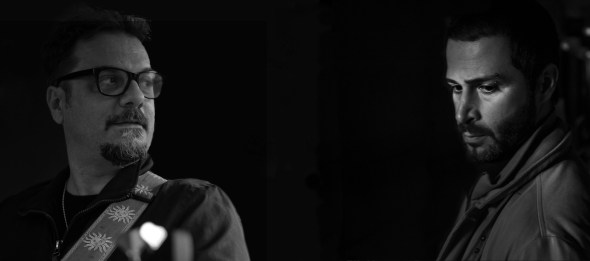 Lorenzo Feliciati and Lorenzo Esposito Fornasari – Courtesy of RareNoiseRecords
****
This is a solicited review.
Revisiting Old Friends and Meeting New
Anthony Phillips: http://www.anthonyphillips.co.uk/
Ant’s friend and illustrator Peter Cross: http://petercrossart.com/
Ant’s (too occasional) collaborator Enrique Berro Garcia: http://quiqueberro.com/
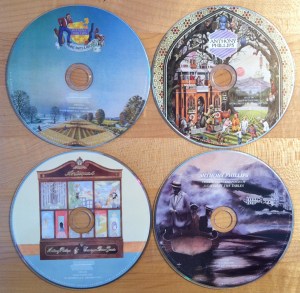
Although he was 18 when he departed from the band Genesis in 1970, many still associate Ant Phillips almost exclusively with that band (despite his approximately 40 commercially released solo albums and collaborations since 1970 in addition to his vast output of library music compositions and commission work). I have been very fortunate over the years to acquire all of these albums, and each time I place one of Ant’s albums on my turntable or a CD player his music takes me to another place and time (the ups and downs of a life). Ant’s music has been a big part of my life and I owe a great deal of my own creative work to being inspired by his. I think Ant said it best on his second Private Parts and Pieces album Back To The Pavilion (released in 1980): “This album is dedicated to all those who still champion the “old fashioned” ideas of beauty, lyricism and grandeur in art against the tide of cynical intellectualism and dissonance.” Many of Ant’s earlier albums are now being completely remastered (from the source tapes) and reissued (often in double CD releases).
Ant and Quique from PP&PPIII – Antiques: Old Wives Tales
Also spinning these days are albums by:

Three Metre Day – Coasting Notes
I have a ceramic artist friend (Hayne Bayless at Sideways Studios) to thank for getting me to these folks (often the best music comes from referrals by friends). At times their music is somewhat mournful, but always reflective and passionate—this trio from Canada is Michelle Willis, Hugh Marsh and Don Rooke with guest appearances by bassist David Piltch and drums by Davide Direnzo. The album is up-close, largely acoustic in instrumentation and delightfully musical.
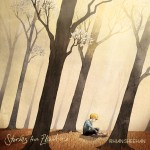
Rhian Sheehan – Stories From Elsewhere
At times the music is delicate and others it’s intense, but it’s always inventive and beautifully recorded. Rhian Sheehan is from New Zealand and has released 7 albums under his name as well as appeared on many compilations and soundtracks.

Iron and Wine – Ghost on Ghost
I sometimes find Samuel Beam’s work to be a bit too intense and serious, but his latest album is open, hopeful and at times playful. The first single Joy is beautiful.
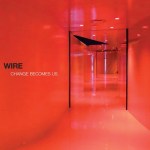
Wire – Change Becomes Us
I kind of lost touch with Wire after their albums Pink Flag and Chairs Missing, but I rediscovered their more recent albums when I updated my original recordings with CD reissues. If this new album sounds a bit like it comes from the late 1970s and early 1980s post punk era it’s because many of the songs were written back then, and haven’t seen the light of day until now. The recordings and production are full, with great clarity and this album just makes me want to turn up the amplifiers.
You can listen to the entire album here: https://soundcloud.com/wirehq/sets/change-becomes-us

Montt Mardié – Skaizerkite
Record Label: http://hybr.is/
David Olof Peter Pagmar has taken many identities and until a few years ago he was Montt Mardié (his website is now defunct) and he has since moved on to new projects, but in early 2009 this was his album of excellent pop tunes and ballads—beautifully recorded and produced. The entire album can be streamed here:
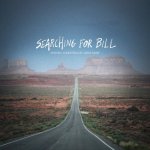
Jonas Munk – Searching For Bill (Original Soundtrack)
Jonas Munk has released many great albums and collaborations as Manual and more recently as Billow Observatory, but this is his first soundtrack. The documentary Searching For Bill is Danish director Jonas Poher Rasmussen’s debut and it explores the meaning of life for those living on the edge of American society. It’s a sensitive and contemplative soundtrack.
Many of these albums are available directly from the artists’ websites or at online merchants like http://darla.com/
*****
Happy Listening and Spring (finally)!
Review: Celer – Viewpoint

Murmur Records: MMR – 17 CD Time 78:31
Murmur Records: http://murmurrec.com/ & Celer: http://thesingularwe.org/celer/
I’m not sure where to begin with this, but it’s likely best that I write as little about it as possible. Some of what I write is speculation or perhaps flawed interpretation, but it doesn’t really matter since music listening and appreciation is often subjective.
Will Long’s (Celer’s) new album Viewpoint is simply gorgeous.
I have listened to Viewpoint while walking, reading, on the edge of sleep, awakening in rays of sunshine and listening as I am now on (what I consider to be) proper audio equipment, with sound filling my listening room. There’s a commentary within the CD cover, and it’s a narrative of (as I see it) the beginnings of a love story, moments in time and place, captured and held in the collective memory of the two who shared it–the connections in words and sound. It took me a few attempts to remain focused for the entirety of the album, but after re-reading the story and dreaming along with the music I was hooked, deeply. There are moments when Viewpoint weaves and peregrinates throughout its twenty-six nearly invisible sections, and at times there are some darker moments (life’s unexpected times) and pleasant daydreams, but eventually it all becomes clear and things interlock and harmony prevails, as tightly as the paving stones that decorate the inner sleeve of the bi-folding CD jacket.
Hold fast to the memories, don’t let them go…
Review: Recent Dronarivm Label Releases

Three albums from far away (to me) arrived at studio wajobu yesterday, and my immediate reaction (aside from the excitement of getting a package from Moscow) was when I opened the envelope, I was very pleasantly surprised with the design approach of the album packaging—a heavy semi-gloss stock tri-folded card (about 5 by 7 inches) with really nice layouts, printing and graphics—simple, elegant and compact.
The three albums are the latest collaboration by Machinefabriek and Minus Pilots entitled Signals, the Aquarius project (a collection of 5 minute works by artists including: Federico Durand, The Green Kingdom, Pjusk, Melodium, Simon Whetham, Loscil, Marsen Jules, Fabio Orsi, Pillowdiver, Machinefabriek, Hakobune + Hiroki Sasajima, Francisco López, Pleq + Mathieu Ruhlmann and Yann Novak) and Darren Harper’s release from late 2012 entitled Passages for the Listless and Tired. What drew me to Dronarivm (at first) was Darren Harper’s album.

Dronarivm Label – Aquarius
DR-09 – CD: 70 minutes – Limited to 200 CD copies and digital download with extra track
http://dronarivm.com/2013/02/25/va-aquarius/
Aquarius, being a sign of the ancient zodiac, representative of one of the many artificial constructs of arrangements of stars in our Universe and on Earth symbolic of undulating waves of water, and in color an aqueous blue. This album is largely the sound of comfort and peacefulness with only occasional hints of stormy seas or skies (as in Untitled #288 by Francisco López). There is a broad sonic presence in each 5 minute track that belies their brevity, each telling a complete and unhurried story. Each track is somehow connected by imaginary links to another and perceptions of the overall whole change if listening is done in the shuffle-mode. There are so many strong pieces on this album, but I had the strongest connection with the incredible pulsing depths of Loscil’s Hemlock. This would be an excellent choice for lying down in the grass on a clear dark night with a pair of headphones and staring into the night sky and as the eyes adjust to the darkness, the many secrets of the great depths are revealed.
***
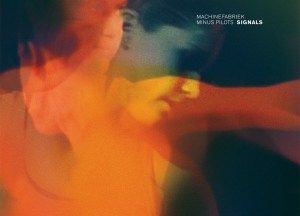
Machinefabriek and Minus Pilots – Signals
DR-10 – CD: About 34 minutes – Limited to 150 CD copies and digital download
http://dronarivm.com/2013/03/15/machinefabriek-minus-pilots-signals/
minuspilots.com & machinefabriek.nu
Signals is the latest release from Dronarivm. Like signals drifting in and out on a shortwave radio far off into the night, Minus Pilots and Machinefabriek have created a sense of mystery and discovery with intertwined and layered sounds. At first constructed with arrayed loops of electric basses created by Minus Pilots and Machinefabriek blending woodwinds, strings and voices into a loosely woven fabric of sound; the result at times being like conversations between unlikely strangers. There are moments of quiescent contemplation contrasting with more vibrant exchanges akin to morning-songs of birds reacting to the rising Sun. Sonic moods shift throughout Signals with more dulcet tones appearing at about the mid-point of the piece before more active coils of sound emerge later. With careful listening, distinct instrumentation can be gleaned from the recording, but blurring the mind yields a gestalt that is like imagining a room full of people (perhaps strangers sitting quietly in an airport lounge or waiting room) with their thoughts being transmitted into the ether, many passing into the nothingness, yet some connecting.
***

Darren Harper – Passages for the Listless and Tired
DR-07 – CD: About 45 minutes
Limited to 100 CD copies and digital download
http://dronarivm.com/2012/12/02/darren-harper-passages-for-the-listless-and-tired/
This is the album that brought me to the Dronarivm Label. I don’t recall how I was drawn to it or what landed me at sampling this album, but it must’ve been a lateral association somewhere in the neighborhood of six degrees (or in this case six passages) of separation and then attraction. The effect of this six-part album is calming, ethereal and curiously grounding. At times it growls (gently, as in Second passage) and often drifts into delightfully pastoral zones (like the closing Sixth passage). There are sections with a sense of flying slowly, just above a landscape in a vividly colorful slow motion dream (think Kubrick’s 2001) with deep almost motionless grooves reminiscent of parts of Tangerine Dream’s Rubycon. At times, the sound reaches, and reaches far, as in Third passage—it just keeps stretching ever closer to an unattainable edge and still onward for more. Despite being created from improvisation, Darren Harper has achieved a well-planned and deeply satisfying journey. There is a soft resonant afterglow present in this album.
***
Note: If you live where I do (far away!), it might take a couple of weeks to receive an order from Dronarivm, but trust me—it’ll be well worth the wait and patience. I look forward to more releases.

The Darren Harper CD was a direct purchase and the other two are solicited reviews.
Review: North Atlantic Drift – Monuments

Sound In Silence #sis015 Limited Edition of 200 CDr in hand numbered sleeve w/ insert
Band: http://northatlanticdrift.com/ & http://northatlanticdrift.bandcamp.com/ & https://soundcloud.com/northatlanticdrift
Label: https://www.facebook.com/soundinsilencerecords?fref=ts & http://soundinsilencerecords.bandcamp.com/
Tracks: 1) Passing Time, 2) Monuments, 3) Concrete Oceans, 4) Sandlab, 5) I Have Never Seen The Light, 6) Scholars Of Time Travel (part 2), 7) Sun Dial, 8) So Long As They Fear Us (on the CDr only)
The overlapping musical origins of Mike Abercrombie and Brad Deschamps have led to a sound that shifts between music genres: Mike’s roots being in electronic music and Brad’s in post-rock. They share common interests in the works of Eno, Satie, Stars of the Lid and others, and their music is soothing yet with a clarity of awareness of the out there beyond what is often the prosaic miasma passing these days as ambient instrumental music. It’s kind of like lightly sleeping with one eye open; taking in a view and related sounds while acknowledging what might lurk in the underneath or the above. At first, the presence of a musical fabric sets a scene and then a transformation to what might be a song in search of a lyric or even a deep transitional groove—it fits well.
At times the change in sound can be more than just a nudge (an unforeseen entrance of percussion or a back beat as in the middle of I Have Never Seen The Light—a wake-up of sorts, as if to ask: “Are you paying attention?—Don’t drift off just yet!”). It appears like a coalesced awareness from within a dream or as if sleeping in the warm sun when a cool breeze unexpectedly but pleasantly arises (a well known Canadian experience, I suspect).
There are threads between pieces on the album (and also to North Atlantic Drift’s first EP) like with the common sonic roots in Passing Time and Monuments (the undercurrent that binds) with the themes further developed with sustained and reverberant electric guitars. I’m somewhat familiar with their previous album Canvas as well as their two EPs Amateur Astronomy and their first work Scholars of Time Travel, the root of the sixth track SOTT (part 2) on Monuments. Part 2 is the awakened day to the original EP’s quiescent night with first an undertow of processed piano, and then the Sun rises as the undisguised piano is revealed.
I find that North Atlantic Drift’s music has a stronger connection to recent work by Robin Guthrie (Cocteau Twins) as opposed to Eno, Satie or SotL, yet the overall sound is more rooted in tangible instrumentation; the alignment with Guthrie’s work being that moods are set with an opening wash of sound (while a spring is being gently wound) and then a release to a fuller rhythmic soundscape. The most visually reflective track on the album is Sun Dial, the slow sweep of shadows passing as the light and activity waxes and wanes with the field-recorded ephemeral sounds of a day. The extra track So Long As They Fear Us on the CDr (not the digital download) is a return to the quietude, like sitting on a porch (in the dark) on a comfortable rainy night with a safely distant thunderstorm.
And don’t forget to go back to their album Canvas—copies are still available.
Recent Discography
Amateur Astronomy: http://northatlanticdrift.bandcamp.com/album/amateur-astronomy
Canvas (first full album): http://northatlanticdrift.bandcamp.com/album/canvas
Scholars of Time Travel: http://northatlanticdrift.bandcamp.com/album/scholars-of-time-travel
*****
This is a solicited review.
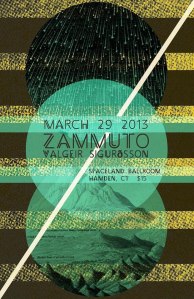
Concert: Zammuto with Valgeir Sigurðsson and Nadia Sirota at the Spaceland Ballroom, Hamden, CT March 29, 2013

Zammuto
http://zammutosound.com/home.cfm http://www.thebooksmusic.com/ http://temporaryresidence.com/
Nick Zammuto – Guitar and Electronics, Nick Oddy – Guitar and Keyboard
Mikey Zammuto – Bass, Sean Dixon – Drums
Valgeir Sigurðsson
http://valgeir.net/ & http://www.bedroomcommunity.net/artists/valgeir_sigurdsson/
Nadia Sirota
http://www.nadiasirota.com/ & http://nadiasirota.bandcamp.com/
Promoter and Venue
http://www.manicproductions.org/ & http://spacelandballroom.com/


I missed the last Zammuto tour in 2012, so I was determined to go see them this time around—and it was a great coincidence that they ended up stopping so close by in Hamden, Connecticut at the new Spaceland Ballroom with promotion by Manic Productions from nearby New Haven. Valgeir Sigurðsson (producer and founder of Iceland’s Bedroom Community record label and Greenhouse Studios) and violist Nadia Sirota started the evening’s show with an introspective and sensitive performance of work from Nadia’s latest album Baroque and Valgeir’s album Architecture of Loss (in addition to some earlier VS work). I think that the performance would’ve been enhanced all the more with a better piano and subwoofer system, but their performance ranged from the contemplative (my son says “chill”) to visceral. I’m less familiar with Sigurðsson’s and Sirota’s individual works, but this performance was a great introduction. My only other hope for this new venue is that the lighting improves to allow one to see the musicians better during their performances (and perhaps some more tables and chairs).


I’ve followed Nick Zammuto’s work since his days with The Books, and have appreciated his mining for music and inspiration in unexpected places, whether from old or new family home movies to skillfully edited (often bizarre) instructional videos. The humor and wordplay also makes his work all the more attractive. The difference (to my ears) between The Books and Nick’s latest incarnation in the band Zammuto is that the music is even more rhythmically infectious and at times, downright joyful. I also appreciate that Zammuto has created in their first eponymous album music created by artists staying true to themselves and their work—always pushing the boundaries and seeking inspiration from the most unlikely of places…making the serious silly and the mundane musical…and to be doing it in beautiful Vermont is all the more enticing. Their work is also an example of what I see as a proper usage of auto-tune technology—not to correct a singer who can’t sing, but to enhance the statement of the art and sound.


Last night’s set was tight, energetic and enhanced by a multimedia show of short films synchronized to the music. Much of the songs were taken from the latest Zammuto album on the Temporary Residence (independent) label. We were also treated to some songs from The Books era, a Paul Simon cover and some unreleased tracks. This was the second performance by new guitar/keyboardist Nick Oddy and he has immediately absorbed the often intense and delightfully quirky parts that Gene Back (up until recently) contributed to the band—bravo!

Zammuto Set List: 1) Groan Man, Don’t Cry, 2) The Shape Of Things To Come, 3) Idiom Wind, 4) Too Late To Topologize, 5) Zebra Butt, 6) FU-C3PO, 7) Harlequin, 8) Fifty Ways To Leave Your Lover by Paul Simon, 9) Yay, 10) The Stick, 11) Tahitian Noni Juice – That Right Ain’t Shit – from The Books The Lemon of Pink, 12) Classy Penguin, 13) The Greatest Autoharp Solo of All Time – A remarkable bit of video/sound editing!, 14) Smells Like Content – from The Books – Lost And Safe and the non-encore 15) The Fig and the Finger

If you haven’t seen Zammuto live yet, go see them—it was a very memorable concert. The link to their current tour is noted above, and I’m told that Nick is working on material for a new album.
****
Please note that all photos are by wajobu.com unless the image is suffixed with “IAB”, in which case it’s by Isaac Burns. We retain all copyrights to the images, but if you choose to borrow or share an image, please at least credit one or both of us. Thank you.
Concert: Stick Men – Infinity Hall and Bistro – March 27, 2013
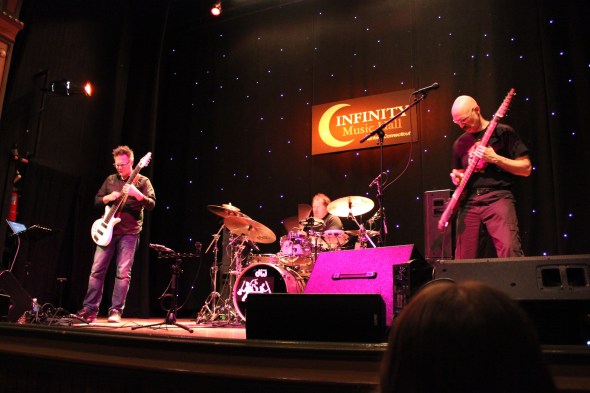
Stick Men: https://www.facebook.com/stickmenofficial
Tony Levin: http://www.papabear.com/
Pat Mastelotto: http://patmastelotto.com/
Markus Reuter: http://www.markusreuter.com/
Stick Men dot Net will take you to: http://iapetus-store.com/album/deep

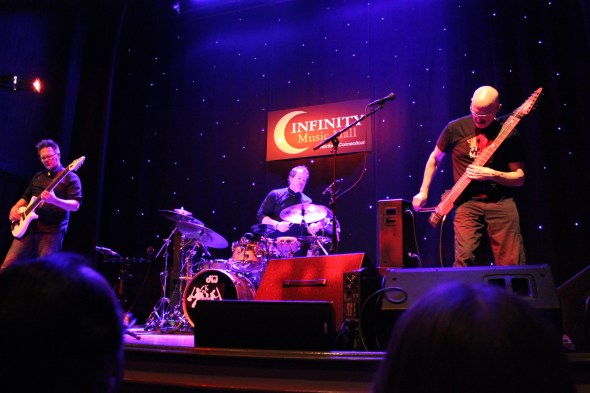
I’m not often prone to numerical connections, but it occurred to me last night on the long quiet drive home from the woods of northwestern Connecticut that here I was in year 13 of this century and it has been (almost to the day) 31 years since I had last seen Tony Levin on stage in Syracuse, New York with the 1982 incarnation of King Crimson (Fripp, Bruford, Belew and Levin) in support of their incredible return album Discipline. Although Tony Levin might disagree, to my eyes his energy and spirit hasn’t aged a day in those 31 years. Last night’s concert in Norfolk, Connecticut was an incredible display of musicianship, sound and an intimate connection between the musicians and the audience (especially in a small hall like Infinity with great acoustics, sound system and a beautifully restored historic building).
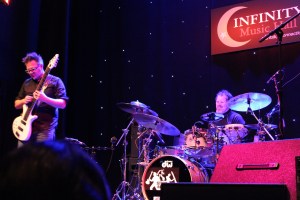
In one way or another this trio of Tony Levin, Pat Mastelotto and Markus Reuter all have a connection to King Crimson (and Robert Fripp) in various incarnations and ongoing KC ProjeKcts, but Stick Men while embracing KC’s influential work, have continued to develop their own voices in progressive rock including vital relationships with other bands, artists in addition each members respective solo work.
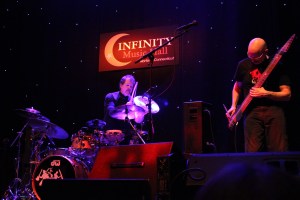
The Bows Come Out!
The set list last night was largely from their new album DEEP (all but two tracks) in addition to some real treats. Tony Levin made a special point to express appreciation to the audience for being so receptive to the new material, rather than insisting on hearing only the old (including many King Crimson favorites)–in effect progressive rock music…PROGRESSES. One thing that I wanted to see after listening intensively to DEEP is just how much of the melodies each instrument would take, and I was surprised to see that many sections that I thought were coming from Reuter’s Touch Guitar turned out to be melody exchanges between Reuter and Levin (the Chapman Stick being an extremely versatile instrument—not just for the bass line). Here are the tracks (along with some brief notes…not on every track, and nothing that I can write will do justice to the intensity and clarity of the sound last night–something to be experienced first-hand!):

1) Nude Ascending Staircase: As is the beginning of the album DEEP, this performance set the tone for the entire night, a seriously raucous (and fun) sound with deep visceral notes from Levin’s stick.
2) On/Off
3) Crack In The Sky

4) Breathless (from Robert Fripp’s 1979 solo album Exposure): This Fripp album is incredible, and it’s still as vital as when I first placed the LP on my turntable in 1979. This was an absolutely shredding performance of this piece. Markus Reuter’s faithful interpretation of Fripp’s work (searing guitar) was just chilling. The trio seriously cooked on this.
5) Cusp
6) Infinity Improv (free improvisation): Tony Levin noted that they record each of their performances (and I had noticed some stage and ambient microphones on stage before the show) in the hopes that some of the improvisations and recordings could lead to future releases.
7) Horatio: Thunderous!

8) Whale Watch: Tony Levin noted that despite his many years of having played the Chapman Stick, he was still learning more about what the instrument could do (and its often unpredictable results). He noted that some nights Whale Watch could turn out differently, depending on whether the instrument needed to be wrestled to the ground (I’m paraphrasing). It’s the story of being on a whale watch, from the start of an ocean journey to spotting, pursuit and arrival to see a whale up-close.
9) Industry (from the 1984 King Crimson album Three of a Perfect Pair): The growl and electronic percussion.
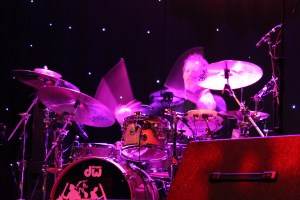
Pat is A-blur
10) Hide The Trees: The growing tension, exchange and release in this piece is deliciously enticing.
11) Open, Pt. 3 (from Stick Men’s 2012 improvisation-based album Open)
12) Larks’ Tongues in Aspic, Part 2 (from the 1973 King Crimson album Larks’ Tongue in Aspic): It was exciting to hear this piece live again, as it was in the concert in 1982 (and previous KC concerts that I had attended)—also, on the heals of the recent 40th anniversary release of the re-mastered album.
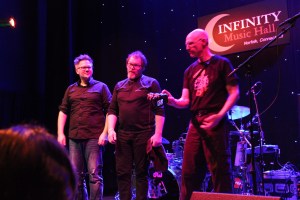
Tony Levin playfully taking a stage photo for the ongoing Crimson Chronicles
13) Encore: A Stick Men arrangement of Stravinsky’s Firebird: Let’s hope that this ends up on a future live album—a forceful and experimental rendition of Stravinsky’s 1910 work.

After the Encore
It was a real treat to observe the persona of each musician on-stage: Tony Levin’s classic broad stance and kinetically expressive movements (resulting in many blurry photos!), Markus Reuter’s calm scanning of the crowd as he switched from touch-fingering his guitar to using it in a more conventional guitar-stance, and Pat Mastelotto’s highly expressive performance on percussion and electronic devices—and just when I thought that he had no more tricks in the bag, out he’d pull even more paraphernalia, including a bow!
At one point during the night Tony Levin noted that King Crimson was still alive, not broken-up, yet (somewhat comically) Levin noted that Robert Fripp had recently attended a Stick Men show (and paid for his ticket, despite a guest pass) and in response to a question about when a King Crimson tour might occur again, Fripp responded “Pain.” I think Mr. Fripp has moved on, and is enjoying his semi-retirement and over-seeing of the re-mastering and re-releasing of their massive archive of concerts and other recordings.

If you’re within striking distance of a Stick Men show—please go see them! They’re appearing at the Iridium Jazz Club this Friday (March 29) and Saturday (March 30) nights in New York City. I’m sure they’ll be on the road again soon. Bravo and thank you to the Stick Men! Oh, and buy their new album DEEP–see also this great review of the album by my friend over at Horse Bits: http://horsebits-jrc.blogspot.com/2012/11/deep-by-stick-men.html
****
Note: Click on any photo to see an enlarged version. Please contact me if there are any factual errors in what I have written above. I have many other high resolution photos of the show, and if you chose to copy or repost any of the photos, please credit me “wajobu.com”. You can’t see them, but the photos ARE watermarked.

Cheerful Pat!
Review: William Tyler – Impossible Truth

Merge Records CD MRG465 – Time: About 54 minutes
http://www.mergerecords.com/artists/tyler%20william and http://www.sebastianspeaks.com/
Tracks: 1) Country Illusion, 2) The Geography Of Nowhere, 3) Cadillac Desert, 4) We Can’t Go Home Again, 5) A Portrait Of Sarah, 6) Hotel Catatonia, 7) The Last Residents Of Westfall, 8) The World Set Free
I posit that William Tyler is a thinker, and is perhaps more comfortable expressing himself with music than with words (although his spoken thoughts on the Merge teaser video have a distinct and interesting clarity). Tyler has worked in a number of bands prior to his solo albums including the Silver Jews, the ongoing experimental collective Hands Off Cuba and Lambchop (in addition to his record label, Sebastian Speaks). Tyler’s work brings a wide range of colors and moods to Lambchop’s sound, where he has been a principal guitarist for many years. Impossible Truth seems to me to be a more cohesive and mature work than his last solo album on the Tompkins Square label, Behold The Spirit. Nonetheless, I urge readers to seek out this very strong album.

The titles of the tracks on this album are like the names of short stories, and from the moment the cord is pulled on the first note of a track we are thrust right into the middle of the scene, without shyness or any lack of confidence. It almost feels like Tyler propels a well-worn yet vibrant flywheel at the start of each piece, and from that moment he is shaping and sculpting the sound and mood until the story is told.
Country Of Illusion starts mysteriously and sounding rather exotic (as if from a foreign land, sitar-like). There are sweeping passages envisioning a changing scene and then there are pauses (almost like a moment of contemplation) before moving through a sonic curtain and then the next passage of the tale. Some tracks show a greater tenderness (with solo acoustic guitar) than others like We Can’t Go Home Again or A Portrait Of Sarah (although musically the latter is quite adventurous, as are many relationships). The Geography Of Nowhere has a resonant otherness of being on the edge of consciousness and sensing the tangible without being able to actually reach it. There are others like Cadillac Desert and Hotel Catatonia that present vistas as broad and intense as a Montana sky (and I never knew what a big sky looked like until I saw one). The fretwork, picking and phrasing are tracing the landscapes and wrapping the listener in the gentle or gusty breezes of sound.
The Last Residents Of Westfall sounds like a scene from a dying or deserted town as the music pans to each of the buildings in the village, all with their own story to tell, some jaunty and others subdued. The closing track of the album, The World Set Free is the most reflective, but it enlivens joyfully as the track progresses—the acoustic bass being a steady and forthright heartbeat, and finally William Tyler releases to a growling close. I am trying to resist comparisons, but the opening section is similar to the instrumental sections of Nick Drake’s Bryter Layter.
Tyler disguises his guitars as many different instruments, and his musicianship and intense fingerings give a sense that more than one set of hands is at work, yet there is never a sense of Tyler playing a guitar hero—my guess is that he sees himself as quite the opposite. Just like Lambchop, William Tyler blurs the distinction of musical genres; first this is an instrumental acoustic and electric guitar album, there are hints of twang, country and roots in it, but also some blues, folk and rock and roll. Merge Records has a wide ranging catalog of musicians and has been around for more than two decades. I just finished reading and thoroughly enjoyed their biography of the first twenty years of Merge, Our Noise. Even though William Tyler has been part of the Merge family for many years in his work with Lambchop, I’m thrilled that he has released this latest brilliant solo album with Merge. This is an album that I highly recommend.
Merge Records just posted this reinterpretation (homage?) to the film Two Lane Blacktop with A Portrait of Sarah as the soundtrack.
Marsen Jules – The Endless Change Of Colour

12k Label – 12k1074 – CD Time: 47:00
Website: http://www.12k.com/index.php/site/releases/the_endless_change_of_colour/
When I was younger and had a completely untrained eye for seeing, as in art of any form, I didn’t realize how many colors went into what I saw, whether in a landscape or an object (same in the musical parallels). It was later, seeing artwork at a museum (paintings up-close), dramatically enlarged photos, and a friend’s work in college (artist, Allen Hirsch) that I started to understand the density and complexity of color–as well as in sound and music, the overtones, harmonics and phasing in addition to the pure waves.
The Endless Change Of Colour affects me in two ways, creating a state of peaceful timelessness (wondering where that nearly-an-hour went) as well as producing a state of nearly motionless cascades of blending sounds that transmute into a sense of relaxing in a stream bed of flowing water on a warm summer’s day–when all else falls away and what remains is that moment. All of this from a generative piece of music built from a single phrase on an old jazz record split into three audio stems. The sounds (and side-effects) that without closer examination and contemplation, we wouldn’t normally sense except for the benefit of the time that this work seems to warp and retrograde during its existence.
There are brief moments when almost familiar sounds enter, only to be absorbed back into the metamorphosing blend. I hear some parallels to the effects created by Nicholas Szczepanik’s brilliant album Please Stop Loving Me, although the feeling in Endless borders on that of a gentle voice on the edge of a dream–a peaceful sense of belonging.
Birds of a Feather – Part 3 – Broken Chip and Simon Whetham
Available at: http://www.flamingpines.com/

The Wonga Pigeon by Broken Chip
Sometimes there are things that I don’t want to end, but then they do, far too soon.* This is how I feel about Broken Chip’s dreamy and elusive The Wonga Pigeon contribution to the latest pair of CD3s released in the Flaming Pines label Birds Of A Feather Series. Broken Chip is one of the musical personas of Martyn Palmer, who is from the Blue Mountains of Australia. Broken Chip has contributed to other Flaming Pines releases, and Palmer’s other nom de plume is Option-Command, for more electronic oriented works. The Wonga Pigeon musically recounts a first mysterious encounter with an unknown bird. Time passed and then the bird reappeared to finally be identified. Despite the presence of (what appear to be) bird calls within the recording, it’s a piano (in my opinion) that takes on the guise of this particular avian creature. All sounds, initially, are distant in the recording, indescribable, and ethereal. Gradually, the identity coalesces, only to disappear back into the ether after a brief second chance encounter.
* – And so, I hit repeat!

The Phoenix by Simon Whetham
The Phoenix is the second CD3 of this latest pair of Birds…, and starts off like a shower of humidity encountered when disembarking from a plane in a distant land—the sudden shock of relocation. The wall of omnipresent sound of the outdoors is from Phoenix Island in Cambodia and at first it is intense (mind your amplifier’s volume control!). Eventually, the body and mind adjusts to this extraordinary new environment, and the sounds around eventually calm, and the vision of what was once like a blinding light comes into focus. Water, wooded areas, bells and gongs can be heard from sound recordings made by Whetham in June, 2012. In a way, the piece starts off with the fervor of the war endured by Cambodia and VietNam not so long ago, and the gradual calming could symbolize the peace that has slowly returned to these environs; The Phoenix rising, symbolically. As with the previous releases in this series, I love the cover illustrations.

Landing Lights by Kate Carr
Also, of note (and I have only heard these samples thus far), I am intrigued by Kate Carr’s latest new album Landing Lights. I quite like the contrast of the growl of her guitar juxtaposed against the soft, floating keyboards as in the track My Brother Came To Stay…I wonder who the brother could be, in the mix? I can’t imagine. 😉 Some samples from Landing Lights are below, so I am definitely interested in hearing more.
My Brother Came To Stay
Thunderstorm
Invention, Influence and Innovation – Bryan Ferry and Steven Wilson
When is a musical work true invention? When is it referential? When is it derivative? Can a work influenced by previous work still be considered original or innovative? I suppose these are questions that could spark a (sometimes heated) discussion like: “What audio speakers sound the best? Is it the east coast or west coast sound?” Often, the proper answer is: “What ever speakers sound best to one’s own ears.”
Generally, I think that most art, design and music works are built on the foundations that came before them and there really is little actual invention, more on the side of innovation or variants of an original. Dig deeply enough and one even can see that Frank Lloyd Wright’s and other modern architectural works (many seemingly original) have been influenced by the works of others or by some reference to design in nature or distant history (like many of Wright’s LA houses of the 1920s being highly influenced by ancient Mayan temples).
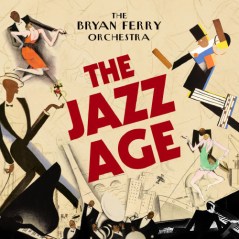

I’m certainly not an expert on the extensive back catalogs of Roxy Music, Bryan Ferry, Porcupine Tree and Steven Wilson (including Wilson’s various side projects), but I have enough of their music in my collection to know that I generally like their respective work (some albums, in my opinion, being better than others—that’s the subjective part, like the what speakers sound better question). Bryan Ferry and Steven Wilson are from two different musical generations and have been influenced by different works and people, but there is some overlap.
Ferry has noted that much of his seminal listening, writing and songs were influenced by early and mid-20th century instrumental jazz (including Charlie Parker and Ornette Coleman): “I loved the way the great soloists would pick up a tune and shake it up – go somewhere completely different – and then return gracefully back to the melody, as if nothing had happened.” With these influences and those of The Beatles, The Rolling Stones, The Who, Pink Floyd, King Crimson and others, Ferry’s band Roxy Music (with a number of different musicians, including Brian Eno and later Eddie Jobson) would go on to create quite innovative and often influential art-glam-pop-progressive rock works in the 1970s and early 80s in addition to Ferry’s distinctive solo works.
Steven Wilson works within a cauldron of many genres (progressive rock, metal, ambient and jazz fusion), and it’s clear from his remixing/remastering work (such as the King Crimson back-catalog, most recently Larks’ Tongues in Aspic) that he has both a deep affection for those influences as well as a respect for the history behind them. Wilson’s latest album The Raven That Refused To Sing is steeped in a mind-bending brew of musical influences, yet stays safely on the side of creatively paying homage while avoiding pastiche or cliché. Throughout the album he tips his hat with musical phrases and instrumental sounds that have kept me looking back into my music collection for their roots (a most welcome research project).
Steven Wilson – Luminol
Steven Wilson – The Raven That Refused To Sing
Whether it’s a soaring guitar bend of Pink Floyd, a vocal introduction reminiscent of McDonald and Giles’ Tomorrow’s People, a Mellotron phrase from Genesis’ Watcher of the Skies, an electric guitar intro akin to the band Focus, acoustic guitar phrases of Ant Phillips’ The Geese and the Ghost or flute phrases of Jethro Tull, Wilson and his current band blend these deftly into the rather sullen tale of The Raven… I can also hear more recent parallels in the menacing track The Holy Drinker, to the works of (Miles Davis scholar) Bob Belden’s jazz-fusion Animation project (the recent post-9/11 track Provocatism from the album Transparent Heart). The musical and sonic success of this album is also thanks to the great live studio engineering care of Alan Parsons and gifted musicians Nick Beggs, Guthrie Govan, Adam Holzman, Marco Minnemann, Theo Travis and Jakko Jakszyk who have interpreted Wilson’s vision into a cohesive and often stunning recording. The dynamics and emotions are broad, from the aggressive percussion/bass opening to the somber balladic close of the title track. There are minimal overdubs on the album, except for using an original King Crimson MKII Mellotron (recorded at DGM).
The Bryan Ferry Orchestra – Do The Strand
In contrast, Bryan Ferry is reinterpreting his own past work with vocals removed, leaving the melodies and harmonies of the original songs, and they’re are filtered through a time machine that brings the listener back to Ferry’s earliest musical influences—the sound, orchestration and recording techniques of the roaring and often buoyant 1920s. Some fans of Roxy Music or Ferry’s original work don’t seem to appreciate the effort (especially the sound treatment, and the monaural recording), but being that I enjoy original pre-and jazz-age acoustic recordings, I think it’s a favorable re-examination of Ferry’s work while avoiding the temptation reissue yet another compilation for the sake of churning a back-catalog. In fact, the recording sounds almost identical to the hi-fidelity of that period, a Victor Orthophonic reproducer and Victrola.
The Bryan Ferry Orchestra – The Jazz Age – The Reinterpreted Tracks
Bryan Ferry – The Jazz Age – The Original Tracks
I like both of these albums very much, for different reasons, and while they are clearly influenced by works before them, they stand very well on their own. Are either as groundbreaking as King Crimson’s In The Court Of The Crimson King? No (again, my subjective opinion). On the positive side, after a somewhat cool start, Steven Wilson’s album has been growing on me (my favorite track, by far, is Drive Home), whereas I liked Ferry’s album almost instantly—I was hooked by Do The Strand. Are either of these albums what I would consider the best of 2013? It’s a bit early for that–let’s wait and see.
Steven Wilson – Drive Home
Review: Cory Allen – The Great Order and Pearls
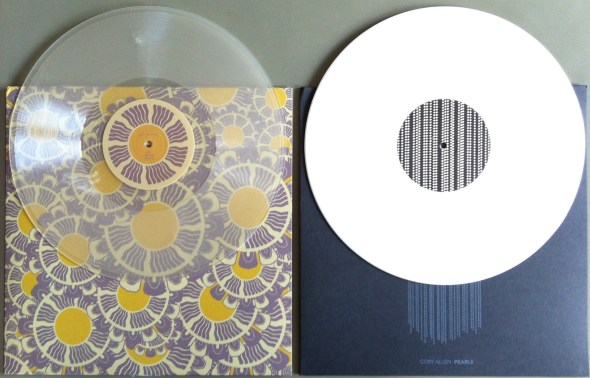
http://quietdesign.us/ and http://www.cory-allen.com/
Musicians: Cory Allen: Piano, Mike Vernusky: Bowed Classical Guitar, Nick Hennies: Bowed and Struck Vibraphone, Brent Fariss: Double Bass, Henna Chou: Cello
The Great Order: A: Movement I: 17:53; B: Movement II: 15:38
I enjoy listening to the Quiet Design podcasts with Cory Allen and Mike Vernusky (available free through iTunes). They discuss observations on art, the world around, how music affects them and their sources of inspiration as well as the musicians and artists they interview, to date: Lawrence English, Simon Scott, Duane Pitre, Taylor Deupree, Sun Hammer, Wide Sky and others. The topics are wide-ranging, often very entertaining and thought provoking. I also appreciate the reflective consideration that Cory Allen brings to the development of his work, and to his experimentation with instrumentation (extant and invented).

From the first sedate piano note of The Great Order, to the almost shy conversation between guitar, vibraphone, cello, and double bass, there is a respectful and somber discipline, a regimen to this largo in two movements. It is evident that there is a prescribed yet restrained foundation to this all-acoustic instrumental work. This is an album about relationships and exploration: the musicians to their instruments, the instruments with each other and how the sounds sustain and resonate both in the recording and ultimately in the listening space (or headphones) and the ears of the listener. No one instrument dominates, and it’s as much about the spaces between the music as it is about the sound. The first movement is somewhat hushed, and the second movement has a slightly increased density of statement-response and layering among the instruments. This is an album that also cleanses the mind and encourages contemplation. The recording has a clarity and live presence that feels as if one is sitting in the room with the musicians, making it all the more intimate.
The album art and design are by Cory Allen, who has done an impeccable job with the entire package (the covers printed by Stumptown Printers in Portland, Oregon). The limited edition LP is pressed in translucent clear vinyl. Also, in conjunction with the release of The Great Order, Cory Allen has issued an LP version of his serene, beautiful and introspective album Pearls (from late 2010). The first 100 copies of Pearls are pressed in white vinyl and 400 copies in black vinyl. For a limited time, both LPs can be purchased at a special price from the Quiet Design website. I’m also looking forward to Cory Allen’s ongoing experiments with his recently created multi-stringed instrument (a sound sample is below).

Pearls: A: Strange Birds, Lost Energizer 17:09; B: Isozaki Clouds, Blue Eyes 18:52
What’s Spinning – Deep Winter Edition
I need some warmth on these cold winter days…
Ron Sexsmith – Forever Endeavour

I love Ron’s work (another thoughtful Canadian songwriter—imagine that?!). He writes such great songs. My problem with his work, at times, is that sometimes his songs are just too sad, but Ron has a gift for making a sad song curiously uplifting, like Michael and His Dad from his last album Long Player Late Bloomer. I started listening to Ron’s work in 1997 with his third album Other Songs (produced by Mitchell Froom and Tchad Blake—coincidentally Froom produced Suzanne Vega’s Nine Objects of Desire the previous year, another favorite album of mine). Forever Endeavour is sparsely arranged, but strings, horn, percussion, pedal steel or electric bass are right there when they’re needed. Other than that, the songs are Ron’s voice, and his acoustic guitar. He has a gift for wordplay and expressing emotions with a deft efficiency that flow so naturally with his melodies. Some songs on Forever Endeavour are ironically upbeat, like Nowhere Is and Snake Road—in a sense, keeping the faith.
The CD has two bonus tracks (songs written with Don Black and recorded by Don Kerr), Life After A Broken Heart and Autumn Light, and they are just plain gorgeous additions to this album.
Nowhere To Go
Lorna – Heart of Wire

http://www.words-on-music.com/index.html and http://lornatheband.com/bio/
This is Lorna’s third album on the Words On Music label. The collective from Nottingham, UK creates dreamy contemplative songs with shy vocals and delicate harmonies. I’ve read of some comparisons to Yo La Tenga, but Lorna’s instrumentation tends to be more complex, and chamber-like at times. I think that this is their most direct album of the three for Words On Music—their sound is more confident, but they haven’t lost the softness and (at times) melancholy of their lyrics. I think the strongest songs on this collection are As She Goes By, Old Shanklin Sunset and Mina and Marco (with a delightful melodic phrase sample borrowed from composer Edward Elgar).
Daphne Lee Martin – Moxie

http://daphneleemartin.com/ and http://telegraphrecordingcompany.com/
A woman after my own heart—part record store owner, part musician; for many years, Daphne has been part of the New London, Connecticut-based band Raise The Rent. Moxie is the first of two releases (the forthcoming being Frost), and is a sultry collection of songs of the (only mildly) lurid backstreets of her imagination (with the added bonus of occasional Mellotron accompaniment!). There are shades of the cheekiness of the Squirrel Nut Zippers and the “heat” of mid-1970s Maria Muldaur in this well-produced album. I have an idea for what to expect from Frost—counterpoint!
Heligoland – Sainte Anne

http://heligoland.org/ and http://heligoland.bandcamp.com/
Sainte Anne is the latest EP from the Paris-based Australian quartet known as Heligoland. Their work in the last few releases has come under the wispy spell of producer and musician Robin Guthrie (who also plays occasional keyboards and bass), so it was only natural that I try their work. My favorite tracks on this EP are Sleepless and 22 Miles—peaceful ethereal guitar and bass balanced with gently pulsing drums and Karen Vogt’s warm and full vocals (channeling, at times, the sound of Christine McVie with a bit of vibrato). Other band members are Dave Olliffe (guitars and keyboards), Steve Wheeler (bass) and new member Antti Mäkinen (drums and percussion). Their previous albums and EPs include: Bethmale (recorded in 2010 and released in 2012), All Your Ships Are White (2010) and A Street Between Us (2006).
Corazón from their album All Your Ships Are White
And even more wonderfully creative releases from the Flau label in Japan… I can’t possibly buy them all, so one must be…somewhat…selective.
http://flau.bandcamp.com/ and http://www.flau.jp/top.html
The Boats – Our Small Ideas (2012 Edition)

http://oursmallideas.tumblr.com/
I have thoroughly enjoyed the various releases by The Boats (Craig Tattersall and Andrew Hargreaves with Danny Norbury, Chris Stewart and others). Our Small Ideas is a re-release and enhancement of an original 2008 CD-R. Contained in this work are the often quirky and sometimes fragile and nascent threads of pieces to be released later (and some are quite recognizable). This album is not unlike the approach of CD #1 of Tape Loop Orchestra’s The Words On My Lips Is Your Name/The Burnley Brass Band Plays On In My Heart.
Sound samples are here (since The Boats seem to eschew Soundcloud): http://www.flau.jp/releases/r09.html
El Fog – Reverberate Slowly

This is a solo project of Berlin-based vibraphonist Masayoshi Fujita, a light blend of acoustic instrumentation with a tranquil late night aura of electronics and subtlest of glitchy rhythms.
Masayoshi Fujita – Stories
Stories is an album of solo acoustic vibraphone works (with occasional violin and cello). Whether struck gently (as in Snow Storm) or bowed (as in Cloud), Fujita paints vivid, yet tender sound pictures. Some pieces are rhythmically playful, and could form the foundations for musical conversations (much like those between Bill Bruford and Michiel Borstlap on their album Every Step A Dance, Every Word A Song). This is an appropriate soundtrack for gently falling snow. The album is beautifully mastered by Nils Frahm.
Swan and Morning Dews
Graham Gouldman – Love and Work

http://www.grahamgouldman.info/
Graham Gouldman has been writing songs since the days of The Yardbirds (For Your Love), and many others like Wayne Fontana and the Mindbenders, before formally crossing paths with Eric Stewart, Lol Creme and Kevin Godley (Hotlegs) who later became 10cc with a long string of albums with sharp, witty and often sardonic songs. Love And Work is an album of twelve beautifully crafted and wide-ranging songs.
The album dedicated to the memory of Andrew Gold, and the song Daylight is about Andrew. They worked together as the duo Wax and earlier on some of 10cc’s later albums.
I’ve seen Graham and Ron Sexsmith appear together on BBC Songwriters Circle programs. Perhaps Graham and Ron will work together someday…
For Your Love
Happy Listening–Stay Warm!
Celer – Black Vinyl Series – Parts 4 and 5
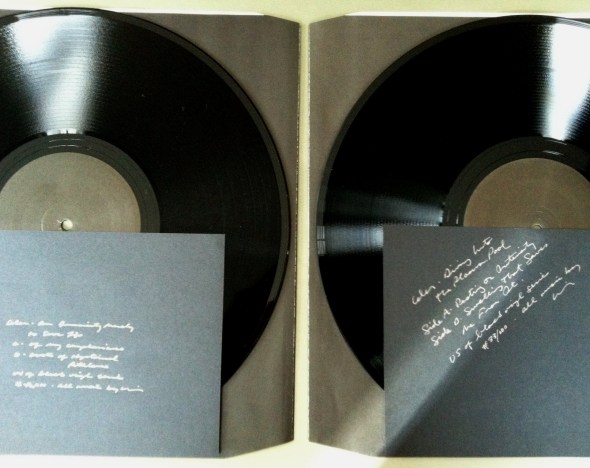
Diving Into The Plasma Pool – Part 5 Black Vinyl Series
Side A: Resting On Intensity 20:33 Side B: Swelling That Saves Me From It 20:10
An Immensity Merely To Save Life – Part 4 Black Vinyl Series
Side A: Of My Complaisance 18:27 Side B: Gusts of Hysterical Petulance 19:05
Self-released Limited Edition of 100 copies on black vinyl with matte black paper sleeve with handwritten credits
Celer’s Websites: http://thesingularwe.org/celer/ & http://celer.bandcamp.com/music

Insert for Diving Into The Plasma Pool
I almost missed them entirely, but something appeared on my screen in late January, and within 5 minutes I was transported to a perfect sunny day, in the middle of a gently rolling sea, on a reach in a sailboat, and to a sonic warmth that dissolved the doldrums of my winter reality. It was Diving Into The Plasma Pool, the latest (and I think last) of the five part Black Vinyl Series by Celer (Will Long). For whatever reason, I missed parts 1 through 3, but as soon as I heard a sample from Resting On Intensity (Side A), I looked to see if there were other LPs still offered—and indeed, Part 4 was (and is) still available. Part 4, An Immensity Merely To Save Life starts a bit darker with Of My Complaisance (Side A) and then softens with Gusts of Hysterical Petulance (Side B).
Insert for An Immensity Merely To Save Life
The subtle enmeshed loops of Diving Into The Plasma Pool flow like Debussy’s Nuages and yearn (although more gently) like Nicholas Szczepanik’s Please Stop Loving Me—they are waves that crest, hold onto a pleasurable edge and then dissolve. The chords and sounds are right in my sweet-spot. But enough from me; just listen—better yet, buy one or both of them. They’re gorgeous, full and resonant—simply magical.
Part 5 (available here): http://celer.bandcamp.com/album/diving-into-the-plasma-pool
Part 4 (available here): http://celer.bandcamp.com/album/an-immensity-merely-to-save-life
Catching The Groove with Martin Schulte

More information on Martin Schulte: https://soundcloud.com/martinschulte
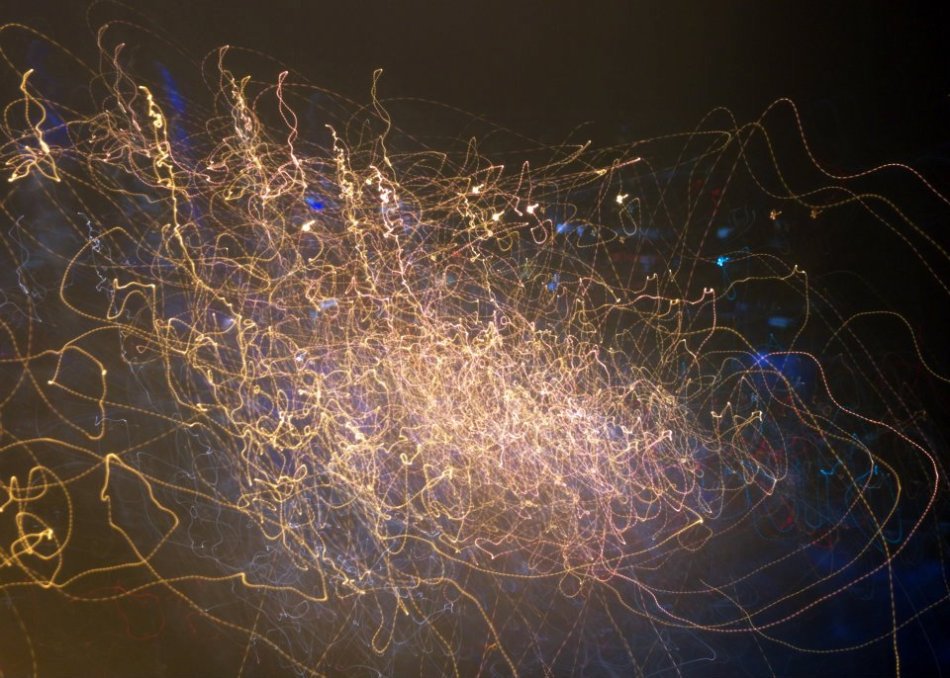
His music is solidly rooted in analog modular sequenced synthesizer works (latter day Kraftwerk, for example). His latest album Slow Beauty is inspired by photography and memories, including images he has taken of the beautiful landscapes near his home (in sharp contrast to the stark winter vista depicted on some of his previous albums). Some tracks have deep visceral* grooves, others are more delicate, sampled and atmospheric, but there’s always infectious motion involved. I have favorites on all four of his albums that I’ve referenced—excellent soundtracks for all sorts of places and experiences.
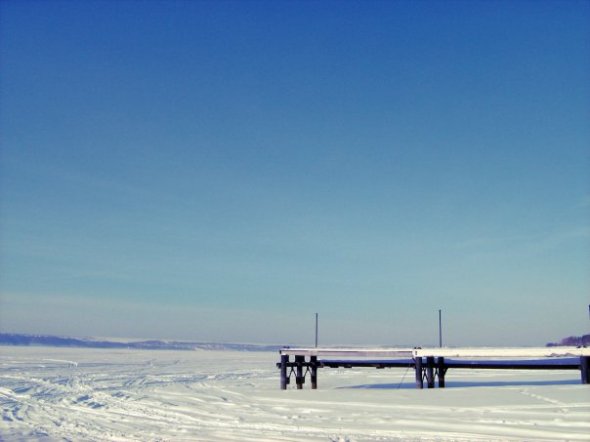
Since I’m rather old-fashioned, and prefer physical releases, to date I have four of Martin Schulte’s CDs, three released on Lantern/Nature Bliss and one on RareNoiseRecords. All are available at Darla Records (US Distributor). There are many other releases available, including some live recordings (see links at his Soundcloud page). Samples of each of his albums are shown below.
* – Although not essential, a subwoofer is a beneficial accessory for the full effect.
Slow Beauty (2012):
Treasure (2011):
Silent Stars (2010):
Odysseia (2009):
****
Please Note: With the exception of the cover of the album Silent Stars, all images are by Marat Shibaev and are used with the permission of Marat Shibaev who retains all rights, credit and copyrights to these images.

 wajobu