Independent Music & Equipment Reviews, Forthcoming Music Label & Sounds

Latest

Review: William Tyler – Impossible Truth

William Tyler - Impossible Truth

Merge Records CD MRG465 – Time: About 54 minutes

http://www.mergerecords.com/artists/tyler%20william and http://www.sebastianspeaks.com/

Tracks: 1) Country Illusion, 2) The Geography Of Nowhere, 3) Cadillac Desert, 4) We Can’t Go Home Again, 5) A Portrait Of Sarah, 6) Hotel Catatonia, 7) The Last Residents Of Westfall, 8) The World Set Free

I posit that William Tyler is a thinker, and is perhaps more comfortable expressing himself with music than with words (although his spoken thoughts on the Merge teaser video have a distinct and interesting clarity).  Tyler has worked in a number of bands prior to his solo albums including the Silver Jews, the ongoing experimental collective Hands Off Cuba and Lambchop (in addition to his record label, Sebastian Speaks).  Tyler’s work brings a wide range of colors and moods to Lambchop’s sound, where he has been a principal guitarist for many years.  Impossible Truth seems to me to be a more cohesive and mature work than his last solo album on the Tompkins Square label, Behold The Spirit.  Nonetheless, I urge readers to seek out this very strong album.

Behold The Spirit - WilliamTyler

The titles of the tracks on this album are like the names of short stories, and from the moment the cord is pulled on the first note of a track we are thrust right into the middle of the scene, without shyness or any lack of confidence.  It almost feels like Tyler propels a well-worn yet vibrant flywheel at the start of each piece, and from that moment he is shaping and sculpting the sound and mood until the story is told.


Country Of Illusion starts mysteriously and sounding rather exotic (as if from a foreign land, sitar-like).  There are sweeping passages envisioning a changing scene and then there are pauses (almost like a moment of contemplation) before moving through a sonic curtain and then the next passage of the tale.  Some tracks show a greater tenderness (with solo acoustic guitar) than others like We Can’t Go Home Again or A Portrait Of Sarah (although musically the latter is quite adventurous, as are many relationships).  The Geography Of Nowhere has a resonant otherness of being on the edge of consciousness and sensing the tangible without being able to actually reach it.  There are others like Cadillac Desert and Hotel Catatonia that present vistas as broad and intense as a Montana sky (and I never knew what a big sky looked like until I saw one).  The fretwork, picking and phrasing are tracing the landscapes and wrapping the listener in the gentle or gusty breezes of sound.

The Last Residents Of Westfall sounds like a scene from a dying or deserted town as the music pans to each of the buildings in the village, all with their own story to tell, some jaunty and others subdued.  The closing track of the album, The World Set Free is the most reflective, but it enlivens joyfully as the track progresses—the acoustic bass being a steady and forthright heartbeat, and finally William Tyler releases to a growling close.  I am trying to resist comparisons, but the opening section is similar to the instrumental sections of Nick Drake’s Bryter Layter.


Tyler disguises his guitars as many different instruments, and his musicianship and intense fingerings give a sense that more than one set of hands is at work, yet there is never a sense of Tyler playing a guitar hero—my guess is that he sees himself as quite the opposite.  Just like Lambchop, William Tyler blurs the distinction of musical genres; first this is an instrumental acoustic and electric guitar album, there are hints of twang, country and roots in it, but also some blues, folk and rock and roll.  Merge Records has a wide ranging catalog of musicians and has been around for more than two decades.  I just finished reading and thoroughly enjoyed their biography of the first twenty years of Merge, Our Noise.  Even though William Tyler has been part of the Merge family for many years in his work with Lambchop, I’m thrilled that he has released this latest brilliant solo album with Merge.  This is an album that I highly recommend.

Merge Records just posted this reinterpretation (homage?) to the film Two Lane Blacktop with A Portrait of Sarah as the soundtrack.


Marsen Jules – The Endless Change Of Colour

12k1074

12k Label – 12k1074 – CD Time: 47:00

Website: http://www.12k.com/index.php/site/releases/the_endless_change_of_colour/

When I was younger and had a completely untrained eye for seeing, as in art of any form, I didn’t realize how many colors went into what I saw, whether in a landscape or an object (same in the musical parallels).  It was later, seeing artwork at a museum (paintings up-close), dramatically enlarged photos, and a friend’s work in college (artist, Allen Hirsch) that I started to understand the density and complexity of color–as well as in sound and music, the overtones, harmonics and phasing in addition to the pure waves.

The Endless Change Of Colour affects me in two ways, creating a state of peaceful timelessness (wondering where that nearly-an-hour went) as well as producing a state of nearly motionless cascades of blending sounds that transmute into a sense of relaxing in a stream bed of flowing water on a warm summer’s day–when all else falls away and what remains is that moment.  All of this from a generative piece of music built from a single phrase on an old jazz record split into three audio stems.  The sounds (and side-effects) that without closer examination and contemplation, we wouldn’t normally sense except for the benefit of the time that this work seems to warp and retrograde during its existence.

There are brief moments when almost familiar sounds enter, only to be absorbed back into the metamorphosing blend.  I hear some parallels to the effects created by Nicholas Szczepanik’s brilliant album Please Stop Loving Me, although the feeling in Endless borders on that of a gentle voice on the edge of a dream–a peaceful sense of belonging.


Birds of a Feather – Part 3 – Broken Chip and Simon Whetham

Available at: http://www.flamingpines.com/

Broken Chip Wonga Pigeon

The Wonga Pigeon by Broken Chip

Sometimes there are things that I don’t want to end, but then they do, far too soon.*  This is how I feel about Broken Chip’s dreamy and elusive The Wonga Pigeon contribution to the latest pair of CD3s released in the Flaming Pines label Birds Of A Feather Series.  Broken Chip is one of the musical personas of Martyn Palmer, who is from the Blue Mountains of Australia.  Broken Chip has contributed to other Flaming Pines releases, and Palmer’s other nom de plume is Option-Command, for more electronic oriented works.  The Wonga Pigeon musically recounts a first mysterious encounter with an unknown bird.  Time passed and then the bird reappeared to finally be identified.  Despite the presence of (what appear to be) bird calls within the recording, it’s a piano (in my opinion) that takes on the guise of this particular avian creature.  All sounds, initially, are distant in the recording, indescribable, and ethereal.  Gradually, the identity coalesces, only to disappear back into the ether after a brief second chance encounter.

* – And so, I hit repeat!


Simon Whetham The Phoenix

The Phoenix by Simon Whetham

The Phoenix is the second CD3 of this latest pair of Birds…, and starts off like a shower of humidity encountered when disembarking from a plane in a distant land—the sudden shock of relocation.  The wall of omnipresent sound of the outdoors is from Phoenix Island in Cambodia and at first it is intense (mind your amplifier’s volume control!).  Eventually, the body and mind adjusts to this extraordinary new environment, and the sounds around eventually calm, and the vision of what was once like a blinding light comes into focus.  Water, wooded areas, bells and gongs can be heard from sound recordings made by Whetham in June, 2012.  In a way, the piece starts off with the fervor of the war endured by Cambodia and VietNam not so long ago, and the gradual calming could symbolize the peace that has slowly returned to these environs; The Phoenix rising, symbolically.  As with the previous releases in this series, I love the cover illustrations.


Kate Carr Landing Lights

Landing Lights by Kate Carr

Also, of note (and I have only heard these samples thus far), I am intrigued by Kate Carr’s latest new album Landing Lights.  I quite like the contrast of the growl of her guitar juxtaposed against the soft, floating keyboards as in the track My Brother Came To Stay…I wonder who the brother could be, in the mix?  I can’t imagine. 😉  Some samples from Landing Lights are below, so I am definitely interested in hearing more.

My Brother Came To Stay


Thunderstorm


Invention, Influence and Innovation – Bryan Ferry and Steven Wilson

When is a musical work true invention?  When is it referential?  When is it derivative?  Can a work influenced by previous work still be considered original or innovative?  I suppose these are questions that could spark a (sometimes heated) discussion like: “What audio speakers sound the best?  Is it the east coast or west coast sound?”  Often, the proper answer is: “What ever speakers sound best to one’s own ears.”

Generally, I think that most art, design and music works are built on the foundations that came before them and there really is little actual invention, more on the side of innovation or variants of an original.  Dig deeply enough and one even can see that Frank Lloyd Wright’s and other modern architectural works (many seemingly original) have been influenced by the works of others or by some reference to design in nature or distant history (like many of Wright’s LA houses of the 1920s being highly influenced by ancient Mayan temples).

Ferry Jazz    Wilson Raven

I’m certainly not an expert on the extensive back catalogs of Roxy Music, Bryan Ferry, Porcupine Tree and Steven Wilson (including Wilson’s various side projects), but I have enough of their music in my collection to know that I generally like their respective work (some albums, in my opinion, being better than others—that’s the subjective part, like the what speakers sound better question).  Bryan Ferry and Steven Wilson are from two different musical generations and have been influenced by different works and people, but there is some overlap.

Ferry has noted that much of his seminal listening, writing and songs were influenced by early and mid-20th century instrumental jazz (including Charlie Parker and Ornette Coleman): “I loved the way the great soloists would pick up a tune and shake it up – go somewhere completely different – and then return gracefully back to the melody, as if nothing had happened.”  With these influences and those of The Beatles, The Rolling Stones, The Who, Pink Floyd, King Crimson and others, Ferry’s band Roxy Music (with a number of different musicians, including Brian Eno and later Eddie Jobson) would go on to create quite innovative and often influential art-glam-pop-progressive rock works in the 1970s and early 80s in addition to Ferry’s distinctive solo works.

Steven Wilson works within a cauldron of many genres (progressive rock, metal, ambient and jazz fusion), and it’s clear from his remixing/remastering work (such as the King Crimson back-catalog, most recently Larks’ Tongues in Aspic) that he has both a deep affection for those influences as well as a respect for the history behind them.  Wilson’s latest album The Raven That Refused To Sing is steeped in a mind-bending brew of musical influences, yet stays safely on the side of creatively paying homage while avoiding pastiche or cliché.  Throughout the album he tips his hat with musical phrases and instrumental sounds that have kept me looking back into my music collection for their roots (a most welcome research project).

Steven Wilson – Luminol


Steven Wilson – The Raven That Refused To Sing


Whether it’s a soaring guitar bend of Pink Floyd, a vocal introduction reminiscent of McDonald and Giles’ Tomorrow’s People, a Mellotron phrase from Genesis’ Watcher of the Skies, an electric guitar intro akin to the band Focus, acoustic guitar phrases of Ant Phillips’ The Geese and the Ghost or flute phrases of Jethro Tull, Wilson and his current band blend these deftly into the rather sullen tale of The Raven…   I can also hear more recent parallels in the menacing track The Holy Drinker, to the works of (Miles Davis scholar) Bob Belden’s jazz-fusion Animation project (the recent post-9/11 track Provocatism from the album Transparent Heart).  The musical and sonic success of this album is also thanks to the great live studio engineering care of Alan Parsons and gifted musicians Nick Beggs, Guthrie Govan, Adam Holzman, Marco Minnemann, Theo Travis and Jakko Jakszyk who have interpreted Wilson’s vision into a cohesive and often stunning recording.  The dynamics and emotions are broad, from the aggressive percussion/bass opening to the somber balladic close of the title track.  There are minimal overdubs on the album, except for using an original King Crimson MKII Mellotron (recorded at DGM).

The Bryan Ferry Orchestra – Do The Strand


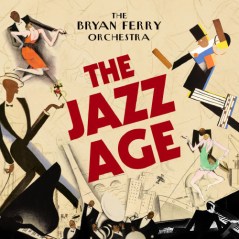
In contrast, Bryan Ferry is reinterpreting his own past work with vocals removed, leaving the melodies and harmonies of the original songs, and they’re are filtered through a time machine that brings the listener back to Ferry’s earliest musical influences—the sound, orchestration and recording techniques of the roaring and often buoyant 1920s.  Some fans of Roxy Music or Ferry’s original work don’t seem to appreciate the effort (especially the sound treatment, and the monaural recording), but being that I enjoy original pre-and jazz-age acoustic recordings, I think it’s a favorable re-examination of Ferry’s work while avoiding the temptation reissue yet another compilation for the sake of churning a back-catalog.  In fact, the recording sounds almost identical to the hi-fidelity of that period, a Victor Orthophonic reproducer and Victrola.

The Bryan Ferry Orchestra – The Jazz Age – The Reinterpreted Tracks


Bryan Ferry – The Jazz Age – The Original Tracks


I like both of these albums very much, for different reasons, and while they are clearly influenced by works before them, they stand very well on their own.  Are either as groundbreaking as King Crimson’s In The Court Of The Crimson King?  No (again, my subjective opinion).  On the positive side, after a somewhat cool start, Steven Wilson’s album has been growing on me (my favorite track, by far, is Drive Home), whereas I liked Ferry’s album almost instantly—I was hooked by Do The Strand.  Are either of these albums what I would consider the best of 2013?  It’s a bit early for that–let’s wait and see.

Steven Wilson – Drive Home


Review: Cory Allen – The Great Order and Pearls

TGOPearls

http://quietdesign.us/ and http://www.cory-allen.com/

Musicians: Cory Allen: Piano, Mike Vernusky: Bowed Classical Guitar, Nick Hennies: Bowed and Struck Vibraphone, Brent Fariss: Double Bass, Henna Chou: Cello

The Great Order: A: Movement I: 17:53; B: Movement II: 15:38

I enjoy listening to the Quiet Design podcasts with Cory Allen and Mike Vernusky (available free through iTunes).  They discuss observations on art, the world around, how music affects them and their sources of inspiration as well as the musicians and artists they interview, to date: Lawrence English, Simon Scott, Duane Pitre, Taylor Deupree, Sun Hammer, Wide Sky and others.  The topics are wide-ranging, often very entertaining and thought provoking.  I also appreciate the reflective consideration that Cory Allen brings to the development of his work, and to his experimentation with instrumentation (extant and invented).

TGO

From the first sedate piano note of The Great Order, to the almost shy conversation between guitar, vibraphone, cello, and double bass, there is a respectful and somber discipline, a regimen to this largo in two movements.  It is evident that there is a prescribed yet restrained foundation to this all-acoustic instrumental work.  This is an album about relationships and exploration: the musicians to their instruments, the instruments with each other and how the sounds sustain and resonate both in the recording and ultimately in the listening space (or headphones) and the ears of the listener.  No one instrument dominates, and it’s as much about the spaces between the music as it is about the sound.  The first movement is somewhat hushed, and the second movement has a slightly increased density of statement-response and layering among the instruments.  This is an album that also cleanses the mind and encourages contemplation.  The recording has a clarity and live presence that feels as if one is sitting in the room with the musicians, making it all the more intimate.


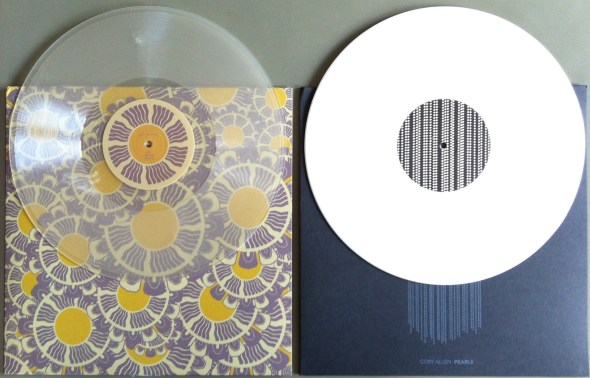
The album art and design are by Cory Allen, who has done an impeccable job with the entire package (the covers printed by Stumptown Printers in Portland, Oregon).  The limited edition LP is pressed in translucent clear vinyl.  Also, in conjunction with the release of The Great Order, Cory Allen has issued an LP version of his serene, beautiful and introspective album Pearls (from late 2010).  The first 100 copies of Pearls are pressed in white vinyl and 400 copies in black vinyl.  For a limited time, both LPs can be purchased at a special price from the Quiet Design website.  I’m also looking forward to Cory Allen’s ongoing experiments with his recently created multi-stringed instrument (a sound sample is below).

Pearls

Pearls: A: Strange BirdsLost Energizer 17:09; B: Isozaki CloudsBlue Eyes 18:52


What’s Spinning – Deep Winter Edition

I need some warmth on these cold winter days…

Ron Sexsmith – Forever Endeavour

RS 4EVRNDVR

http://www.ronsexsmith.com/

I love Ron’s work (another thoughtful Canadian songwriter—imagine that?!).  He writes such great songs.  My problem with his work, at times, is that sometimes his songs are just too sad, but Ron has a gift for making a sad song curiously uplifting, like Michael and His Dad from his last album Long Player Late Bloomer.  I started listening to Ron’s work in 1997 with his third album Other Songs (produced by Mitchell Froom and Tchad Blake—coincidentally Froom produced Suzanne Vega’s Nine Objects of Desire the previous year, another favorite album of mine).  Forever Endeavour is sparsely arranged, but strings, horn, percussion, pedal steel or electric bass are right there when they’re needed.  Other than that, the songs are Ron’s voice, and his acoustic guitar.  He has a gift for wordplay and expressing emotions with a deft efficiency that flow so naturally with his melodies.  Some songs on Forever Endeavour are ironically upbeat, like Nowhere Is and Snake Road—in a sense, keeping the faith.

The CD has two bonus tracks (songs written with Don Black and recorded by Don Kerr), Life After A Broken Heart and Autumn Light, and they are just plain gorgeous additions to this album.

Nowhere To Go


Lorna – Heart of Wire

WM34_300

http://www.words-on-music.com/index.html and http://lornatheband.com/bio/

This is Lorna’s third album on the Words On Music label.  The collective from Nottingham, UK creates dreamy contemplative songs with shy vocals and delicate harmonies.  I’ve read of some comparisons to Yo La Tenga, but Lorna’s instrumentation tends to be more complex, and chamber-like at times.  I think that this is their most direct album of the three for Words On Music—their sound is more confident, but they haven’t lost the softness and (at times) melancholy of their lyrics.  I think the strongest songs on this collection are As She Goes ByOld Shanklin Sunset and Mina and Marco (with a delightful melodic phrase sample borrowed from composer Edward Elgar).


Daphne Lee Martin – Moxie

DLM Moxie

http://daphneleemartin.com/ and http://telegraphrecordingcompany.com/

A woman after my own heart—part record store owner, part musician; for many years, Daphne has been part of the New London, Connecticut-based band Raise The Rent.  Moxie is the first of two releases (the forthcoming being Frost), and is a sultry collection of songs of the (only mildly) lurid backstreets of her imagination (with the added bonus of occasional Mellotron accompaniment!).  There are shades of the cheekiness of the Squirrel Nut Zippers and the “heat” of mid-1970s Maria Muldaur in this well-produced album.  I have an idea for what to expect from Frost—counterpoint!


Heligoland – Sainte Anne

Heligoland Sainte Anne

http://heligoland.org/ and http://heligoland.bandcamp.com/

Sainte Anne is the latest EP from the Paris-based Australian quartet known as Heligoland.  Their work in the last few releases has come under the wispy spell of producer and musician Robin Guthrie (who also plays occasional keyboards and bass), so it was only natural that I try their work.  My favorite tracks on this EP are Sleepless and 22 Miles—peaceful ethereal guitar and bass balanced with gently pulsing drums and Karen Vogt’s warm and full vocals (channeling, at times, the sound of Christine McVie with a bit of vibrato).  Other band members are Dave Olliffe (guitars and keyboards), Steve Wheeler (bass) and new member Antti Mäkinen (drums and percussion).  Their previous albums and EPs include: Bethmale (recorded in 2010 and released in 2012), All Your Ships Are White (2010) and A Street Between Us (2006).


Corazón from their album All Your Ships Are White


And even more wonderfully creative releases from the Flau label in Japan…  I can’t possibly buy them all, so one must be…somewhat…selective.

http://flau.bandcamp.com/ and http://www.flau.jp/top.html

The Boats – Our Small Ideas (2012 Edition)

The Boats OSI

http://oursmallideas.tumblr.com/

I have thoroughly enjoyed the various releases by The Boats (Craig Tattersall and Andrew Hargreaves with Danny Norbury, Chris Stewart and others).  Our Small Ideas is a re-release and enhancement of an original 2008 CD-R.  Contained in this work are the often quirky and sometimes fragile and nascent threads of pieces to be released later (and some are quite recognizable).  This album is not unlike the approach of CD #1 of Tape Loop Orchestra’s The Words On My Lips Is Your Name/The Burnley Brass Band Plays On In My Heart.

Sound samples are here (since The Boats seem to eschew Soundcloud): http://www.flau.jp/releases/r09.html

El Fog – Reverberate Slowly

El Fog RS

This is a solo project of Berlin-based vibraphonist Masayoshi Fujita, a light blend of acoustic instrumentation with a tranquil late night aura of electronics and subtlest of glitchy rhythms.


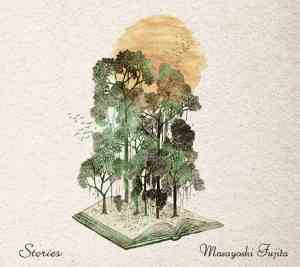
Masayoshi Fujita – Stories

MF Stories

http://masayoshifujita.com/

Stories is an album of solo acoustic vibraphone works (with occasional violin and cello).  Whether struck gently (as in Snow Storm) or bowed (as in Cloud), Fujita paints vivid, yet tender sound pictures.  Some pieces are rhythmically playful, and could form the foundations for musical conversations (much like those between Bill Bruford and Michiel Borstlap on their album Every Step A Dance, Every Word A Song).  This is an appropriate soundtrack for gently falling snow.  The album is beautifully mastered by Nils Frahm.


Swan and Morning Dews


Graham Gouldman – Love and Work

GG Love And Work

http://www.grahamgouldman.info/

Graham Gouldman has been writing songs since the days of The Yardbirds (For Your Love), and many others like Wayne Fontana and the Mindbenders, before formally crossing paths with Eric Stewart, Lol Creme and Kevin Godley (Hotlegs) who later became 10cc with a long string of albums with sharp, witty and often sardonic songs.  Love And Work is an album of twelve beautifully crafted and wide-ranging songs.

The album dedicated to the memory of Andrew Gold, and the song Daylight is about Andrew.  They worked together as the duo Wax and earlier on some of 10cc’s later albums.


I’ve seen Graham and Ron Sexsmith appear together on BBC Songwriters Circle programs.  Perhaps Graham and Ron will work together someday…


For Your Love


Happy Listening–Stay Warm!

Celer – Black Vinyl Series – Parts 4 and 5

Celer Immensity Plasma

Diving Into The Plasma Pool – Part 5 Black Vinyl Series

Side A: Resting On Intensity 20:33  Side B: Swelling That Saves Me From It 20:10

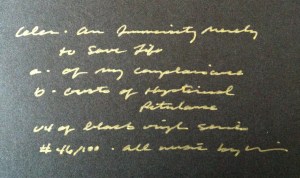
An Immensity Merely To Save Life – Part 4 Black Vinyl Series

Side A: Of My Complaisance 18:27  Side B: Gusts of Hysterical Petulance 19:05

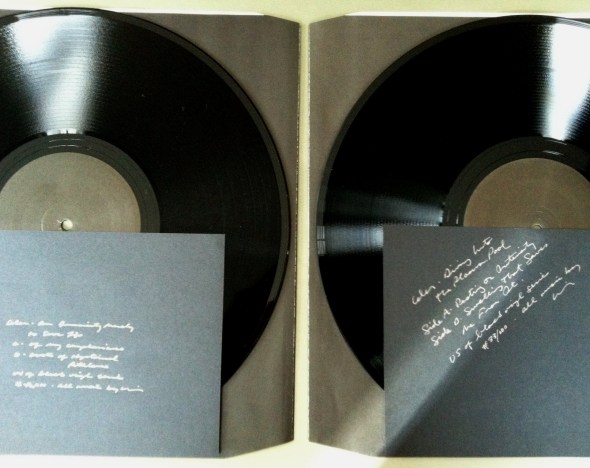
Self-released Limited Edition of 100 copies on black vinyl with matte black paper sleeve with handwritten credits

Celer’s Websites: http://thesingularwe.org/celer/ & http://celer.bandcamp.com/music

Plasma

Insert for Diving Into The Plasma Pool

I almost missed them entirely, but something appeared on my screen in late January, and within 5 minutes I was transported to a perfect sunny day, in the middle of a gently rolling sea, on a reach in a sailboat, and to a sonic warmth that dissolved the doldrums of my winter reality.  It was Diving Into The Plasma Pool, the latest (and I think last) of the five part Black Vinyl Series by Celer (Will Long).  For whatever reason, I missed parts 1 through 3, but as soon as I heard a sample from Resting On Intensity (Side A), I looked to see if there were other LPs still offered—and indeed, Part 4 was (and is) still available.  Part 4, An Immensity Merely To Save Life starts a bit darker with Of My Complaisance (Side A) and then softens with Gusts of Hysterical Petulance (Side B).

Immensity

Insert for An Immensity Merely To Save Life

The subtle enmeshed loops of Diving Into The Plasma Pool flow like Debussy’s Nuages and yearn (although more gently) like Nicholas Szczepanik’s Please Stop Loving Me—they are waves that crest, hold onto a pleasurable edge and then dissolve.  The chords and sounds are right in my sweet-spot.  But enough from me; just listen—better yet, buy one or both of them.  They’re gorgeous, full and resonant—simply magical.

Part 5 (available here): http://celer.bandcamp.com/album/diving-into-the-plasma-pool


Part 4 (available here): http://celer.bandcamp.com/album/an-immensity-merely-to-save-life


Catching The Groove with Martin Schulte

MartinSchulteB

More information on Martin Schulte: https://soundcloud.com/martinschulte

Musician and DJ Martin Schulte is the nom de plume of Marat Shibaev, who is from Kazan, Russia (about 500 miles east of Moscow, in the Republic of Tartarstan).  Whether working, relaxing or out for a night, there are times when a groove just needs to be caught, and Martin Schulte helps get me there.  Without getting too much in the sub-genres of his music (which could spark a debate like which speaker is the best, in audio circles), let’s just stick with words like Electronica, Techno with small doses of ambient field recordings.

MartinSchulteC

His music is solidly rooted in analog modular sequenced synthesizer works (latter day Kraftwerk, for example).  His latest album Slow Beauty is inspired by photography and memories, including images he has taken of the beautiful landscapes near his home (in sharp contrast to the stark winter vista depicted on some of his previous albums).  Some tracks have deep visceral* grooves, others are more delicate, sampled and atmospheric, but there’s always infectious motion involved.  I have favorites on all four of his albums that I’ve referenced—excellent soundtracks for all sorts of places and experiences.

MartinSchulteA

Since I’m rather old-fashioned, and prefer physical releases, to date I have four of Martin Schulte’s CDs, three released on Lantern/Nature Bliss and one on RareNoiseRecords.  All are available at Darla Records (US Distributor).  There are many other releases available, including some live recordings (see links at his Soundcloud page).  Samples of each of his albums are shown below.

* – Although not essential, a subwoofer is a beneficial accessory for the full effect.

Slow Beauty (2012):

Treasure (2011):

Silent Stars (2010):

Odysseia (2009):

****

Please Note: With the exception of the cover of the album Silent Stars, all images are by Marat Shibaev and are used with the permission of Marat Shibaev who retains all rights, credit and copyrights to these images.

Chris Dooks / Machinefabriek – The Eskdalemuir Harmonium

Eskdalemuir

LP Title: The Eskdalemuir Harmonium

N-LRoS-EH

EP Title: Non-Linear Responses of Self-Excited Harmoniums

Komino K0M1N0-004 (Vinyl LP & Digital w/ EP) Time: LP About 36 Minutes EP About 13 Minutes

Record Label: http://kominorecords.com/

Chris Dooks: http://www.dooks.org/  More on the LP trilogy: http://www.idioholism.com/

Machinefabriek: http://www.machinefabriek.nu/

Tracks LP (LP & Digital): 1) The Pike Knowes The Loupin’ Stanes; 2) Betamax and Dictaphones; 3) Ewe Knowe The Girdle Stanes; 4) Settlement

Tracks EP (Digital): 1) Steady States and Transient Oscillations; 2) Aerodynamic Excitation of the Harmonium Reed; 3) The Motion of Air-Driven Free Reeds

Authentic, synthetic, living, languishing, animate, inanimate, well, ailing, history and the now: these are the explorations of the latest collaboration of Chris Dooks and Rutger Zuydervelt (Machinefabriek).  Like many, I have always been drawn to the old and mysterious, wanting to know more about the history of things, the times in which they existed (and in this case, what hands and feet brought these venerable machines to life).  Harmoniums are vestiges of another time (mostly from the late 18th C through the middle 20th C), inanimate objects, strangely biomorphic in their inner workings that are revived with physical exertion, air in their bellows (the lungs) and resonant metal reeds producing the sounds (the vocal chords).  Neglected harmoniums often mournfully creak and object to being revived after long slumbers.  A friend of mine once used the term “lumbering harmonium” to describe his relic on an instrument—curiously descriptive in both reality and material (when the verb is used as a noun).


These soundtracks depict a retreat of solitude into the Scottish countryside, one of a series of three projected works and part of Chris Dooks’s PhD research in sound art and medical humanities, as well as response to a chronic illness; the search for comfort and rest through improvised sonic threads (passed between Dooks and Zuydervelt during their development) that were crafted from music, field and voice recordings.  The resulting drone-like ambiance is a fascinating and relaxing journey with sociological, archaeological and radio documentary parallels.  Thanks to the on-location recordings, there is a strong sense of place and memory imbued into this album.

IMG_3212

The recordings, liner sleeve and notes, photographs and graphics are impeccably produced as is the ruby red vinyl LP.  This is the second Komino Records LP that I have acquired (the first being Kyle Bobby Dunn’s In Miserum Stercus, which I reviewed in late 2012).  The digital EP presents additional serene field and harmonium recordings—a beautiful production overall.

The next album in the series will be Three Hundred Square Miles of Upwards.

Pre-Master Recordings from Three Hundred Square Miles of Upwards


The third album will be CIG{R}LES.

Pre-Master Samples from CIG{R}LES


Review: Celer – Without Retrospect, the Morning

Celer WR,tM

Glacial Movements Records – GM015 (CD) Time: 52:13

Artist Websites: http://thesingularwe.org/celer/ & http://celer.bandcamp.com/music

Record Label: http://www.glacialmovements.com/ & https://soundcloud.com/glacial_movements

Tracks: 1) Holdings of Electronic Lifts; 2) A Small Rush into Exile; 3) Dry and Disconsolate; 4) Variorum of Hierophany; 5) A Landscape Once Uniformly White; 6) Distance and Mortality; 7) With Some Effort, the Sunset;

Although not as indiscriminate as is denoted by the term, I am often a completist when it comes to collecting the works of selected authors and musicians.  Yet, I would be hard-pressed, given his massive output of creative work, to even begin to collect all the music of Will Long in the guise of Celer.  By now, I probably have a dozen or so of Celer’s recordings, but if I had to recommend one and only one recent work, it might just be this almost mystical and entrancing album.   I’m also drawn to this release since it fulfills one of the most significant inspirations for why I listen to music—it takes me somewhere, and the images and sensations are vivid.

Album Samples


This is the third work in a trilogy based on water (to some, water symbolizes comfort and freedom).  The two previous albums are Cursory Asperses (2008) and Escaping Lakes (2009)—the former alluding to the slow movements of small streams and the latter to the calmer depths.  The music on this album being inspired in part by Will’s trip to southern Alberta in 2009 (documenting the wilderness in photographs for a local Park Service).

Without Retrospect, the Morning is different from the first two in the series in that it has distinct tracks (versus a continuous thread of sound) and it captures water (or the sense of it) in a different state—a chilled desolation, at times at the edge of an existence where the potential energy is stored and released ever so sparingly in a landscape yearning for Sun and warmth.  It’s therefore appropriate that this album landed at the Glacial Movements record label, a self-proclaimed “glacial and isolationist ambient” label.  I also appreciate that the recording has been mastered with a softness that retains the intricate clarity of the many layers of sound buried in the crystalline strata (to heck with the loudness wars!).  There are also hidden sonic depths, and some passages might be felt before they are heard (as in Dry and Disconsolate).

A lateral effect of this CD is that it triggers (for me) some pleasant, albeit quirky, sonic memories from long ago.  I’m a fan of the original 1960s Star Trek.  There was some great incidental music and ambient sounds used in that series that, to my ears, are recalled in a track like Distance and Mortality (see if you hear the resonance of the wind from the pilot episode, The Menagerie or the sound of the transporter beam).

Distance and Mortality


So find a quiet room, bundle-up, get comfortable, and explore stunning breadth of this vast hyperborean landscape.  Just remember to turn the volume back down on your amplifier before you change the sources on your preamp or pop-in another CD.

MINDBENDERS

Learn, Ponder, Discuss

richard jefferies

visionary author and naturalist (1848-1887)

My Patronus Is Coffee

Life is Messy. Send Coffee and Posh.

Wendy Artin, photos from the exhibition

This is a blog with news - to see Wendy Artin's website, please visit www.wendyartin.com

JAZZ LIVES

MAY YOUR HAPPINESS INCREASE! "Lives" is both noun and verb.

No More Workhorse

Appear highbrow without trying by reading...

Stationary Travels

Journeys in Sound & Music

The Oxford Culture Review

"I have nothing to say, and I am saying it" - John Cage

Kendra Steiner Editions (Bill Shute)

publishers and champions of contemporary poetry and experimental music from San Antonio, Texas

monty adkins | SKRIKA

composer | dark ambient sound artist

Sunnymeade Astro

An Amateur Astronomer's Observing Diary from the Welsh Border

Wist Rec.

Handy Music Handmade

Somme Battlefields

WW1 Centenary website by Paul Reed

WW1 Centenary

Great War Centenary 2014-2018 website by Paul Reed

Out of Battle

Musings of a Military Historian

The Echoes Blog

The weblog of Echoes, the nightly music soundscape on Public Radio and the internet.

gleamingsilverribbon

Words, sounds and pictures by Kate Carr