Independent Music & Equipment Reviews, Forthcoming Music Label & Sounds

Latest

Review: Roger Eno – Ted Sheldrake

Backwater Records OLKCD023 – Time: About 42 minutes (CD & Digital Files)

Record Label Website: http://www.backwaterrecords.com/

Artist Websites: http://rogereno.co.uk/ and http://rogereno.com/

Tracks:  1) You’re Just A Bloke; 2) All In A Garden; 3) The Old Queen’s Head; 4) There’s Something Wrong With Ted; 5) The Cold Night Is Over; 6) Marrers; 7) My Old Bike; 8) You’re Just A Bloke (Ted); 9) Moon Waltz; 10) Ever True; 11) Sally; 12) Bittersweet; 13) Ted’s Funeral Music

I find it hard to believe that my original LP copy of Apollo (Brian Eno, Daniel Lanois and Roger Eno) will be thirty years old in 2013, but there it is—one of the great albums of the ambient music genre.  When I think of Roger Eno’s music over the years, three words come to mind: thoughtful, quirky and sometimes playful.  Whether lyric or instrumental, RE’s works tell stories that can either be tightly sewn threads or loosely knitted yarns.  Often, the subjects are quiet ruminations, but they can also be spirited and cheerful.  His works can also be rather enigmatic, as noted in an autobiographical analysis from his website: [He is] “On an ongoing and heterogeneous musical journey which twists and turns and goes whichever way you think it won’t.”

Roger Eno entered the professional music scene with Apollo after music lessons and college to study music (as a multi-instrumentalist and singer), as well as running a music therapy course at a local hospital.  In addition to working with his brother Brian, Roger has collaborated with artists including Bill Nelson, Kate St. John, Lol Hammond, Peter Hammill and Michael Brook, and has provided soundtracks for films and advertisements.

RE’s most memorable albums for me (of his 25 or so) include: Voices (1985), The Familiar (w/ Kate St. John, 1993), Automatic and Excellent Spirits (both with Channel Light Vessel, 1994 and 1996), Lost In Translation (1995), Swimming (1996), The Music of Neglected English Composers (1997), and more recently Fragile (Music) (2005), Anatomy (2008) and Flood (2008, a reinterpretation of a soundtrack constructed for Salthouse Art Festival in North Norfolk).  I hope that Roger works again with Kate St. John and Bill Nelson; their work together on The Familiar is some of the most touching and enchantingly inspired work that I have in my music collection.

Ted Sheldrake is a departure from Roger Eno’s instrumental ambient work; originally a quiet neighbor and later a friend, it’s a tribute to a life, and even though it takes place in recent times, it could have just as easily taken place a hundred years ago—in many respects it did.  It’s a familiar story in literature as well.  In Victorian times, Richard Jefferies told the stories of common labourers, from the farm fields in his books like Green Ferne FarmRound About A Great Estate (both from 1880), The Life Of The Fields (1884), and in newspaper articles during that time in the late 19th century.  In the first half of the 20th century Henry Williamson also wrote of life in a West Devon village known as Ham (The Village Book and The Labouring Life in 1930 and 1932, respectively) and described the country life in the narrow village streets, fields and hedgerows, “local colour”, and stories of the “everyman”.

The compiled, mostly song-oriented work traces Ted in East Anglia (Suffolk and Norfolk, UK), being from a family of hearty stock, farm labourers and fishermen, and he spent his years working on an estate and living in a village where the pace of life was slower and the work was hard, but satisfying.  In his younger days Ted learned to play a melodeon (hand organ), and as the years passed he became known for composing and performing songs in local pubs and village halls.  In his later years, following his retirement, TS suffered the loss of his beloved wife, and something changed in him and it comes through in his music.


The album is divided, the way I see it, into two sections (observations and then reflections) and includes a number of recordings (songs, spoken word with accompaniment, and instrumental) made on location with cast of characters and talent connected to his life.

You’re Just A Bloke is an introduction to Ted’s work through the voices of others; a group interpretation of this universal and common man.  This is the first indication that Ted’s work and life isn’t embellished with ornate descriptions, he’s the “real stuff”, with genuine words.  Village life includes folks gathering in thatched cob or flint-walled cottages, village halls or pubs, and the jolly and perceptive All In A Garden brings this experience to life.  Ted’s songs are also a bit like tiny memoirs, recounting special occasions and getting spiffed-up for The Old Queen’s Head.

As time passes, Ted’s meager existence and loss of friends weighs on him.  Some around him sense a change in his countenance.  There’s Something Wrong With Ted tells the worry of a friend, layered austerely with piano and a keyboard.  The Cold Night Is Over is the beginning of Ted’s reflections of melancholy and pastoral memories of the farm fields and long views to the sea.  Marrers (marrows or zucchinis) is perhaps the most beautiful track on the album—deeply reflective, and one of the main reasons Ted would still rise in the morning—for his garden; at first a lone piano, then an open and sincere expression of longing.  The melodic theme is expanded modestly (and somewhat cheerfully at first), this time overlaid with memories in My Old Bike.  Ted’s is a simple life in the village, never needing to leave East Anglia, and now missing his dear wife.


The original version of You’re Just A Bloke is rendered by Ted—directly, perhaps even more so than Hemingway.  The last section of songs (with piano) present Ted’s most personal feelings, the endearing yet untrained voice, and uncomplicated romanticism of Moon Waltz and Ever TrueSally is an instrumental tribute to his wife, which is proud and forthright.  Bittersweet is apparently Ted’s last song, interpreted by an ensemble of his mates (documented by local schoolteacher Miss Kemp—Ted didn’t write music, he just played it).  The final tribute to his life is the piece Ted’s Funeral Music, which sounds like it’s played on an old harmonium or church organ.

So, slow the world down, set a spell, and get to know Ted Sheldrake and his humble existence.  He might turn out to be someone you know, and it’s a simply delightful chronicle.

Ted Sheldrake will be released on January 7th, 2013.
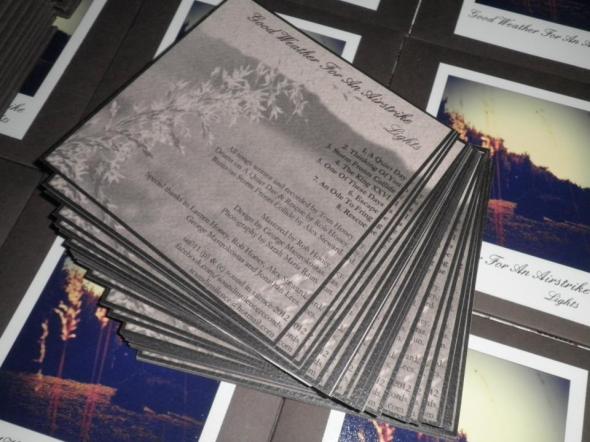
Review: Good Weather For An Airstrike – Lights

Sound In Silence SIS011 – Time: About 40 minutes (CDr & Digital Files)

Record Label Website & Contact: https://www.facebook.com/soundinsilencerecords & http://www.myspace.com/soundinsilencerecords E-Mail: soundinsilence@hotmail.com

Artist Website: http://goodweatherforanairstrike.bandcamp.com/

Tracks: 1) A Quiet Day; 2) Thinking Of You; 3) Storm Fronts Collide; 4) The King XXVI; 5) One Of These Days; 6) Escape; 7) An Ode To Fring; 8) Rescue

The sounds that keep one up at night; they could be the house creaking, babies crying, traffic on the streets, the sounds of animals stirring outdoors, and my personal favorite the hoots of owls sending messages to each other in the dark.  In the case of Tom Honey (aka Good Weather For An Airstrike), what keeps him up at night is the ringing in his ears—tinnitus.  So, in 2009 Tom started his GWFAA music project as a means to help him relax and get to sleep (sounds like a candidate for a Slaapwel project too).  I know of at least six releases by GWFAA since 2009 (with labels Hibernate, Rural Colors, Bad Panda, Audio Gourmet, Sonic Reverie and his own Hawk Moon Records), but I’m sure that there are more, including his most recent and lovely tribute EP to his wife Lauren entitled This Is As Good A Place As Any.

His latest album Lights is to be released by the small independent Greek record label Sound In Silence (their contact information is noted above) in a hand made sleeve and is limited to 200 copies.  The album is arranged a bit like a meditation session, with instrumentation including guitar, banjo, strings, piano and percussion.  The sound is steadier and fuller than many recent ambient albums, and I’ll resist the temptation to compare GWFAA’s sound to the works of others.

A Quiet Day begins softly before introducing a calming and guiding pulse with a mantra first from a piano and then supplemented by gentle percussion.  Once in a more focused state Lights goes deeper, into the tranquil canon-like Thinking Of You.  There isn’t a feeling of yearning here for what cannot be or the unattainable; there is just an idyllic state of belonging.

Thinking Of You


As with any period of slumber, the brain still sends signals to be processed, and periodically there are voices, broadcasts and sounds that appear to be sorted-out.  Dreams send flashes that are discernible and other times are fleeting and out of reach.  Storm Fronts Collide returns to the time of the Paris Peace Accords and the VietNam War in 1973—voices from the past (forgotten by some and unknown to others, except those who lived through those times); the codified yet unratified tragic melancholy that sometimes enters the drifting mind.  The King XXVI and One Of These Days are also brief episodes in the sequence of reverie with the sounds of the outdoors and the cheerful voices of children.

Escape is a transition to the last section of the album, an arrival at pleasant and calmer memories.  The mind is no longer distracted and has returned to the center in An Ode To Fring, perhaps from halcyon recollections of East Anglia, Norfolk.  Rescue closes the album, and it is both the final state of slumber and the slow return to the conscious world.  The opening theme of the album is more broadly reprised like the rising sun not yet seen, but still a signal to an awakening.  Enjoy your travels, and the weather.

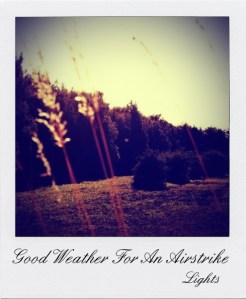
Photo Courtesy of Sound In Silence

****

This is a solicited review

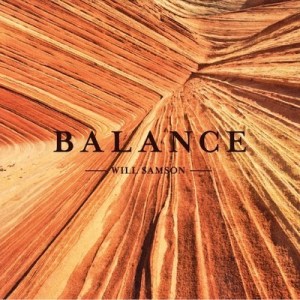
Review: Will Samson – Balance *UPDATED with VIDEO*

Karaoke Kalk 69LP – Time: About 34 minutes (LP, CD & Digital Files)

Record Label Website:

http://www.karaokekalk.de/ & http://www.karaokekalk.de/will-samson-balance/

Artist Websites:

http://willsamson.bandcamp.com/ & http://wsamson.tumblr.com/ & http://willsamson.co.uk/

Recorded & Mixed By: Florian Frenzel & Will Samson  Mastered By: Nils Frahm

Tracks:  1) Oceans Are Wilder; 2) Cathedrals; 3) Hunting Shadows; 4) Eat Sleep Travel, Repeat; 5) Painting A Horizon; 6) Music For Autumn; 7) Storms Above The Submarine; 8) Dusty Old Plane

Some may recall my review of Will Samson’s last album Hello Friends, Goodbye Friends (there’s a link to it on the right of this page, near the bottom of the list or use the Search box).  HFGF was timely; it rang like a beacon of hope.  It was a pretty special thing to think that a 20-something had such an affect on this 50-something, but there are all kinds of wisdom floating around and sometimes age really doesn’t matter.  I don’t mind admitting this at all, as it has been music that has helped me at many times throughout my journey in this life.  So, at the first mention from Will that he had another album in the works, I was excited; resisting temptation to listen to early previews, preferring to wait for its full and formal release.  So, I ordered the LP, with the striking cover photo by Scott McClarin.

It was worth the wait.

From the first celeste (vibraphone?) notes and soft vocal harmonies of Oceans Are Wilder, I knew that there was a great synergy in Will’s work with Florian Frenzel and Nils Frahm—complementing the music and lyrics so well.  As the album progresses it moves from a soft state of consciousness to a deeper meditation (with one brief diversion).  There is a lovely balance of instrumentation, vocals, ambient sounds and the outdoors.  These are songs of friendship, strange journeys, and visits to places real and imagined.  The mix of six vocal songs and two instrumental respites is a bit like Nick Drake’s second album, Bryter Layter.


Samson continues to use his upper register (and falsetto) voices prominently, although there are times when full-throated harmonies are blended.  Vocals are also fuller in the mix of this album, and the overall sound is different; the result of using venerable analogue equipment, tapes (old cassettes, a Tascam 8-track) and working with Florian Frenzel’s salvaged organs, analogue tape delays and old microphones.

The ambiance of the analogue equipment is strongly present in Cathedrals, it gives a misty quality to the sound, a sense of the ancient, like the foxed pages and deckled-edges of aged books or the opening title sequence to an old film.  In particular, I think the layering of sound is particularly strong, starting with simple acoustic guitar, then unadorned vocals, then vocal harmonies added ending with the lyric “That spin so separately…” and then an abrupt and lyrical chord change into “Impossible became much easier…” and shifting to an electric guitar drone to the end—it’s mystical and soulful.


Hunting Shadows is an outdoor walk, and the music and treatments take the place of moving light, shadows and the lightly moving breezes of a new day.  Eat Sleep Travel, Repeat has the ambiance of being aboard a ship at sea late into the night, composing (acoustic) music by candlelight and the stars, with slow swaying movements, as does the more electric (with broad vocal harmonies) Painting A Horizon.  The trombone solo in Eat Sleep is an impeccable complement as are the banjo and cello on Painting.  There are similarities with the more plaintive side two of Brian Eno’s album Before and After Science, the three tracks Julie With…, By This River, and Spider and I.

Eat Sleep Travel, Repeat (Premiere Video)


The second instrumental piece (again, with cello) on the album is Music For Autumn.  It’s as if the sun is lowering in the cool night sky and as the track closes, Samson adds a warming chorus of voices.  The brief diversion noted above is Storms Above The Submarine, which starts playfully, with furtive notes, sounding a bit like some sonic experiments of Raymond Scott.  Then a somber throaty organ mixes with Will’s overdubbed voices (which are treated to sound a bit like a mournful saxophone) and altered guitars.  Dusty Old Plane (and oh so beautiful, it is) closes the album, with practically a whisper of droning keyboard, reverberant electric and acoustic guitars and Samson’s harmonies.  Listen carefully; there are birds in the background.  This peaceful track is a sonic blessing, and a farewell of sorts.  I also note that this album is dedicated to his father.

Please keep making music Will; you have a true gift.

****

A postscript: I have only one (hopefully received as constructive) comment on what is otherwise a brilliant album, and that is to recommend to not let the desire to use aged and lumbering analogue equipment for ambiance shroud the quality and beauty of the music too much.

Flaming Pines Label

Record Label Website: http://www.flamingpines.com/

Soundcloud Page: http://soundcloud.com/flaming-pines

Bandcamp Page: http://flamingpines.bandcamp.com/

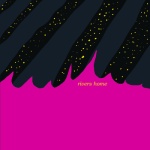
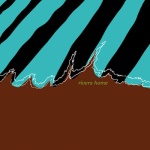
I am always looking for new and interesting music, and often works with a message or a foundation.  Late in 2011, I came across a label from Sydney, Australia named Flaming Pines.  I first noticed an EP release by Marcus Fischer and then realized that it was part of a series entitled Rivers Home.  The first series consisted of 5 separate 3 inch CDs, each with works by a different artist (Marcus Fischer, Kate Carr, Field Rotation, Broken Chip and Billy Gomberg).  There was also a common theme to the CDs, and I immediately took note of the striking cover artwork.  Rivers Home (and its later Part Two with releases by The Boats, Seth Chrisman, Dan Whiting, Savaran, and All N4tural) “…celebrates the wonder of rivers at a time when many of them are particularly vulnerable.  Many of us dream about rivers, ride along rivers, take ferries along rivers and sit on river banks. This series is a musical exploration of the ways we influence rivers and they influence us.”  The founder of Flaming Pines it turns out is Kate Carr, whose work is also featured in the series.  Kate also produces the artwork for the covers.  I ultimately bought the entire set.  Many of Flaming Pines’ releases are mastered by Taylor Deupree of 12k.

Marcus Fischer – Willamette River


The Boats – River Calder


Recent releases include a split album by Kate Carr (Blue) and Gail Priest (Green), which is an exploration of sound and color.  The last track of each side serves as a transition to the other side of the LP, and the color references are subtle (as colors are muted at dawn and dusk), and reveal the natural world with field recordings and gossamers of acoustic and electronic instrumentation and effects.  The LP silences the distracting world around and reveals the many things missed in the background as the days and seasons come and go all too fast.  The LP is a co-production of Flaming Pines and Metal Bitch Recordings.

Kate Carr – Excerpt from Blue


Gail Priest – Excerpt from Green


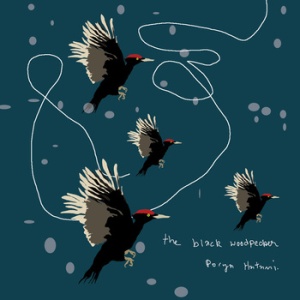
Just released in September is the next series of EPs on a theme, this time Birds Of A Feather, and the covers keep getting better!  The first two are the Black Woodpecker by Iran’s Porya Hatami and Great Northern Loon by Canadian Michael Trommer.  Carr notes of this series, “…the role of birds as muse, as musical guide and inspiration has been well documented in classical music, from Mozart’s pet starling to Beethoven’s birdsong filled Pastoral Symphony and Sibelius’s swan hymn to Messaien’s birdsong compositions.  Birds Of A Feather celebrates the role of birds in ambient music, and the beautiful fragility of birds more generally.”  Both of these EPs are deeply layered soundscapes with field recordings of the chosen birds and environs mixed with acoustic and electronic instrumentation that heighten the experience.  It’s like getting lost in the woods or paddling a canoe on a hidden lake.

As with Rivers Home, Birds Of A Feather will be a series of about 12 three inch CDs released as pairs in editions of 100 over the next year.  The next pair of CDs will be by The Green Kingdom and Darren McClure.

My favorite of the cover artwork thus far is the expressive Black Woodpecker.

Michael Trommer – Great Northern Loon Excerpt


Porya Hatami – Black Woodpecker Excerpt


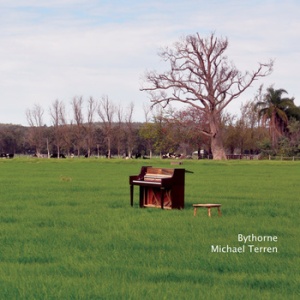
The latest October release is a debut by Michael Terren entitled Bythorne, who lives in far western Australia in Perth.  In June of this year, he strapped his piano to a trailer and drove it 200 kilometers to a farm of his childhood.  There he recorded this EP of six compositions (Cureaking, These Ones, All Nine of Them, Midiology, Bythorne and Dardyboys).  The tracks echo the surroundings and ever-changing weather (from placid blue skies to sudden stormy weather in from the Indian Ocean) as well as the pastoral timelessness.  I get a strong feeling of the sense of place from the beautiful title track.  The sleeve is handmade and the EP is limited to 100 copies.

Michael Terren – Bythorne


Review: Animation – Transparent Heart

RareNoiseRecords RNR028 – Time: 76:59 (CD & Digital Files)

Label & Soundfiles: http://www.rarenoiserecords.com/jukebox/animation/transparent-heart/

Artist Website: http://www.animationismusic.com/

Band: Bob Belden: sax/flute; Peter Clagett: trumpet & effects; Jacob Smith: bass; Roberto Verastegui: keyboards & samplers; Matt Young: drums

Tracks: 1) Terra Incognito; 2) Urbanoia; 3) Cry In The Wind; 4) Transparent Heart; 5) Seven Towers; 6) Provocatism; 7) Vanishment; 8) Occupy!

Bob Belden is a composer, arranger, conductor, musician as well as past head of A&R for Blue Note Records.  He is also has a strong sense of the history of Jazz, including being a scholar of the works of Miles Davis, and having received Grammy Awards for the reissues of Miles Davis’s work on Columbia Records.  In his own work, Belden is a story-teller of the lives of others, whether orchestral, jazz-fusion or soundtracks.

Perhaps his best known works are the 2001 Grammy Award-winning Black Dahlia (the mysterious tragic death of actress Elizabeth Short’s in 1947) and the more recent collective world jazz fusion productions (with Miles Davis alums) Miles From India (2008), and Miles Español – New Sketches of Spain (2011).  In the guise of the project known as Animation, Belden released the album Asiento in 2010, a live interpretation of Miles Davis’s 1970 album Bitches Brew, along with a 2011 3D60 surround sound remix of the album, entitled Agemo (both on RareNoiseRecords).

Belden’s latest album Transparent Heart represents a shift in his work; this time the story is his own.  It is a musical memoir of his life in New York City for more than the past three decades, and the dramatic changes seen since his first arrival in Manhattan in 1979 with Woody Herman’s band—the post-disco era.  Not only is this album personal, it’s also a social and political history and commentary of this period.  There are common threads throughout the decades (not the least of which is fear: from Communism to terrorism and the latest, the corporate takeover of America and the rise and fall of Wall Street and the financial sector and the revolt against it and corporate dominance).

During this period there was a gradual change from the mean streets of the 1970s (as depicted in the films French Connection, Dog Day Afternoon, Serpico and especially my favorite Taxi Driver) to the gentrification and commercialization of many areas throughout the five boroughs of NYC.  We have seen huge changes since the 1970s in the music and arts scene, and in places like Times Square, Harlem and Greenwich Village.  New York City in 1979 was a LONG way from Belden’s own home in Goose Creek, South Carolina.  For Transparent Heart, Belden assembled a group of young musicians from his alma mater, the University of North Texas, ranging in age from 19 to 32.

Like the opening to a 1970s era film, Terra Incognito is the overview, the panning shot of Manhattan with its cavernous avenues of towers, and Belden’s first impressions seen wide-eyed with young optimism.  It’s a majestic and confident arrival, although a view from above.  By contrast, in this new city, there is another side; despite the city’s size and population there is isolation and the unknown, and living in the rough neighborhoods, a long way from home is what Urbanoia is about (and the old NYC time clock on the other end of the phone, a companion to some).  The track also has a contrasting section, more up-tempo giving the impression of a city on the move; pulsing and lurching.  Trumpet and soprano sax trade solos like people dodging the traffic of the rhythm section in mid-town or up-town.  There are phrases in this track that remind me of works by Weather Report (funk and fusion), Miroslav Vitous’s Magical Shepard, and even sections of Deodato’s (popular at the time on the radio) 2001 Space Odyssey, a reinterpretation of Strauss.

As big as New York City is, there is also the personal side to the city, and encounters with people in need.  Cry In The Wind recounts the aftermath of a woman in Belden’s neighborhood being stabbed, and him staying with her until help arrived.  It’s the somber voices of solo flute and trumpet, and the isolation of the moment.  Some of the hopeful opening themes are reintroduced in Transparent Heart, this time with a more turbulent undercurrent pulse of the city and stronger rhythms.  This is the era of Herbie Hancock’s Future Shock (with the ground-breaking hard-hitting percussive and inventive track Rockit) and a bit later, Miles Davis’s Tutu.  This was also the time when there was a great effort by NYC authorities to fight crime and clean-up the streets.

In some respects Seven Towers begins its life in February of 1993 with the first terrorist bombing on the World Trade Center.  First-responder and air-traffic control radios open the track, and the undercurrent of rhythm and state of alert and fear that surrounded the south of Manhattan for eight years until September 11, 2001 when the bottom fell out of everything (security and economic).  The track deteriorates into a frenzy of chaotic and searching rhythms and solos as the events unfold.  Scattered electric piano, flute and drums continue in the middle of the track as if they are the ongoing cloud of debris and smoke that existed for days after the attack as determined rescuers cleared the debris and searched for survivors.  The track closes with a building and re-energized rhythm and trumpet solo, as if Manhattan is determined to recover, and get back to normal.


After the 9/11 attack lower Manhattan was a different place, businesses closed, clean-up began, people were searching for missing loved-ones, and NYC was in a constant state of alert.  Posters and memorials appeared spontaneously as people ventured out onto the streets to see the aftermath of the attacks.  Provocatism is about the post-9/11 experience, survival, surveillance and exploration in the neighborhoods, with an energetic pace of fighting for survival.  Much like the aftermath of Hurricane Katrina in New Orleans, many residents in lower Manhattan, including artists and musicians left the area and could no longer afford to return as damaged neighborhoods were redeveloped.  Vanishment is the embodiment of this sense of loss; a lone flute, mournful rhythm, and the lament of a muted trumpet.

With the Recession economic meltdown of the mid to late 2000s, it was the big banks and Wall Street financial institutions that received the bailouts, not the people whose jobs, assets and homes were lost due to risky bundled investments sold by the very institutions that received the bailouts (perceived by many as economic terrorism by corporations against citizens who ultimately would pay the bill).  The reaction was (and still is) the Occupy Wall Street movement that spread across America.  The final track Occupy! expresses the anger and frustration of the protesters and law enforcement trying to contain the crowds.  In this the full band plays the part of the crowds of protesters (sometimes organized chaos) and solos are the voices of the town halls and mike-checks interlaced with field and law enforcement recordings.  Glimpses of the original (although altered and subdued) trumpet and sax theme return from Terra Incognito to illustrate that it’s still Manhattan, but things have changed with the passage of time.

Transparent Heart is an album of discovery, wide-eyed optimism, conflict, activism, conflicting ideologies, displacement, and the results of terrorism (warfare and economic) on a city, its art-scene and most of all, its people.  This is not an album for sitting down and relaxing to; it’s a thoughtful, skillful and eye-opening musical diary that forces reflection about the state of our world, politics and economic foundations in the spirit of composers and activists like Stravinsky and Copland.  It’s thought-provoking and riveting.


****

This is a solicited review.

Review: Brambles – Charcoal

Serein SERE003 – Time: About 38 minutes (CD & Digital Files)

Record Label Website: http://www.serein.co.uk/   Artist Website: http://iambrambles.com

Mastered by: Donal Whelan at Hafod

Tracks: 1) To Speak Of Solitude; 2) Such Owls As You; 3) In The Androgynous Dark; 4) Salt Photographs; 5) Pink And Golden Billows; 6) Arête; 7) Deep Corridor; 8) Unsayable

I am a relatively new listener to works on the Serein label, which was founded in 2005, originally with works available as free digital downloads.  In 2009, Serein switched to “carefully considered commercial” releases.  Serein is a name taken from the natural world, being a fine rain that falls from a clear sky after sunset (a phenomenon more common in the tropics, but I can’t say that it doesn’t occur in ancient, pastoral and industrialized Wales, where Serein is located).  I first became acquainted with Serein after looking for back catalogue work by Olan Mill, and there I found their beautiful album Pine.  So, another record label on which to get hooked!

Brambles is the alias of Mark Dawson, a musician born in the UK, a resident of Australia, and from what I have read, he is traveling throughout Europe (and currently in Berlin, according to his Twitter-feed @brambles, for those who adventure into the Twittersphere).  Charcoal, his debut release, was largely recorded (piano, strings, woodwinds and field recordings) while in residence at The Painted Palace, a low-environmental-footprint communal house of artists and thinkers in Melbourne, Australia.

For me, Charcoal is an album of observation and contemplation at opposite ends of a given day.  Beginning at the end—at dimmity*, the settling-in to night then shifting to first-light and awakening.  The moods range from brooding (though not gloomy) to amorous (a deep feeling of warmth and comfort).  There are times when the album verges on haunting, as in the dark visceral (and unexpected) tones of Deep Corridor.


Charcoal opens with the resting heartbeat of plucked strings and piano of To Speak of Solitude; to me it’s as if observing the setting sun, viewing the horizon and skies in contemplation.  The pace slows further with similar instrumentation and gentle woodwinds, to a meditative state in Such Owls As You; the silence of a late candle-lit night.  There is a slow Jazz vibe to In The Androgynous Dark, which has a feeling of reflection, of what might have been.  It’s a quiet and mournful trio of drums, piano and woodwinds (with some electronic atmospherics).

The album gently stirs with Salt Photographs, as time passes with sounds of exploration.  Soft pulses of keyboard (electric piano?) and nylon guitar narrate, and bowed strings entwine the rhythmic foundation and probe to awaken memories before fading away.  Pink And Golden Billows is a light-hearted, plucky, meandering awakening to dawn.  By contrast, Arête opens with a stark yet expansive scene, punctuated by a lone cello, like a knife edge of rock (the arête) cutting the view.  A somber piano responds, the balance.  It could be a scene of surveying a mountain ridge, and then making the decision to traverse it, represented by the quickening rhythm, as if hiking across to a destination.

The most mysterious and atmospheric of the tracks on the album is Deep Corridor.  It is as if spelunking an uncharted cave with a dim head-lamp, with sounds (and some of earthly-low frequency) all around from unknown sources.  I’ll date myself and note that there are times when it sounds like Tangerine Dream’s Desert Dream from their 1977 live album EncoreCharcoal closes with the whispering lament Unsayable, on what sounds like an old saloon upright or pin piano; reminiscent of some recent works by Harold Budd or Nils Frahm.

Once again, the best discoveries in music for me are the result of lateral associations with other artists or their record labels.  I am happy to have discovered the Serein label and Brambles.  While Charcoal is seemingly a personal work, so fortunate we are to have a window into Mark Dawson’s journey.  His debut work is peaceful, timeless and transcendent.

*- Dimmity or dimmit-light (twilight), an old West Country (Devon, UK) term used by Henry Williamson, to open the original text version of his book Tarka The Otter, published in 1927.

****

This is a solicited review.

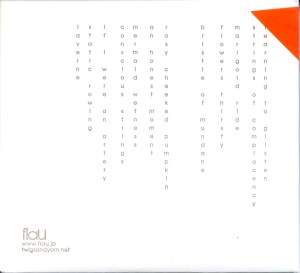
Twigs & Yarn – The Language Of Flowers

Flau28 CD – Time: About 43 Minutes (Also available in 12” vinyl LP)

Artists Website: http://www.twigsandyarn.net         Record Label Website: http://www.flau.jp

Mastered by: Nick Zammuto: http://www.zammutosound.com

Tracks (*Note: Track order according to iTunes readout appears to be in reverse order, although the music order is correct.  The track order that follows is properly sequenced with the sound files on the CD and has been confirmed with the artist.)

1) Laverne; 2) Static Rowing; 3) If Were An Artery; 4) Conscious Strings; 5) Mermaid Wetness; 6) An Honest Moment; 7) Rosy Cheeked Pumpkin; 8) Bristle Of Mundane; 9) Flowers Thirsty; 10) Marigold Ride; 11) Strings Of Complacency; 12) Learning To Glisten

I sometimes listen to shortwave radio, late into the night, or in the early morning, as signals and sleep drift; voices and sounds emerge and disappear.  Every so often my radio will lock in on a clear signal, and for a time there are voices from foreign lands, interesting new music, field correspondents reporting, or the strange sounds of open carrier frequencies waiting for a signal to fill them.

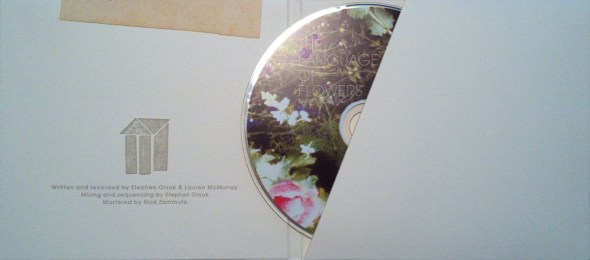
The Language Of Flowers is the enchanting (and often quirky) new album by Twigs & Yarn, and it has some parallels to late night radio listening, a mixing of familiar sounds, music and fleeting recollections.  Both artists and musicians, Stephen Orsak resides in Texas, and Lauren McMurray is in Japan, and their work takes shape over the airwaves, satellites and international cables via computers and ftp servers.  I didn’t discover Twigs & Yarn on my own; I have Michael Cottone of The Green Kingdom to thank for introducing me to their works.  I come across new artists by exploring record label websites, visiting the few record shops that are left and (often the best method), word of mouth from musicians and friends.  I don’t yet have the LP version, but the CD is packaged in a letter-pressed hand decorated collage (each one is slightly different).

The album opens with the mysteriously diaphanous Laverne, which shimmers like filtered sound-light on a bright morning, then passes quickly into the gentle swaying of Static Rowing.  The fourth track Conscious Strings is both the clear reality of a solo acoustic guitar, combined with the meandering voices of a daydream.  Some tracks seem to blend together as observations shift, and there is peaceful warmth in the sounds of a given day, whether inward looking as in Mermaid Wetness (with ingeniously repeated cadenced sound-samples) or outward as in the strangely discordant An Honest Moment which merges into street sounds, bells, voices, and then into a tranquil music box and electric guitar reflection in Rosy Cheeked Pumpkin reminiscent of Daniel Lanois’ pedal steel work on his album here is what is.

Bristle Of Mundane is an unexpected contrast, which opens with a heavily-distorted music box, eventually settling into gentle waves.  The experience of late night radio listening is present in Flowers Thirsty, tuning in and out from pop-music radio samples to a distant ebb and flow of music and whispers, the mind drifts late into the night, until being awakened by the radio-alarm (this is my favorite piece on the album, mysterious and great keyboard sounds).  The gentle pulsing organ of Marigold Ride contains a soft repeated vocal, flowing into acoustic guitar of Strings Of Complacency (sounding a bit like some recent solo guitar work of Ant Phillips combined with light treatments from Eno’s Julie With from the album Before And After Science).  Learning To Glisten is the postlude to the album, the purest of all the tracks, with little sonic movement, and is a soothing close.


The Language of Flowers is like rotating a radio tuning knob late at night, or peering into a window overlooking a secret garden, or ephemeral visions in a dream.  It’s an assemblage of existence all around, from the broadest landscapes down to the tiniest whispers, and even memories of childhood games as in the gently spirited and delightfully melodic third track, If I Were An Artery.  The music, field recordings, samples and instrumentation are assembled with an idiosyncratic aplomb that yield a very cohesive and soothing quality, like a less energetic, more contemplative version of works by The Books combined with gossamers of the dearly departed Sparklehorse.  So, it makes complete sense that Nick Zammuto (ex-Book) mastered this album; a symbiotic chemistry.

Videos

Static Rowing


Mermaid Wetness


Marigold Ride


Kane Ikin – Sublunar

12k1071 CD – Time: 53:33

Artist’s Website: http://www.kaneikin.com        Record Label Website: http://www.12k.com

Tracks: 1) Europa; 2) Slow Waves; 3) In The Arc; 4) Ebbing; 5) Rhea; 6) Titan; 7) Sleep Spindle; 8) An Infinite Moment; 9) The Violent Silence; 10) Black Sands; 11) Lo; 12) Prometheus’ Tail; 13) Oberon; 14) Compression Waves; 15) In The Shadow Of The Vanishing Night; 16) Hyperion;


I don’t know exactly on what plane Kane Ikin exists, but I can tell you that I’d like to get there.  There is a sense of deep mystery, the fleeting ethereal and a curious otherness in his musical travels.  I’ll gladly get on his spaceship, anytime.

Kane Ikin is one half of Solo Andata (along with Paul Fiocco, both being from Australia), and he has also collaborated with other artists including David Wenngren (aka Library Tapes) on their February 2012 album Strangers (KESH017).  I first encountered Solo Andata’s work in the 2009 self-titled 12k release.

Earlier this year, Ikin gave us a taster EP entitled Contrail (clear vinyl 7”, and a separate download of four tracks), and the title track alone was worth the price of the entire EP, not to mention the marvelous job that 12k did with the packaging.  Also, of note, Sublunar is packaged in 12k’s new (no plastic, and I assume, recycled cardboard) sleeve design.


Ikin’s music is decidedly lo-fi in production (tape loops, altered field recordings, sampling, warped instrumental recordings), but the quality and care that he takes in combining tangible instrumentation with highly manipulated sounds gives the end result an indescribable yet comforting quality.  His solo work also tends (so far) to focus on shorter format recordings (the longest track Oberon on Sublunar is 4:51).  Also, while I consider his work to be highly original in form and sound; there are occasional (intentional?) references to works of others.  At the risk of driving my readers bonkers, I’ll again reference Kraftwerk and their track Kling Klang from the 1972 album Kraftwerk 2, which came to mind when I first heard the gongs and bells in track (6) Titan.

Sublunar is a series of short journeys, just enough time to experience the sense of place Ikin is depicting, but not so long that one feels the urge to get to the next destination too quickly.  I’m going to resist the temptation to describe each track (there’s a full single track sound file for Europa and an Experimedia sampler of excerpts from the entire album), because I think that might diminish a sense of self-exploration for the listener.  Some tracks meander with little guidance from a recognizable beat, whereas others have highly treated percussion with extended decay.  I especially like how Kane treats the sound of strings in the mix; he uses the entirety of an acoustic guitar’s resonance.  Sublunar is a potent musical experience, and I hope Kane Ikin continues his voyages of experimentation, because I’m completely hooked.

****

Sublunar‘s Teaser Video


Experimedia’s Sampler of the Album


Marcus Fischer + The OO-Ray – Tessellations

Optic Echo – oe010 LP limited to 250 LP copies

Marcus Fischer: http://www.mapmap.ch/index.php/recordings/tessellations/

Ted Laderas (The OO-Ray): http://15people.net/ & http://eatguide.tumblr.com/The-OO-Ray & http://waveguideaudio.com/

Record Label Website: http://www.opticecho.com/OE/News.html

LP Time: about 43 minutes.  Digital Time*: about 49 minutes with Track 8*.

Credits: Mastered by Taylor Deupree at 12k.  Cut by Rashad at Dubplates & Mastering.  Cover Design: Marcus Fischer


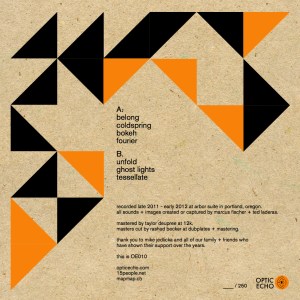
Tracks: 1) belong; 2) cold spring; 3) bokeh; 4) fourier; 5) unfold; 6) ghost lights; 7) tessellate (tessellation); 8) music for caverns*

Improvisation is about taking risks, experimenting and responding to the immediate results.  It is the outcome of the instantaneous transition from thought to motion, and then to sound.  It sometimes takes practice, and it requires chemistry between the artists; the kind of vibe evident between Marcus Fischer and Ted Laderas (aka The-OO-Ray).  Music can yield a far timelier reward compared to other slower [art] forms, like in architecture or science, where the results of research and collaboration can often take years to behold.

This has been a busy year for Marcus Fischer with at least five published recordings, touring, and new projects in the works.  I’ve certainly enjoyed all of them, solo and collaborative.  It is thanks to Fischer’s work that I have become familiar with Ted Laderas (The OO-Ray: self-professed on his Twitter bio “Half Scientist, Half Cellist, All Shoegazer”) and his electro-acoustic chamber-drones.

Tessellations is the result of a series of long-form improvisations between the Fischer and Laderas.  It was commissioned by the Optic Echo label in 2011.  The instrumentation is largely stringed (acoustic and electric guitars, cello, lap harp) with percussion, loops, processing and minimal synthesizers.  The album has a dynamic richness with a combination of soothing observation and introspection.  I also appreciate that this is an album of largely non-electronic instrumentation, not necessarily a rejection of sequenced analog or digital electronics, but a return to earlier tangible instrumental roots, and a sense of the ageless.  It kind of takes me back to some of Kraftwerk’s oft-forgotten earlier works from Kraftwerk 1 and 2, and Ralf and Florian; like the guitar portions of Tongebirge (Mountain of Sound) from 1973.

The album opens with belong, rising like the sun on a dewy morn; crisp and hopeful with a gentleness that avoids any sense of melancholy.  Stark and mysterious is the ambience of cold spring with OO-Ray’s cello seeking the edges, and hints of Harold Budd’s Boy About 10 from the album By The Dawn’s Early Light.  The largo metronomic of the bass line maintains the focus of bokeh as cello, keyboards and other instrumentation blurs the musical depth of field.

The shifting of sounds, interlocking, matching and then contrasting (much like a moiré pattern) is the sense presented in fourier, which is perhaps the most densely packed and expansive of the tracks.  By contrast, unfold is perhaps the most peaceful track on the album, a private [waterside] contemplation with gently flowing cello, meandering lap harp layered and a soft droning veil.  Then, the mystical and shimmering reverb of ghost lights emerges, and is reminiscent of the recent Unrecognizable Now album (Fischer’s collaboration with Matt Jones, KESH018) Two Rooms, with shifting chords and bowed strings (and has some of the sound I noted earlier in Tongebirge).

tessellate is the longest (about 10 minutes) and most subtle of the tracks on the album (titled tessellation on the download).  It has the most nuanced transitions, with Fischer and Laderas trading themes and responses, and weaving phrases back into the fabric of the piece.  It brings the LP to a placid close.  *music for caverns is the bonus track with the digital download, and is a warm postlude to the day that started with belong, and in some respects is similar to the closing tracks of Eno, Lanois & Eno’s album,  Apollo: Atmospheres and Soundtracks—one of my favorite of Eno’s collaborative works.

Marcus Fischer + The OO-Ray have deftly assembled in their collaborative improvisational work both a cohesive sonic realism, and impressionistic vision with a timeless authenticity.

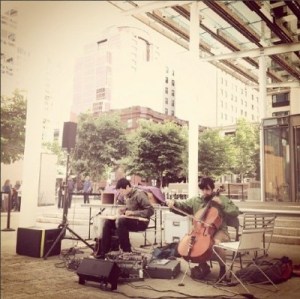
Marcus Fischer + The OO-Ray – Photo by Seth Chrisman

Review: Every Hidden Color – Luz

Label: Streamline #1033 12” Vinyl LP (no digital download) – Tracks: I – 17: 04 & II – 18:00

Album available from NSZCZ: http://www.nszcz.com/a-few-copies-of-luz-are-for-sale/

Nicholas Szczepanik http://www.nszcz.com/  http://soundcloud.com/nszcz

Federico Durand http://www.federicodurand.blogspot.com/ http://soundcloud.com/federicodurand

More information on album and available at http://www.dragcity.com/artists/every-hidden-color


Every Hidden Color is a collaboration of two hemispheres and opposing seasons: Nicholas Szczepanik in North America (Chicago) and Federico Durand in South America (Buenos Aires).  The work of these two artists to date is, to my ears, quite different, and the results in Luz are intriguingly harmonious.

Szczepanik’s work tends to be more serious and deliberate, and at times quite dense with broad masses of sound.  Of his most recent work, my strongest connection, is to his album Please Stop Loving Me, which is indescribably beautiful and yearning in its meshing of sound and emotion.  I am less familiar with Federico Durand’s work, but I have heard portions of his albums La Siesta del Ciprés (The Nap of the Cypress on the Spekk label) and the more recent (and bad luck for me it’s sold out!) album El Extasis de las Flores Pequeñas (The Ecstasy of Small Flowers on the Own Records label).  Durand’s work tends more towards the introspective and ethereal, deftly woven with field recordings.

The pulsing of cicadas, crickets and a streetscape is how Luz opens before drifting into gentle winds (or is it the noise of a distant highway…or does it really matter?) and then a rhythmically swaying melody appearing like a soothing mantra, to then disappear into a sparsely layered and introspective suspension of reality.  From there, come gentle rains, soft guitars, birds in the nearby trees, and then all drifts into the softest of walls of sound and finally gentle voices.

This is an album of contemplation and a sensitive appreciation of the world around us, from the smallest sound to the broadest landscape, and also to the light—Luz.

MINDBENDERS

Learn, Ponder, Discuss

richard jefferies

visionary author and naturalist (1848-1887)

My Patronus Is Coffee

Life is Messy. Send Coffee and Posh.

Wendy Artin, photos from the exhibition

This is a blog with news - to see Wendy Artin's website, please visit www.wendyartin.com

JAZZ LIVES

MAY YOUR HAPPINESS INCREASE! "Lives" is both noun and verb.

No More Workhorse

Appear highbrow without trying by reading...

Stationary Travels

Journeys in Sound & Music

The Oxford Culture Review

"I have nothing to say, and I am saying it" - John Cage

Kendra Steiner Editions (Bill Shute)

publishers and champions of contemporary poetry and experimental music from San Antonio, Texas

monty adkins | SKRIKA

composer | dark ambient sound artist

Sunnymeade Astro

An Amateur Astronomer's Observing Diary from the Welsh Border

Wist Rec.

Handy Music Handmade

Somme Battlefields

WW1 Centenary website by Paul Reed

WW1 Centenary

Great War Centenary 2014-2018 website by Paul Reed

Out of Battle

Musings of a Military Historian

The Echoes Blog

The weblog of Echoes, the nightly music soundscape on Public Radio and the internet.

gleamingsilverribbon

Words, sounds and pictures by Kate Carr